
Call Center

Call Center

Call Center

Call Center Role Play Scripts + AI Training 2026

Jun 3, 2026

Jun 3, 2026

10 min read

10 min read

/ / / / / / / /

Call Center Role Play Scripts + AI Training 2026

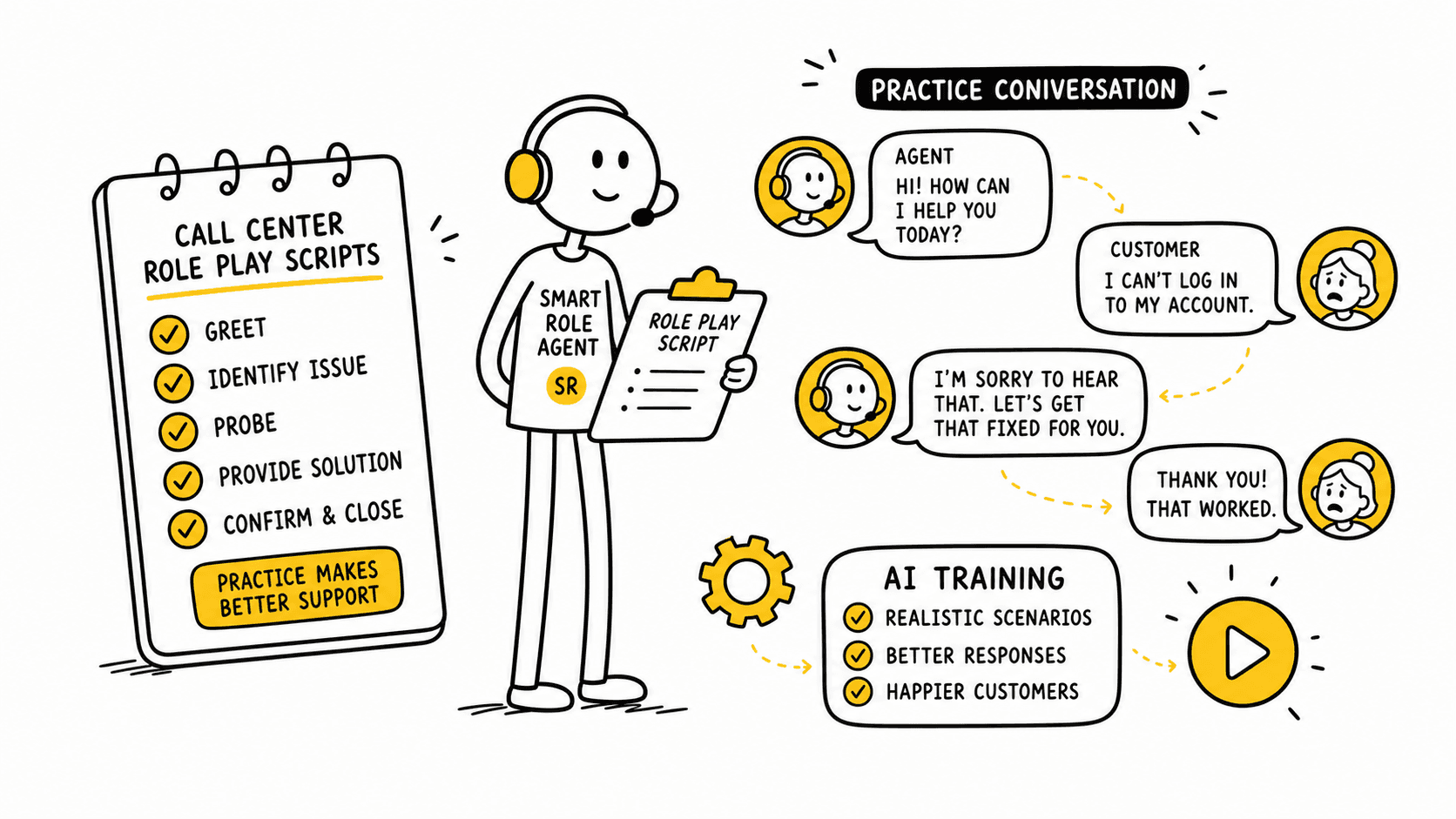
A call center role play script is a structured training scenario that simulates a customer interaction so agents can practise communication, problem-solving, and service skills before handling live calls. Contact centres that invest in regular roleplay consistently report faster onboarding, stronger QA scores, and more confident agents.

TL;DR

  • Call center role play scripts help agents practise real customer conversations before going live.

  • The best roleplays include a scenario, customer prompt, agent goal, and scoring criteria.

  • Consistent evaluation requires a structured QA scorecard.

  • Static scripts build foundations, but AI roleplay adds realism, repetition, and personalised coaching.

  • Modern contact centres increasingly combine traditional scripts with AI-powered simulations.

What Are Call Center Role Play Scripts?

Call center role play scripts are structured practice exercises where agents simulate customer interactions in a controlled environment. Rather than handling real calls unprepared, agents rehearse common scenarios using scripted prompts and defined success criteria. This creates a consistent training foundation before agents go live.

Common use cases include:

  • New hire onboarding

  • QA calibration sessions

  • Escalation management training

  • Compliance practice

  • Soft skills development

  • Product knowledge reinforcement

Benefits include:

  • Faster confidence building

  • Safe practice environment

  • Improved communication skills

  • Better coaching opportunities

Limitations include:

  • Scenarios become predictable

  • Peer roleplays often lack realism

  • Feedback quality varies by coach

  • Scheduling sessions consumes manager time

Related resources:

12 Call Center Role Play Scripts You Can Use Today

Use each scenario with three elements: agent role, customer role, and success criteria.

Script 1: Billing Dispute

Scenario: Customer believes they were charged twice.

Customer prompt: "I have been billed twice this month and nobody is helping me."

Agent goal: Acknowledge the concern, verify the account billing record, and resolve the duplicate charge.

Evaluation criteria:

  • Active listening

  • Empathy

  • Accuracy

  • Clear next steps

Script 2: Angry Customer Requesting a Refund

Scenario: Customer wants a refund after a poor experience.

Customer prompt: "This service is unacceptable. I want my money back."

Agent goal: De-escalate the situation and process the refund or offer a suitable alternative resolution.

Evaluation criteria:

  • Emotional control

  • Empathy

  • Policy adherence

  • Resolution quality

Script 3: Late Delivery Complaint

Scenario: An order has not arrived within the promised timeframe.

Customer prompt: "My package was supposed to arrive three days ago."

Agent goal: Locate the order, provide an updated delivery estimate, and offer compensation where appropriate.

Evaluation criteria:

  • Ownership

  • Communication clarity

  • Problem solving

Script 4: Technical Support Troubleshooting

Scenario: Customer cannot access a product feature.

Customer prompt: "The app keeps crashing every time I log in."

Agent goal: Guide the customer through troubleshooting steps until the issue is resolved or appropriately escalated.

Evaluation criteria:

  • Questioning skills

  • Technical accuracy

  • Customer guidance

Script 5: Subscription Cancellation

Scenario: Customer wants to cancel a recurring service.

Customer prompt: "I do not use this anymore and want to cancel today."

Agent goal: Process the cancellation respectfully while presenting any applicable retention options.

Evaluation criteria:

  • Respectful communication

  • Compliance

  • Retention approach

Script 6: Product Not Working as Expected

Scenario: Customer believes a product is defective.

Customer prompt: "This product does not do what your website promised."

Agent goal: Understand the problem fully, clarify product usage, and offer a resolution or replacement.

Evaluation criteria:

  • Discovery questions

  • Product knowledge

  • Resolution effectiveness

Script 7: Language Barrier Support

Scenario: Customer has limited proficiency in the agent's language.

Customer prompt: "I not understand invoice problem."

Agent goal: Adjust communication style to ensure the customer fully understands the resolution.

Evaluation criteria:

  • Clarity

  • Patience

  • Communication effectiveness

Script 8: High-Value Customer Escalation

Scenario: VIP customer threatens to leave.

Customer prompt: "If this is not fixed today, we are moving to a competitor."

Agent goal: Protect the relationship while resolving the issue.

Evaluation criteria:

  • Ownership

  • Professionalism

  • Escalation handling

Script 9: First Contact Resolution Challenge

Scenario: Customer has multiple connected issues.

Customer prompt: "I need help with my billing, login, and recent order."

Agent goal: Resolve all issues during a single interaction where possible.

Evaluation criteria:

  • Organisation

  • Efficiency

  • First contact resolution

Script 10: Cross-Sell Opportunity

Scenario: Customer asks about a product feature.

Customer prompt: "Do you have anything that works better for larger teams?"

Agent goal: Identify needs and recommend suitable options.

Evaluation criteria:

  • Discovery

  • Relevance

  • Customer focus

Script 11: Call Transfer Scenario

Scenario: Customer reaches the wrong department.

Customer prompt: "I have already explained this twice."

Agent goal: Transfer smoothly while minimising customer effort.

Evaluation criteria:

  • Ownership

  • Handover quality

  • Customer experience

Script 12: Complaint About Previous Agent

Scenario: Customer is dissatisfied with an earlier interaction.

Customer prompt: "The last agent was rude and did not help me."

Agent goal: Rebuild trust and resolve the issue.

Evaluation criteria:

  • Empathy

  • Accountability

  • Service recovery

Roleplay Checklist for Trainers

  • Define a clear objective

  • Use realistic customer language

  • Include emotional context

  • Score against QA standards

  • Deliver immediate feedback

  • Repeat until competence improves

Additional reading:

How to Score Call Center Role Plays Effectively

Without structured scoring, roleplay feedback quickly becomes subjective.

A practical scorecard should evaluate:

  • Greeting

  • Active listening

  • Empathy

  • Resolution

  • Compliance

  • Closing

Sample 1 to 5 Scale

  • 1: Poor

  • 2: Needs improvement

  • 3: Meets expectations

  • 4: Strong

  • 5: Excellent

Example Scoring Framework

Category

Weight

Greeting

10%

Active Listening

20%

Empathy

20%

Resolution

25%

Compliance

15%

Closing

10%

Customer experience research consistently shows that service quality and issue resolution strongly influence customer loyalty. (Source: Qualtrics, 2026)

Objective scoring creates:

  • Better coaching consistency

  • Easier QA calibration

  • Measurable skill development

To improve reliability, define what success looks like for each category. For example, active listening may require paraphrasing the issue, while empathy may require acknowledging customer frustration before moving into troubleshooting. Detailed scoring criteria reduce evaluator bias and make coaching conversations more productive.

Static Scripts vs AI Roleplay Simulation

Traditional scripts are useful, but they have limitations when agents begin memorising responses instead of developing adaptable skills.

Capability

Static Scripts

Peer Roleplay

AI Roleplay Simulation

Realism

Low

Medium

High

Scenario Variety

Limited

Medium

Extensive

Coaching Consistency

Low

Medium

High

Scalability

High

Low

High

Feedback Speed

Delayed

Delayed

Instant

Performance Tracking

Manual

Manual

Automated

Why does realism matter?

Learning science suggests that skill acquisition improves through practice, feedback, and repetition. Deliberate practice research highlights the importance of repeated performance with targeted feedback. (Source: Harvard Business Review)

Static scripts often create predictable patterns:

  • Customers follow expected paths

  • Agents memorise responses

  • Difficult objections rarely appear

AI simulations introduce variability:

  • Different customer personalities

  • Dynamic objections

  • Escalation pathways

  • Adaptive difficulty levels

The result is more authentic practice that better reflects live customer interactions.

Why Call Centers Are Moving Toward AI-Powered Roleplay Training

Many contact centres face three recurring challenges:

  • Limited manager coaching time

  • Scheduling constraints

  • Inconsistent feedback quality

Traditional roleplay requires people, coordination, and dedicated coaching resources. As teams grow, maintaining training quality becomes harder.

AI-powered roleplay addresses these challenges by providing:

  • Unlimited practice sessions

  • Personalised scenarios

  • Automated scoring

  • Consistent evaluation standards

  • Progress tracking

Experiential learning has long been recognised as an effective way to build practical skills because learners actively apply knowledge rather than passively consume information. (Source: IBM Training and Skills Resources, 2026)

Gallup's workplace research consistently links employee development and coaching with stronger performance outcomes. (Source: Gallup Workplace Research, 2026)

For contact centres, AI roleplay offers an operational advantage: agents can practise difficult conversations repeatedly without requiring managers or peers to participate every time.

This increases coaching capacity while preserving consistency across large teams. Supervisors can then focus their time on targeted coaching, performance reviews, and complex customer situations that benefit from human expertise.

Smart Role lets agents practise difficult customer conversations with AI, receive instant feedback, and track improvement over time. Test realistic call center scenarios without requiring managers or peer participants. Start your interactive test drive.

How Smart Role Builds on Traditional Call Center Role Play Scripts

The most effective training programmes do not discard scripts. They build on them.

Smart Role starts with proven call center scenarios and transforms them into dynamic conversations that adapt in real time.

Teams can:

  • Convert existing scripts into simulations

  • Measure performance automatically

  • Track improvement trends

  • Adjust difficulty levels

This approach is particularly useful for:

  • BPOs

  • Customer support teams

  • Contact centres

  • Outsourced service providers

Rather than replacing traditional training, AI roleplay extends it with scale, consistency, and measurable outcomes.

Best Practices for Building Your Own Call Center Role Play Library

The strongest roleplay libraries are built from real customer interactions.

Use this checklist:

  • Review high-volume contact reasons

  • Analyse QA findings

  • Include emotional scenarios

  • Align scoring to QA standards

  • Refresh content quarterly

  • Track business impact

Prioritise scenarios that affect:

  • Customer satisfaction

  • Compliance risk

  • Escalation volume

  • Revenue retention

A small set of realistic, frequently updated scenarios often delivers more value than a large library that no longer reflects customer behaviour. Many training teams also tag scenarios by skill type such as empathy, compliance, de-escalation, and retention so managers can assign targeted practice based on individual QA gaps.

Related Reading

FAQ

What is a call center role play script?

A call center role play script is a structured training scenario that simulates a customer interaction so agents can practise communication, problem-solving, and service skills before handling live calls.

How often should call center agents do roleplay training?

Most contact centres benefit from ongoing roleplay practice. New hires may train several times per week during onboarding, while experienced agents often participate in weekly or monthly sessions focused on new skills, products, or common customer issues.

Are AI roleplay simulations better than traditional roleplay?

AI roleplay simulations provide consistent scenarios, instant feedback, automated scoring, and unlimited practice opportunities. Traditional roleplay remains useful for foundational training, but AI simulations scale coaching more efficiently across large teams.

What should be included in a call center role play scorecard?

A call center role play scorecard should measure greeting quality, active listening, empathy, compliance, issue resolution, customer experience, and closing effectiveness. Clear scoring criteria create consistent evaluations and actionable coaching feedback.

About the Author

Thibaut Martin is COO of Smart Role, an AI-powered training platform for customer support teams and BPOs. Before joining Smart Role, he worked at Google and later led customer experience operations at Otrium, where he was responsible for support performance and quality assurance.

Conclusion

Call center role play scripts remain an effective starting point for training agents, building confidence, and standardising coaching. However, static scripts eventually reach a ceiling. AI-powered roleplay introduces realistic conversations, instant feedback, and unlimited practice opportunities that scale across entire contact centre teams.

Ready to move beyond static scripts? Experience AI-powered call center roleplay training with Smart Role. Start your test drive.

Sources

Call Center Role Play Scripts + AI Training 2026

A call center role play script is a structured training scenario that simulates a customer interaction so agents can practise communication, problem-solving, and service skills before handling live calls. Contact centres that invest in regular roleplay consistently report faster onboarding, stronger QA scores, and more confident agents.

TL;DR

  • Call center role play scripts help agents practise real customer conversations before going live.

  • The best roleplays include a scenario, customer prompt, agent goal, and scoring criteria.

  • Consistent evaluation requires a structured QA scorecard.

  • Static scripts build foundations, but AI roleplay adds realism, repetition, and personalised coaching.

  • Modern contact centres increasingly combine traditional scripts with AI-powered simulations.

What Are Call Center Role Play Scripts?

Call center role play scripts are structured practice exercises where agents simulate customer interactions in a controlled environment. Rather than handling real calls unprepared, agents rehearse common scenarios using scripted prompts and defined success criteria. This creates a consistent training foundation before agents go live.

Common use cases include:

  • New hire onboarding

  • QA calibration sessions

  • Escalation management training

  • Compliance practice

  • Soft skills development

  • Product knowledge reinforcement

Benefits include:

  • Faster confidence building

  • Safe practice environment

  • Improved communication skills

  • Better coaching opportunities

Limitations include:

  • Scenarios become predictable

  • Peer roleplays often lack realism

  • Feedback quality varies by coach

  • Scheduling sessions consumes manager time

Related resources:

12 Call Center Role Play Scripts You Can Use Today

Use each scenario with three elements: agent role, customer role, and success criteria.

Script 1: Billing Dispute

Scenario: Customer believes they were charged twice.

Customer prompt: "I have been billed twice this month and nobody is helping me."

Agent goal: Acknowledge the concern, verify the account billing record, and resolve the duplicate charge.

Evaluation criteria:

  • Active listening

  • Empathy

  • Accuracy

  • Clear next steps

Script 2: Angry Customer Requesting a Refund

Scenario: Customer wants a refund after a poor experience.

Customer prompt: "This service is unacceptable. I want my money back."

Agent goal: De-escalate the situation and process the refund or offer a suitable alternative resolution.

Evaluation criteria:

  • Emotional control

  • Empathy

  • Policy adherence

  • Resolution quality

Script 3: Late Delivery Complaint

Scenario: An order has not arrived within the promised timeframe.

Customer prompt: "My package was supposed to arrive three days ago."

Agent goal: Locate the order, provide an updated delivery estimate, and offer compensation where appropriate.

Evaluation criteria:

  • Ownership

  • Communication clarity

  • Problem solving

Script 4: Technical Support Troubleshooting

Scenario: Customer cannot access a product feature.

Customer prompt: "The app keeps crashing every time I log in."

Agent goal: Guide the customer through troubleshooting steps until the issue is resolved or appropriately escalated.

Evaluation criteria:

  • Questioning skills

  • Technical accuracy

  • Customer guidance

Script 5: Subscription Cancellation

Scenario: Customer wants to cancel a recurring service.

Customer prompt: "I do not use this anymore and want to cancel today."

Agent goal: Process the cancellation respectfully while presenting any applicable retention options.

Evaluation criteria:

  • Respectful communication

  • Compliance

  • Retention approach

Script 6: Product Not Working as Expected

Scenario: Customer believes a product is defective.

Customer prompt: "This product does not do what your website promised."

Agent goal: Understand the problem fully, clarify product usage, and offer a resolution or replacement.

Evaluation criteria:

  • Discovery questions

  • Product knowledge

  • Resolution effectiveness

Script 7: Language Barrier Support

Scenario: Customer has limited proficiency in the agent's language.

Customer prompt: "I not understand invoice problem."

Agent goal: Adjust communication style to ensure the customer fully understands the resolution.

Evaluation criteria:

  • Clarity

  • Patience

  • Communication effectiveness

Script 8: High-Value Customer Escalation

Scenario: VIP customer threatens to leave.

Customer prompt: "If this is not fixed today, we are moving to a competitor."

Agent goal: Protect the relationship while resolving the issue.

Evaluation criteria:

  • Ownership

  • Professionalism

  • Escalation handling

Script 9: First Contact Resolution Challenge

Scenario: Customer has multiple connected issues.

Customer prompt: "I need help with my billing, login, and recent order."

Agent goal: Resolve all issues during a single interaction where possible.

Evaluation criteria:

  • Organisation

  • Efficiency

  • First contact resolution

Script 10: Cross-Sell Opportunity

Scenario: Customer asks about a product feature.

Customer prompt: "Do you have anything that works better for larger teams?"

Agent goal: Identify needs and recommend suitable options.

Evaluation criteria:

  • Discovery

  • Relevance

  • Customer focus

Script 11: Call Transfer Scenario

Scenario: Customer reaches the wrong department.

Customer prompt: "I have already explained this twice."

Agent goal: Transfer smoothly while minimising customer effort.

Evaluation criteria:

  • Ownership

  • Handover quality

  • Customer experience

Script 12: Complaint About Previous Agent

Scenario: Customer is dissatisfied with an earlier interaction.

Customer prompt: "The last agent was rude and did not help me."

Agent goal: Rebuild trust and resolve the issue.

Evaluation criteria:

  • Empathy

  • Accountability

  • Service recovery

Roleplay Checklist for Trainers

  • Define a clear objective

  • Use realistic customer language

  • Include emotional context

  • Score against QA standards

  • Deliver immediate feedback

  • Repeat until competence improves

Additional reading:

How to Score Call Center Role Plays Effectively

Without structured scoring, roleplay feedback quickly becomes subjective.

A practical scorecard should evaluate:

  • Greeting

  • Active listening

  • Empathy

  • Resolution

  • Compliance

  • Closing

Sample 1 to 5 Scale

  • 1: Poor

  • 2: Needs improvement

  • 3: Meets expectations

  • 4: Strong

  • 5: Excellent

Example Scoring Framework

Category

Weight

Greeting

10%

Active Listening

20%

Empathy

20%

Resolution

25%

Compliance

15%

Closing

10%

Customer experience research consistently shows that service quality and issue resolution strongly influence customer loyalty. (Source: Qualtrics, 2026)

Objective scoring creates:

  • Better coaching consistency

  • Easier QA calibration

  • Measurable skill development

To improve reliability, define what success looks like for each category. For example, active listening may require paraphrasing the issue, while empathy may require acknowledging customer frustration before moving into troubleshooting. Detailed scoring criteria reduce evaluator bias and make coaching conversations more productive.

Static Scripts vs AI Roleplay Simulation

Traditional scripts are useful, but they have limitations when agents begin memorising responses instead of developing adaptable skills.

Capability

Static Scripts

Peer Roleplay

AI Roleplay Simulation

Realism

Low

Medium

High

Scenario Variety

Limited

Medium

Extensive

Coaching Consistency

Low

Medium

High

Scalability

High

Low

High

Feedback Speed

Delayed

Delayed

Instant

Performance Tracking

Manual

Manual

Automated

Why does realism matter?

Learning science suggests that skill acquisition improves through practice, feedback, and repetition. Deliberate practice research highlights the importance of repeated performance with targeted feedback. (Source: Harvard Business Review)

Static scripts often create predictable patterns:

  • Customers follow expected paths

  • Agents memorise responses

  • Difficult objections rarely appear

AI simulations introduce variability:

  • Different customer personalities

  • Dynamic objections

  • Escalation pathways

  • Adaptive difficulty levels

The result is more authentic practice that better reflects live customer interactions.

Why Call Centers Are Moving Toward AI-Powered Roleplay Training

Many contact centres face three recurring challenges:

  • Limited manager coaching time

  • Scheduling constraints

  • Inconsistent feedback quality

Traditional roleplay requires people, coordination, and dedicated coaching resources. As teams grow, maintaining training quality becomes harder.

AI-powered roleplay addresses these challenges by providing:

  • Unlimited practice sessions

  • Personalised scenarios

  • Automated scoring

  • Consistent evaluation standards

  • Progress tracking

Experiential learning has long been recognised as an effective way to build practical skills because learners actively apply knowledge rather than passively consume information. (Source: IBM Training and Skills Resources, 2026)

Gallup's workplace research consistently links employee development and coaching with stronger performance outcomes. (Source: Gallup Workplace Research, 2026)

For contact centres, AI roleplay offers an operational advantage: agents can practise difficult conversations repeatedly without requiring managers or peers to participate every time.

This increases coaching capacity while preserving consistency across large teams. Supervisors can then focus their time on targeted coaching, performance reviews, and complex customer situations that benefit from human expertise.

Smart Role lets agents practise difficult customer conversations with AI, receive instant feedback, and track improvement over time. Test realistic call center scenarios without requiring managers or peer participants. Start your interactive test drive.

How Smart Role Builds on Traditional Call Center Role Play Scripts

The most effective training programmes do not discard scripts. They build on them.

Smart Role starts with proven call center scenarios and transforms them into dynamic conversations that adapt in real time.

Teams can:

  • Convert existing scripts into simulations

  • Measure performance automatically

  • Track improvement trends

  • Adjust difficulty levels

This approach is particularly useful for:

  • BPOs

  • Customer support teams

  • Contact centres

  • Outsourced service providers

Rather than replacing traditional training, AI roleplay extends it with scale, consistency, and measurable outcomes.

Best Practices for Building Your Own Call Center Role Play Library

The strongest roleplay libraries are built from real customer interactions.

Use this checklist:

  • Review high-volume contact reasons

  • Analyse QA findings

  • Include emotional scenarios

  • Align scoring to QA standards

  • Refresh content quarterly

  • Track business impact

Prioritise scenarios that affect:

  • Customer satisfaction

  • Compliance risk

  • Escalation volume

  • Revenue retention

A small set of realistic, frequently updated scenarios often delivers more value than a large library that no longer reflects customer behaviour. Many training teams also tag scenarios by skill type such as empathy, compliance, de-escalation, and retention so managers can assign targeted practice based on individual QA gaps.

Related Reading

FAQ

What is a call center role play script?

A call center role play script is a structured training scenario that simulates a customer interaction so agents can practise communication, problem-solving, and service skills before handling live calls.

How often should call center agents do roleplay training?

Most contact centres benefit from ongoing roleplay practice. New hires may train several times per week during onboarding, while experienced agents often participate in weekly or monthly sessions focused on new skills, products, or common customer issues.

Are AI roleplay simulations better than traditional roleplay?

AI roleplay simulations provide consistent scenarios, instant feedback, automated scoring, and unlimited practice opportunities. Traditional roleplay remains useful for foundational training, but AI simulations scale coaching more efficiently across large teams.

What should be included in a call center role play scorecard?

A call center role play scorecard should measure greeting quality, active listening, empathy, compliance, issue resolution, customer experience, and closing effectiveness. Clear scoring criteria create consistent evaluations and actionable coaching feedback.

About the Author

Thibaut Martin is COO of Smart Role, an AI-powered training platform for customer support teams and BPOs. Before joining Smart Role, he worked at Google and later led customer experience operations at Otrium, where he was responsible for support performance and quality assurance.

Conclusion

Call center role play scripts remain an effective starting point for training agents, building confidence, and standardising coaching. However, static scripts eventually reach a ceiling. AI-powered roleplay introduces realistic conversations, instant feedback, and unlimited practice opportunities that scale across entire contact centre teams.

Ready to move beyond static scripts? Experience AI-powered call center roleplay training with Smart Role. Start your test drive.

Sources

Call Center Role Play Scripts + AI Training 2026

A call center role play script is a structured training scenario that simulates a customer interaction so agents can practise communication, problem-solving, and service skills before handling live calls. Contact centres that invest in regular roleplay consistently report faster onboarding, stronger QA scores, and more confident agents.

TL;DR

  • Call center role play scripts help agents practise real customer conversations before going live.

  • The best roleplays include a scenario, customer prompt, agent goal, and scoring criteria.

  • Consistent evaluation requires a structured QA scorecard.

  • Static scripts build foundations, but AI roleplay adds realism, repetition, and personalised coaching.

  • Modern contact centres increasingly combine traditional scripts with AI-powered simulations.

What Are Call Center Role Play Scripts?

Call center role play scripts are structured practice exercises where agents simulate customer interactions in a controlled environment. Rather than handling real calls unprepared, agents rehearse common scenarios using scripted prompts and defined success criteria. This creates a consistent training foundation before agents go live.

Common use cases include:

  • New hire onboarding

  • QA calibration sessions

  • Escalation management training

  • Compliance practice

  • Soft skills development

  • Product knowledge reinforcement

Benefits include:

  • Faster confidence building

  • Safe practice environment

  • Improved communication skills

  • Better coaching opportunities

Limitations include:

  • Scenarios become predictable

  • Peer roleplays often lack realism

  • Feedback quality varies by coach

  • Scheduling sessions consumes manager time

Related resources:

12 Call Center Role Play Scripts You Can Use Today

Use each scenario with three elements: agent role, customer role, and success criteria.

Script 1: Billing Dispute

Scenario: Customer believes they were charged twice.

Customer prompt: "I have been billed twice this month and nobody is helping me."

Agent goal: Acknowledge the concern, verify the account billing record, and resolve the duplicate charge.

Evaluation criteria:

  • Active listening

  • Empathy

  • Accuracy

  • Clear next steps

Script 2: Angry Customer Requesting a Refund

Scenario: Customer wants a refund after a poor experience.

Customer prompt: "This service is unacceptable. I want my money back."

Agent goal: De-escalate the situation and process the refund or offer a suitable alternative resolution.

Evaluation criteria:

  • Emotional control

  • Empathy

  • Policy adherence

  • Resolution quality

Script 3: Late Delivery Complaint

Scenario: An order has not arrived within the promised timeframe.

Customer prompt: "My package was supposed to arrive three days ago."

Agent goal: Locate the order, provide an updated delivery estimate, and offer compensation where appropriate.

Evaluation criteria:

  • Ownership

  • Communication clarity

  • Problem solving

Script 4: Technical Support Troubleshooting

Scenario: Customer cannot access a product feature.

Customer prompt: "The app keeps crashing every time I log in."

Agent goal: Guide the customer through troubleshooting steps until the issue is resolved or appropriately escalated.

Evaluation criteria:

  • Questioning skills

  • Technical accuracy

  • Customer guidance

Script 5: Subscription Cancellation

Scenario: Customer wants to cancel a recurring service.

Customer prompt: "I do not use this anymore and want to cancel today."

Agent goal: Process the cancellation respectfully while presenting any applicable retention options.

Evaluation criteria:

  • Respectful communication

  • Compliance

  • Retention approach

Script 6: Product Not Working as Expected

Scenario: Customer believes a product is defective.

Customer prompt: "This product does not do what your website promised."

Agent goal: Understand the problem fully, clarify product usage, and offer a resolution or replacement.

Evaluation criteria:

  • Discovery questions

  • Product knowledge

  • Resolution effectiveness

Script 7: Language Barrier Support

Scenario: Customer has limited proficiency in the agent's language.

Customer prompt: "I not understand invoice problem."

Agent goal: Adjust communication style to ensure the customer fully understands the resolution.

Evaluation criteria:

  • Clarity

  • Patience

  • Communication effectiveness

Script 8: High-Value Customer Escalation

Scenario: VIP customer threatens to leave.

Customer prompt: "If this is not fixed today, we are moving to a competitor."

Agent goal: Protect the relationship while resolving the issue.

Evaluation criteria:

  • Ownership

  • Professionalism

  • Escalation handling

Script 9: First Contact Resolution Challenge

Scenario: Customer has multiple connected issues.

Customer prompt: "I need help with my billing, login, and recent order."

Agent goal: Resolve all issues during a single interaction where possible.

Evaluation criteria:

  • Organisation

  • Efficiency

  • First contact resolution

Script 10: Cross-Sell Opportunity

Scenario: Customer asks about a product feature.

Customer prompt: "Do you have anything that works better for larger teams?"

Agent goal: Identify needs and recommend suitable options.

Evaluation criteria:

  • Discovery

  • Relevance

  • Customer focus

Script 11: Call Transfer Scenario

Scenario: Customer reaches the wrong department.

Customer prompt: "I have already explained this twice."

Agent goal: Transfer smoothly while minimising customer effort.

Evaluation criteria:

  • Ownership

  • Handover quality

  • Customer experience

Script 12: Complaint About Previous Agent

Scenario: Customer is dissatisfied with an earlier interaction.

Customer prompt: "The last agent was rude and did not help me."

Agent goal: Rebuild trust and resolve the issue.

Evaluation criteria:

  • Empathy

  • Accountability

  • Service recovery

Roleplay Checklist for Trainers

  • Define a clear objective

  • Use realistic customer language

  • Include emotional context

  • Score against QA standards

  • Deliver immediate feedback

  • Repeat until competence improves

Additional reading:

How to Score Call Center Role Plays Effectively

Without structured scoring, roleplay feedback quickly becomes subjective.

A practical scorecard should evaluate:

  • Greeting

  • Active listening

  • Empathy

  • Resolution

  • Compliance

  • Closing

Sample 1 to 5 Scale

  • 1: Poor

  • 2: Needs improvement

  • 3: Meets expectations

  • 4: Strong

  • 5: Excellent

Example Scoring Framework

Category

Weight

Greeting

10%

Active Listening

20%

Empathy

20%

Resolution

25%

Compliance

15%

Closing

10%

Customer experience research consistently shows that service quality and issue resolution strongly influence customer loyalty. (Source: Qualtrics, 2026)

Objective scoring creates:

  • Better coaching consistency

  • Easier QA calibration

  • Measurable skill development

To improve reliability, define what success looks like for each category. For example, active listening may require paraphrasing the issue, while empathy may require acknowledging customer frustration before moving into troubleshooting. Detailed scoring criteria reduce evaluator bias and make coaching conversations more productive.

Static Scripts vs AI Roleplay Simulation

Traditional scripts are useful, but they have limitations when agents begin memorising responses instead of developing adaptable skills.

Capability

Static Scripts

Peer Roleplay

AI Roleplay Simulation

Realism

Low

Medium

High

Scenario Variety

Limited

Medium

Extensive

Coaching Consistency

Low

Medium

High

Scalability

High

Low

High

Feedback Speed

Delayed

Delayed

Instant

Performance Tracking

Manual

Manual

Automated

Why does realism matter?

Learning science suggests that skill acquisition improves through practice, feedback, and repetition. Deliberate practice research highlights the importance of repeated performance with targeted feedback. (Source: Harvard Business Review)

Static scripts often create predictable patterns:

  • Customers follow expected paths

  • Agents memorise responses

  • Difficult objections rarely appear

AI simulations introduce variability:

  • Different customer personalities

  • Dynamic objections

  • Escalation pathways

  • Adaptive difficulty levels

The result is more authentic practice that better reflects live customer interactions.

Why Call Centers Are Moving Toward AI-Powered Roleplay Training

Many contact centres face three recurring challenges:

  • Limited manager coaching time

  • Scheduling constraints

  • Inconsistent feedback quality

Traditional roleplay requires people, coordination, and dedicated coaching resources. As teams grow, maintaining training quality becomes harder.

AI-powered roleplay addresses these challenges by providing:

  • Unlimited practice sessions

  • Personalised scenarios

  • Automated scoring

  • Consistent evaluation standards

  • Progress tracking

Experiential learning has long been recognised as an effective way to build practical skills because learners actively apply knowledge rather than passively consume information. (Source: IBM Training and Skills Resources, 2026)

Gallup's workplace research consistently links employee development and coaching with stronger performance outcomes. (Source: Gallup Workplace Research, 2026)

For contact centres, AI roleplay offers an operational advantage: agents can practise difficult conversations repeatedly without requiring managers or peers to participate every time.

This increases coaching capacity while preserving consistency across large teams. Supervisors can then focus their time on targeted coaching, performance reviews, and complex customer situations that benefit from human expertise.

Smart Role lets agents practise difficult customer conversations with AI, receive instant feedback, and track improvement over time. Test realistic call center scenarios without requiring managers or peer participants. Start your interactive test drive.

How Smart Role Builds on Traditional Call Center Role Play Scripts

The most effective training programmes do not discard scripts. They build on them.

Smart Role starts with proven call center scenarios and transforms them into dynamic conversations that adapt in real time.

Teams can:

  • Convert existing scripts into simulations

  • Measure performance automatically

  • Track improvement trends

  • Adjust difficulty levels

This approach is particularly useful for:

  • BPOs

  • Customer support teams

  • Contact centres

  • Outsourced service providers

Rather than replacing traditional training, AI roleplay extends it with scale, consistency, and measurable outcomes.

Best Practices for Building Your Own Call Center Role Play Library

The strongest roleplay libraries are built from real customer interactions.

Use this checklist:

  • Review high-volume contact reasons

  • Analyse QA findings

  • Include emotional scenarios

  • Align scoring to QA standards

  • Refresh content quarterly

  • Track business impact

Prioritise scenarios that affect:

  • Customer satisfaction

  • Compliance risk

  • Escalation volume

  • Revenue retention

A small set of realistic, frequently updated scenarios often delivers more value than a large library that no longer reflects customer behaviour. Many training teams also tag scenarios by skill type such as empathy, compliance, de-escalation, and retention so managers can assign targeted practice based on individual QA gaps.

Related Reading

FAQ

What is a call center role play script?

A call center role play script is a structured training scenario that simulates a customer interaction so agents can practise communication, problem-solving, and service skills before handling live calls.

How often should call center agents do roleplay training?

Most contact centres benefit from ongoing roleplay practice. New hires may train several times per week during onboarding, while experienced agents often participate in weekly or monthly sessions focused on new skills, products, or common customer issues.

Are AI roleplay simulations better than traditional roleplay?

AI roleplay simulations provide consistent scenarios, instant feedback, automated scoring, and unlimited practice opportunities. Traditional roleplay remains useful for foundational training, but AI simulations scale coaching more efficiently across large teams.

What should be included in a call center role play scorecard?

A call center role play scorecard should measure greeting quality, active listening, empathy, compliance, issue resolution, customer experience, and closing effectiveness. Clear scoring criteria create consistent evaluations and actionable coaching feedback.

About the Author

Thibaut Martin is COO of Smart Role, an AI-powered training platform for customer support teams and BPOs. Before joining Smart Role, he worked at Google and later led customer experience operations at Otrium, where he was responsible for support performance and quality assurance.

Conclusion

Call center role play scripts remain an effective starting point for training agents, building confidence, and standardising coaching. However, static scripts eventually reach a ceiling. AI-powered roleplay introduces realistic conversations, instant feedback, and unlimited practice opportunities that scale across entire contact centre teams.

Ready to move beyond static scripts? Experience AI-powered call center roleplay training with Smart Role. Start your test drive.

Sources

Join the Smart Role newsletter

Success in customer service is 10% knowledge and 90% how you apply it in real situations.

Join the Smart Role newsletter

Success in customer service is 10% knowledge and 90% how you apply it in real situations.

Join the Smart Role newsletter

Success in customer service is 10% knowledge and 90% how you apply it in real situations.

Smart Role is the global standard for CX governance.
We provide the simulation infrastructure to scale customer support across internal and outsourced teams with zero compromise on quality.

Ask AI for a summary of Smart Role
English

Smart Role is the global standard for CX governance.
We provide the simulation infrastructure to scale customer support across internal and outsourced teams with zero compromise on quality.

Ask AI for a summary of Smart Role
English

Smart Role is the global standard for CX governance.
We provide the simulation infrastructure to scale customer support across internal and outsourced teams with zero compromise on quality.

Ask AI for a summary of Smart Role
English