
CX
CX
CX
10 Most Shocking Customer Service Fails & Lessons Learned (2026)
/ / / / / / / /
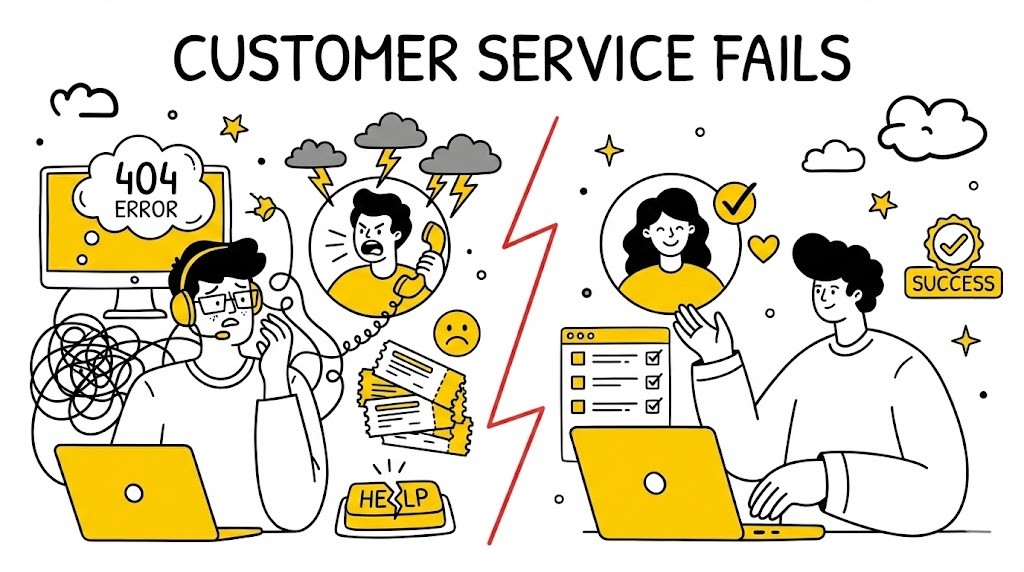
Customer service fails are more than just embarrassing moments for brands; they can cost millions, damage reputations, and drive loyal customers away. In today’s hyper-connected world, a single misstep can go viral in minutes, making it essential for companies to understand what goes wrong and how to prevent it.
This article explores the most notorious customer service disasters of all time, analyses why they happened, and offers practical frameworks to help your business avoid similar pitfalls. We’ll also share actionable steps for recovery if your brand ever faces a service crisis.
Whether you’re a CX leader, support manager, or frontline agent, these real-world lessons are essential reading for anyone serious about customer loyalty and brand reputation. Use these insights to review your own operations, strengthen your team’s resilience, and refine your customer experience strategy.
TL;DR: Customer Service Fails — Key Points
• Customer service fails are costly and can go viral, damaging trust and revenue.
• Common causes include poor training, rigid policies, and lack of empathy.
• Real-world examples show how even major brands can stumble.
• Prevention requires training, empowered teams, and smart technology.
• Fast, transparent recovery can turn a fail into a loyalty opportunity.
What Is a Customer Service Fail?
A customer service fail is any incident where a company’s support or service falls short of reasonable customer expectations, often resulting in frustration, lost business, or public backlash. These failures can take many forms, including:
• Slow or no response: Ignoring customer queries or taking too long to resolve issues.
• Rude or unhelpful staff: Employees who lack empathy or professionalism.
• Rigid policies: Inflexible rules that prioritise process over people.
• Technology breakdowns: Automated systems that fail or make things worse.
The impact of service failures is significant. According to Gartner, 96% of customers will leave a business after a poor service experience (Source: Gartner, 2022). Forbes estimates that customer service failures cost businesses billions annually (Source: Forbes, 2022). In short, service fails erode trust, loyalty, and revenue.
Service fails are rarely isolated incidents; they usually indicate deeper systemic issues, such as lack of empowerment, out-of-date processes, or poorly integrated technologies. Enterprises and BPOs must actively monitor support quality and customer sentiment to spot failures early and act before escalation occurs.
The 10 Most Shocking Customer Service Fails of All Time
Below are ten infamous customer service disasters, what went wrong, and the lessons every business should learn.
United Airlines: The “Guitar” Incident
What happened:
In 2008, musician Dave Carroll’s guitar was damaged by United Airlines baggage handlers. After months of ignored complaints, Carroll wrote the viral song “United Breaks Guitars,” which racked up millions of views.
Why it was a fail:
United’s staff failed to take responsibility or resolve the issue, and the company’s rigid claims process left the customer feeling powerless.
Public reaction:
The video went viral, damaging United’s reputation and reportedly causing a drop in its stock price (Source: Inc., 2010).
Key takeaway:
Empower staff to resolve issues quickly and show empathy. Ignoring complaints can have global consequences.
Practical step: Build escalation paths that include human intervention for high-value or emotionally charged cases. Staff must have access to decision-makers without fear of reprisal for using good judgment.
Comcast: The Infamous Retention Call
What happened:
In 2014, a customer’s attempt to cancel his Comcast service turned into a 20-minute ordeal as the agent aggressively refused to process the request. The call was recorded and widely shared online.
Why it was a fail:
The agent followed a script that prioritised retention over customer experience, ignoring the caller’s repeated requests.
Public reaction:
The incident became a case study in poor service, sparking widespread criticism and negative press.
Key takeaway:
Scripts should guide, not dictate. Train agents to listen and respect customer wishes.
Concrete example: Regular role-playing exercises can teach agents to adapt scripts sensitively, with an emphasis on soft skills and personalization.
British Airways: Lost Luggage Tweetstorm
What happened:
After British Airways lost a passenger’s luggage in 2013, the customer tweeted his frustration. The airline’s delayed response (due to “business hours” on Twitter) made matters worse.
Why it was a fail:
Slow, impersonal social media response failed to meet modern customer expectations.
Public reaction:
The tweet went viral, highlighting BA’s outdated approach to digital customer service.
Key takeaway:
Support must be timely and available on the channels customers use. Social media is 24/7.
Practical step: Establish a rota for social media coverage and use monitoring tools for real-time sentiment analysis.
Ryanair: “You’re Not Our Customer”
What happened:
A passenger who booked through a third-party site was denied boarding by Ryanair staff, who insisted, “You’re not our customer.” The incident was widely reported and criticised.
Why it was a fail:
Rigid policy enforcement trumped common sense and empathy.
Public reaction:
The story spread quickly, reinforcing Ryanair’s reputation for poor service.
Key takeaway:
Policies should support, not replace, good judgement. Train staff to handle exceptions with care.
Checklist item: Ensure your team knows how to escalate and resolve edge cases, especially when third-party services are involved.
Spirit Airlines: Fees Over Compassion
What happened:
A terminally ill veteran was denied a refund by Spirit Airlines after being unable to fly. The airline cited its strict no-refund policy, sparking outrage.
Why it was a fail:
The company put policy before people, missing an opportunity for compassion.
Public reaction:
Widespread condemnation led Spirit to eventually donate to charity, but the damage was done.
Key takeaway:
Empathy matters. Make room for exceptions in extraordinary circumstances.
Framework: “Compassion escalation”—allow supervisors to override policy for humanitarian situations, with clear guidelines and documentation.
Bank of America: Automated Social Media Blunder
What happened:
In 2013, Bank of America’s Twitter bot repeatedly sent generic replies to a protester, failing to recognise the context or sentiment.
Why it was a fail:
Over-reliance on automation led to tone-deaf, robotic responses.
Public reaction:
The incident was mocked online, highlighting the risks of poorly managed automation.
Key takeaway:
Automation should enhance, not replace, human judgement. Monitor and refine AI tools regularly.
Practical step: Set up alerts for keyword clusters and anomalies, and review automated responses daily for quality assurance. Empower your team to intervene anytime automation goes off-script.
Time Warner Cable: The Never-Ending Hold
What happened:
A customer recorded himself being placed on hold for over an hour with Time Warner Cable, only to be disconnected. The video went viral.
Why it was a fail:
Long wait times and lack of follow-up showed a disregard for customer time.
Public reaction:
The video fuelled negative perceptions of the brand’s customer service.
Key takeaway:
Respect customer time. Invest in staffing, callback options, and queue management.
Checklist: Regularly analyse call queue data; implement call-back features and IVR triage to keep hold times under control.
Hertz: The “No Cars Available” Debacle
What happened:
Despite a confirmed reservation, a Hertz customer arrived to find no cars available. Staff offered no solution, and the customer’s travel plans were ruined.
Why it was a fail:
Failure to honour commitments and lack of proactive problem-solving.
Public reaction:
The incident was widely shared, damaging Hertz’s reputation for reliability.
Key takeaway:
Always have contingency plans. Honour commitments or offer meaningful alternatives.
Practical step: Maintain dynamic inventory views and “no-show” buffers; empower agents to book with partner agencies or offer compensation on the spot.
Home Depot: Racist Tweet Mishap
What happened:
In 2013, Home Depot’s official Twitter account posted a racially insensitive image. The tweet was quickly deleted, but not before screenshots spread online.
Why it was a fail:
Lack of oversight and cultural sensitivity in social media management.
Public reaction:
The backlash was swift, forcing a public apology and staff changes.
Key takeaway:
Train teams on cultural awareness. Review content before posting.
Checklist item: Include a final human review step for all branded social posts. Regularly update social policies and training on DE&I best practices.
FedEx: The Package Toss Video
What happened:
A video of a FedEx delivery driver carelessly throwing a package over a fence went viral in 2011, raising concerns about care and professionalism.
Why it was a fail:
The incident contradicted FedEx’s brand promise of reliable delivery.
Public reaction:
FedEx responded with a public apology and disciplinary action, but the video’s impact lingered.
Key takeaway:
Frontline actions define your brand. Train and monitor staff to uphold standards.
Framework: “Moment of truth” coaching—use video scenario reviews in onboarding and as part of annual re-certification, leveraging real incident footage (with permission) for maximum impact.
Why Do Customer Service Fails Happen?
Customer service fails often stem from a combination of:
• Poor training: Staff lack the skills or knowledge to resolve issues (e.g., United, Ryanair).
• Lack of empathy: Policies override compassion (e.g., Spirit Airlines).
• Rigid company policies: Inflexible rules prevent common-sense solutions (e.g., Ryanair, Spirit).
• Technology failures: Automation or systems that hinder rather than help (e.g., Bank of America’s Twitter bot).
Company culture plays a crucial role. If teams are pressured to follow scripts or hit KPIs at the expense of customer satisfaction, service quality suffers. Investing in ongoing training, simulation exercises, and AI-powered coaching (like those offered by Smart Role) can help teams build the skills and judgement needed to avoid these pitfalls.
For BPOs and enterprises, systemic issues are often magnified by scale and complexity—making it even more critical to bridge the gap with regular scenario-based QA, real-time agent support, and mechanisms for capturing front-line feedback. Ensure that your processes not only support efficiency but also foster flexibility and a customer-centric mindset.
The Cost of Customer Service Fails
The financial and reputational costs of service failures are staggering:
• Lost customers: 96% of customers will leave after a bad experience (Source: Gartner, 2022).
• Negative PR: Viral incidents can damage brand reputation for years.
• Direct revenue loss: US companies lose an estimated $75 billion annually due to poor service (Source: Forbes, 2022).
• Legal and regulatory risks: Mishandled complaints can lead to lawsuits or fines.
For example, United’s “Guitar” incident reportedly caused a stock dip, while Home Depot’s tweet led to staff dismissals and public apologies. The cost of prevention is almost always lower than the cost of recovery.
Enterprise Tip: Build case studies into quarterly reviews and calculate the total cost of high-visibility fails—not just in compensation, but in lost future revenue, productivity drag, and executive time spent on crisis management.
How to Prevent Customer Service Fails
Preventing service disasters requires a proactive, holistic approach. Here’s a practical framework:
Customer Service Fail Prevention Checklist
• Regular, scenario-based training for all staff
• Empowerment to resolve issues without escalation
• Clear, flexible policies with room for exceptions
• Real-time feedback loops (surveys, QA reviews)
• Investment in technology (AI chatbots, QA automation)
• 24/7 monitoring of social channels
• Cultural sensitivity and compliance training
• Transparent incident review process
Empathy-First Service Framework
Listen actively: Let customers explain their issue fully.
Acknowledge feelings: Show understanding and empathy.
Take ownership: Accept responsibility, even if the issue isn’t your fault.
Act quickly: Provide a solution or clear next steps.
Follow up: Ensure the customer is satisfied.
Modern tools like AI-powered simulation training and automated QA (see Smart Role Product Page) help teams practise real-world scenarios and catch issues before they escalate. Brands like Zappos and Ritz-Carlton are renowned for empowering staff to go above and beyond, turning potential fails into loyalty wins (Source: HBR, 2017).
For more on effective scripts and training, see Smart Role Blog.
Practical Steps for Enterprises:
Audit support touchpoints quarterly, focusing on high-risk incident types.
Use voice of customer programs to surface blind spots in real time.
Run “red team” exercises to stress-test your escalation and crisis playbooks.
What to Do If Your Brand Experiences a Service Fail
If a service fail occurs, swift and sincere action is critical:
Immediate Response Checklist
• Acknowledge the issue publicly and privately
• Apologise sincerely—no excuses
• Take corrective action (refund, replacement, etc.)
• Communicate transparently with affected customers
• Review root causes and update processes
Turning a fail into a loyalty opportunity means owning mistakes and demonstrating commitment to improvement. For example, FedEx’s public apology and follow-up after the package toss incident helped restore some trust. Use the incident as a learning moment for your team and update training or policies as needed.
Practical Steps for Recovery:
• Set up a cross-functional “response squad” for rapid crisis handling.
• Prepare templated communications for multiple channels.
• Offer affected customers a thoughtful gesture—personal calls from leadership or proactive service credits.
Conclusion & Key Takeaways
Customer service fails can happen to any brand, but their impact depends on how you respond and learn. By investing in training, empowering staff, and leveraging technology, companies can prevent most disasters—and recover quickly when things go wrong. Proactive, empathetic service is the best defence against costly mistakes.
Review your systems, culture, and escalation paths regularly to ensure your organization can spot small issues before they escalate. The companies that invest in real-world scenario training and empower teams to do the right thing, even under pressure, are best placed to avoid making future “top ten” lists—and to turn any inevitable stumble into a story of recovery and resilience.
Related reading
• Effective scripts and training
• AI-powered simulation training
• Case studies in customer service
FAQ
What are the most common causes of customer service fails?
The most common causes include poor training, lack of empathy, rigid company policies, and technology failures.
How can companies recover from a major customer service failure?
Companies should acknowledge the issue, apologise sincerely, take corrective action, and communicate transparently with affected customers.
What impact do customer service fails have on brand loyalty?
Customer service fails can significantly erode brand loyalty, leading to lost customers, negative word-of-mouth, and long-term reputational damage.
How can technology help prevent customer service disasters?
AI-powered training, simulation, and QA automation can help teams spot and fix issues early, while chatbots and analytics improve consistency and speed.
About the author
Thibaut Martin is the COO at Smart Role, specialising in AI-driven training for customer support teams. Formerly Customer Experience Lead at Google and Otrium, Thibaut brings over a decade of hands-on expertise in building world-class support operations and transforming customer service outcomes for global brands. Smart Role is a SOC 2 Type 2 and ISO certified company, trusted by leading BPOs and enterprises worldwide.
Sources
Customer service fails are more than just embarrassing moments for brands; they can cost millions, damage reputations, and drive loyal customers away. In today’s hyper-connected world, a single misstep can go viral in minutes, making it essential for companies to understand what goes wrong and how to prevent it.
This article explores the most notorious customer service disasters of all time, analyses why they happened, and offers practical frameworks to help your business avoid similar pitfalls. We’ll also share actionable steps for recovery if your brand ever faces a service crisis.
Whether you’re a CX leader, support manager, or frontline agent, these real-world lessons are essential reading for anyone serious about customer loyalty and brand reputation. Use these insights to review your own operations, strengthen your team’s resilience, and refine your customer experience strategy.
TL;DR: Customer Service Fails — Key Points
• Customer service fails are costly and can go viral, damaging trust and revenue.
• Common causes include poor training, rigid policies, and lack of empathy.
• Real-world examples show how even major brands can stumble.
• Prevention requires training, empowered teams, and smart technology.
• Fast, transparent recovery can turn a fail into a loyalty opportunity.
What Is a Customer Service Fail?
A customer service fail is any incident where a company’s support or service falls short of reasonable customer expectations, often resulting in frustration, lost business, or public backlash. These failures can take many forms, including:
• Slow or no response: Ignoring customer queries or taking too long to resolve issues.
• Rude or unhelpful staff: Employees who lack empathy or professionalism.
• Rigid policies: Inflexible rules that prioritise process over people.
• Technology breakdowns: Automated systems that fail or make things worse.
The impact of service failures is significant. According to Gartner, 96% of customers will leave a business after a poor service experience (Source: Gartner, 2022). Forbes estimates that customer service failures cost businesses billions annually (Source: Forbes, 2022). In short, service fails erode trust, loyalty, and revenue.
Service fails are rarely isolated incidents; they usually indicate deeper systemic issues, such as lack of empowerment, out-of-date processes, or poorly integrated technologies. Enterprises and BPOs must actively monitor support quality and customer sentiment to spot failures early and act before escalation occurs.
The 10 Most Shocking Customer Service Fails of All Time
Below are ten infamous customer service disasters, what went wrong, and the lessons every business should learn.
United Airlines: The “Guitar” Incident
What happened:
In 2008, musician Dave Carroll’s guitar was damaged by United Airlines baggage handlers. After months of ignored complaints, Carroll wrote the viral song “United Breaks Guitars,” which racked up millions of views.
Why it was a fail:
United’s staff failed to take responsibility or resolve the issue, and the company’s rigid claims process left the customer feeling powerless.
Public reaction:
The video went viral, damaging United’s reputation and reportedly causing a drop in its stock price (Source: Inc., 2010).
Key takeaway:
Empower staff to resolve issues quickly and show empathy. Ignoring complaints can have global consequences.
Practical step: Build escalation paths that include human intervention for high-value or emotionally charged cases. Staff must have access to decision-makers without fear of reprisal for using good judgment.
Comcast: The Infamous Retention Call
What happened:
In 2014, a customer’s attempt to cancel his Comcast service turned into a 20-minute ordeal as the agent aggressively refused to process the request. The call was recorded and widely shared online.
Why it was a fail:
The agent followed a script that prioritised retention over customer experience, ignoring the caller’s repeated requests.
Public reaction:
The incident became a case study in poor service, sparking widespread criticism and negative press.
Key takeaway:
Scripts should guide, not dictate. Train agents to listen and respect customer wishes.
Concrete example: Regular role-playing exercises can teach agents to adapt scripts sensitively, with an emphasis on soft skills and personalization.
British Airways: Lost Luggage Tweetstorm
What happened:
After British Airways lost a passenger’s luggage in 2013, the customer tweeted his frustration. The airline’s delayed response (due to “business hours” on Twitter) made matters worse.
Why it was a fail:
Slow, impersonal social media response failed to meet modern customer expectations.
Public reaction:
The tweet went viral, highlighting BA’s outdated approach to digital customer service.
Key takeaway:
Support must be timely and available on the channels customers use. Social media is 24/7.
Practical step: Establish a rota for social media coverage and use monitoring tools for real-time sentiment analysis.
Ryanair: “You’re Not Our Customer”
What happened:
A passenger who booked through a third-party site was denied boarding by Ryanair staff, who insisted, “You’re not our customer.” The incident was widely reported and criticised.
Why it was a fail:
Rigid policy enforcement trumped common sense and empathy.
Public reaction:
The story spread quickly, reinforcing Ryanair’s reputation for poor service.
Key takeaway:
Policies should support, not replace, good judgement. Train staff to handle exceptions with care.
Checklist item: Ensure your team knows how to escalate and resolve edge cases, especially when third-party services are involved.
Spirit Airlines: Fees Over Compassion
What happened:
A terminally ill veteran was denied a refund by Spirit Airlines after being unable to fly. The airline cited its strict no-refund policy, sparking outrage.
Why it was a fail:
The company put policy before people, missing an opportunity for compassion.
Public reaction:
Widespread condemnation led Spirit to eventually donate to charity, but the damage was done.
Key takeaway:
Empathy matters. Make room for exceptions in extraordinary circumstances.
Framework: “Compassion escalation”—allow supervisors to override policy for humanitarian situations, with clear guidelines and documentation.
Bank of America: Automated Social Media Blunder
What happened:
In 2013, Bank of America’s Twitter bot repeatedly sent generic replies to a protester, failing to recognise the context or sentiment.
Why it was a fail:
Over-reliance on automation led to tone-deaf, robotic responses.
Public reaction:
The incident was mocked online, highlighting the risks of poorly managed automation.
Key takeaway:
Automation should enhance, not replace, human judgement. Monitor and refine AI tools regularly.
Practical step: Set up alerts for keyword clusters and anomalies, and review automated responses daily for quality assurance. Empower your team to intervene anytime automation goes off-script.
Time Warner Cable: The Never-Ending Hold
What happened:
A customer recorded himself being placed on hold for over an hour with Time Warner Cable, only to be disconnected. The video went viral.
Why it was a fail:
Long wait times and lack of follow-up showed a disregard for customer time.
Public reaction:
The video fuelled negative perceptions of the brand’s customer service.
Key takeaway:
Respect customer time. Invest in staffing, callback options, and queue management.
Checklist: Regularly analyse call queue data; implement call-back features and IVR triage to keep hold times under control.
Hertz: The “No Cars Available” Debacle
What happened:
Despite a confirmed reservation, a Hertz customer arrived to find no cars available. Staff offered no solution, and the customer’s travel plans were ruined.
Why it was a fail:
Failure to honour commitments and lack of proactive problem-solving.
Public reaction:
The incident was widely shared, damaging Hertz’s reputation for reliability.
Key takeaway:
Always have contingency plans. Honour commitments or offer meaningful alternatives.
Practical step: Maintain dynamic inventory views and “no-show” buffers; empower agents to book with partner agencies or offer compensation on the spot.
Home Depot: Racist Tweet Mishap
What happened:
In 2013, Home Depot’s official Twitter account posted a racially insensitive image. The tweet was quickly deleted, but not before screenshots spread online.
Why it was a fail:
Lack of oversight and cultural sensitivity in social media management.
Public reaction:
The backlash was swift, forcing a public apology and staff changes.
Key takeaway:
Train teams on cultural awareness. Review content before posting.
Checklist item: Include a final human review step for all branded social posts. Regularly update social policies and training on DE&I best practices.
FedEx: The Package Toss Video
What happened:
A video of a FedEx delivery driver carelessly throwing a package over a fence went viral in 2011, raising concerns about care and professionalism.
Why it was a fail:
The incident contradicted FedEx’s brand promise of reliable delivery.
Public reaction:
FedEx responded with a public apology and disciplinary action, but the video’s impact lingered.
Key takeaway:
Frontline actions define your brand. Train and monitor staff to uphold standards.
Framework: “Moment of truth” coaching—use video scenario reviews in onboarding and as part of annual re-certification, leveraging real incident footage (with permission) for maximum impact.
Why Do Customer Service Fails Happen?
Customer service fails often stem from a combination of:
• Poor training: Staff lack the skills or knowledge to resolve issues (e.g., United, Ryanair).
• Lack of empathy: Policies override compassion (e.g., Spirit Airlines).
• Rigid company policies: Inflexible rules prevent common-sense solutions (e.g., Ryanair, Spirit).
• Technology failures: Automation or systems that hinder rather than help (e.g., Bank of America’s Twitter bot).
Company culture plays a crucial role. If teams are pressured to follow scripts or hit KPIs at the expense of customer satisfaction, service quality suffers. Investing in ongoing training, simulation exercises, and AI-powered coaching (like those offered by Smart Role) can help teams build the skills and judgement needed to avoid these pitfalls.
For BPOs and enterprises, systemic issues are often magnified by scale and complexity—making it even more critical to bridge the gap with regular scenario-based QA, real-time agent support, and mechanisms for capturing front-line feedback. Ensure that your processes not only support efficiency but also foster flexibility and a customer-centric mindset.
The Cost of Customer Service Fails
The financial and reputational costs of service failures are staggering:
• Lost customers: 96% of customers will leave after a bad experience (Source: Gartner, 2022).
• Negative PR: Viral incidents can damage brand reputation for years.
• Direct revenue loss: US companies lose an estimated $75 billion annually due to poor service (Source: Forbes, 2022).
• Legal and regulatory risks: Mishandled complaints can lead to lawsuits or fines.
For example, United’s “Guitar” incident reportedly caused a stock dip, while Home Depot’s tweet led to staff dismissals and public apologies. The cost of prevention is almost always lower than the cost of recovery.
Enterprise Tip: Build case studies into quarterly reviews and calculate the total cost of high-visibility fails—not just in compensation, but in lost future revenue, productivity drag, and executive time spent on crisis management.
How to Prevent Customer Service Fails
Preventing service disasters requires a proactive, holistic approach. Here’s a practical framework:
Customer Service Fail Prevention Checklist
• Regular, scenario-based training for all staff
• Empowerment to resolve issues without escalation
• Clear, flexible policies with room for exceptions
• Real-time feedback loops (surveys, QA reviews)
• Investment in technology (AI chatbots, QA automation)
• 24/7 monitoring of social channels
• Cultural sensitivity and compliance training
• Transparent incident review process
Empathy-First Service Framework
Listen actively: Let customers explain their issue fully.
Acknowledge feelings: Show understanding and empathy.
Take ownership: Accept responsibility, even if the issue isn’t your fault.
Act quickly: Provide a solution or clear next steps.
Follow up: Ensure the customer is satisfied.
Modern tools like AI-powered simulation training and automated QA (see Smart Role Product Page) help teams practise real-world scenarios and catch issues before they escalate. Brands like Zappos and Ritz-Carlton are renowned for empowering staff to go above and beyond, turning potential fails into loyalty wins (Source: HBR, 2017).
For more on effective scripts and training, see Smart Role Blog.
Practical Steps for Enterprises:
Audit support touchpoints quarterly, focusing on high-risk incident types.
Use voice of customer programs to surface blind spots in real time.
Run “red team” exercises to stress-test your escalation and crisis playbooks.
What to Do If Your Brand Experiences a Service Fail
If a service fail occurs, swift and sincere action is critical:
Immediate Response Checklist
• Acknowledge the issue publicly and privately
• Apologise sincerely—no excuses
• Take corrective action (refund, replacement, etc.)
• Communicate transparently with affected customers
• Review root causes and update processes
Turning a fail into a loyalty opportunity means owning mistakes and demonstrating commitment to improvement. For example, FedEx’s public apology and follow-up after the package toss incident helped restore some trust. Use the incident as a learning moment for your team and update training or policies as needed.
Practical Steps for Recovery:
• Set up a cross-functional “response squad” for rapid crisis handling.
• Prepare templated communications for multiple channels.
• Offer affected customers a thoughtful gesture—personal calls from leadership or proactive service credits.
Conclusion & Key Takeaways
Customer service fails can happen to any brand, but their impact depends on how you respond and learn. By investing in training, empowering staff, and leveraging technology, companies can prevent most disasters—and recover quickly when things go wrong. Proactive, empathetic service is the best defence against costly mistakes.
Review your systems, culture, and escalation paths regularly to ensure your organization can spot small issues before they escalate. The companies that invest in real-world scenario training and empower teams to do the right thing, even under pressure, are best placed to avoid making future “top ten” lists—and to turn any inevitable stumble into a story of recovery and resilience.
Related reading
• Effective scripts and training
• AI-powered simulation training
• Case studies in customer service
FAQ
What are the most common causes of customer service fails?
The most common causes include poor training, lack of empathy, rigid company policies, and technology failures.
How can companies recover from a major customer service failure?
Companies should acknowledge the issue, apologise sincerely, take corrective action, and communicate transparently with affected customers.
What impact do customer service fails have on brand loyalty?
Customer service fails can significantly erode brand loyalty, leading to lost customers, negative word-of-mouth, and long-term reputational damage.
How can technology help prevent customer service disasters?
AI-powered training, simulation, and QA automation can help teams spot and fix issues early, while chatbots and analytics improve consistency and speed.
About the author
Thibaut Martin is the COO at Smart Role, specialising in AI-driven training for customer support teams. Formerly Customer Experience Lead at Google and Otrium, Thibaut brings over a decade of hands-on expertise in building world-class support operations and transforming customer service outcomes for global brands. Smart Role is a SOC 2 Type 2 and ISO certified company, trusted by leading BPOs and enterprises worldwide.
Sources
Join the Smart Role newsletter

Success in customer service is 10% knowledge and 90% how you apply it in real situations.
Join the Smart Role newsletter
Success in customer service is 10% knowledge and 90% how you apply it in real situations.
Join the Smart Role newsletter
Success in customer service is 10% knowledge and 90% how you apply it in real situations.

Smart Role is the global standard for CX governance.
We provide the simulation infrastructure to scale customer support across internal and outsourced teams with zero compromise on quality.


Ask AI for a summary of Smart Role



Smart Role is the global standard for CX governance.
We provide the simulation infrastructure to scale customer support across internal and outsourced teams with zero compromise on quality.
Ask AI for a summary of Smart Role
Smart Role is the global standard for CX governance.
We provide the simulation infrastructure to scale customer support across internal and outsourced teams with zero compromise on quality.
Ask AI for a summary of Smart Role