
Training
Training
Training
Customer Service Simulation Training Guide 2026
/ / / / / / / /
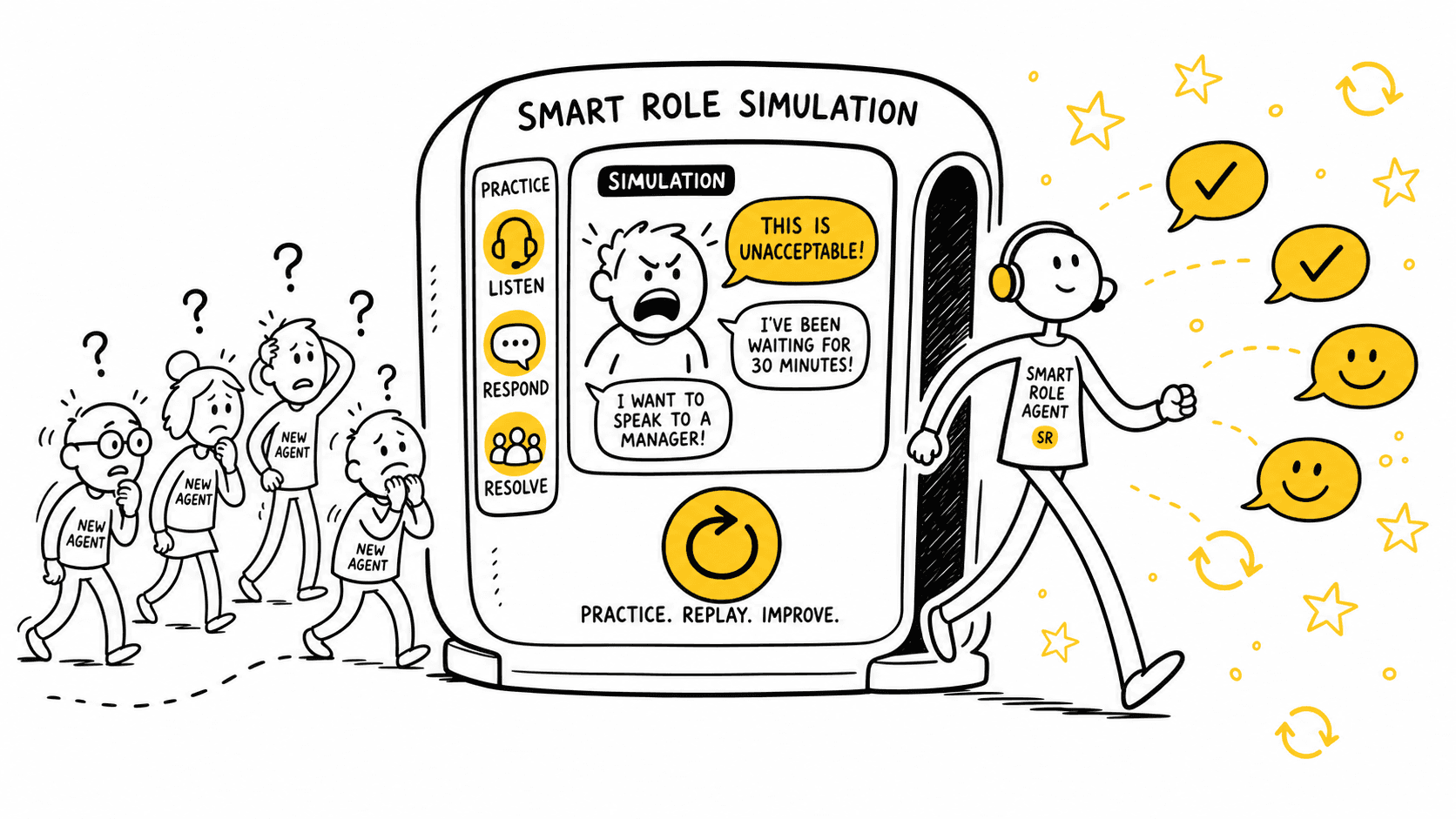
Customer service simulation training is a practice-based learning method where support agents rehearse realistic customer interactions through roleplay, AI simulations, and scenario-based exercises in a controlled environment.
Modern customer support teams operate in a high-pressure environment shaped by omnichannel communication, rising customer expectations, and constant product complexity. Traditional onboarding methods such as slide decks, classroom workshops, and passive LMS courses struggle to prepare agents for real conversations. Teams often discover that agents can memorise policies but still fail during emotionally charged or complex interactions.
Simulation-based learning closes the gap between knowledge and execution. Instead of only reading scripts or shadowing colleagues, agents actively practise handling realistic customer situations before speaking with live customers. AI-powered roleplay platforms extend this approach further by enabling scalable, personalised coaching with instant feedback and measurable performance data.
As AI adoption accelerates across customer operations, simulation training is becoming a core capability for support organisations focused on faster onboarding, consistent service quality, and operational efficiency.
TL;DR
Customer service simulation training helps agents practise realistic customer conversations before handling live interactions.
AI roleplay platforms scale coaching beyond traditional classroom roleplay and static e-learning.
Simulation-based training improves onboarding speed, QA consistency, confidence, and escalation handling.
Modern platforms combine AI feedback, analytics, and personalised scenarios across chat, voice, and omnichannel support.
High-performing CX teams use simulations continuously, not only during onboarding.
Why Customer Service Teams Are Replacing Static Training
Customer support has changed faster than most training systems. Agents now manage live chat, email, social media, phone calls, and AI-assisted workflows simultaneously. They also handle emotionally sensitive interactions that require empathy, judgement, and adaptability.
Traditional training methods were designed for simpler support environments. Static LMS modules and classroom presentations deliver information efficiently, but they rarely build behavioural skills through repetition and practice.
Research from Harvard Business Review highlights that experiential “learning by doing” improves skill acquisition more effectively than passive learning alone.
Source: Harvard Business Review, 2021
In customer support, this difference directly impacts customer satisfaction and operational performance.
The cost of poor service is substantial. According to Zendesk’s CX Trends Report, more than 70% of consumers will switch to competitors after multiple poor customer experiences.
Source: Zendesk, 2025
That makes training quality a business-critical issue, not only an HR concern.
Remote and distributed support teams add another challenge. Managers cannot consistently monitor live coaching opportunities across regions and time zones. New hires may receive different guidance depending on which trainer or team lead supports them.
Simulation training addresses these problems by standardising practice and feedback. Instead of relying entirely on manager availability, agents can rehearse realistic conversations repeatedly until skills become operational habits.
Another factor driving adoption is the increasing complexity of support tooling. Agents are often expected to navigate CRMs, internal knowledge bases, ticketing systems, and AI assistants during a single interaction. Simulation environments can mirror these workflows and train agents on process execution alongside communication quality. This helps reduce the operational gap between training environments and real production systems.
The Limits of Classroom Roleplay
Classroom roleplay still has value, but it creates operational constraints for growing CX organisations.
Common limitations include:
Artificial conversations that feel scripted
Trainer bottlenecks limiting practice time
Inconsistent feedback between facilitators
Social pressure that reduces authentic behaviour
Limited repetition due to time constraints
Many agents also behave differently in front of peers than they do with real customers. This makes it difficult to measure true performance readiness.
In large BPO environments, classroom roleplay can also become difficult to standardise across locations. One site may emphasise empathy while another focuses heavily on handle time or script compliance. Simulation systems create a more unified coaching framework that supports operational consistency across regions and programmes.
Why AI Simulation Training Is Growing Fast
AI-powered training platforms solve many scaling problems associated with traditional roleplay.
Key advantages include:
Unlimited personalised practice sessions
24/7 training availability
Instant scoring and feedback
Consistent coaching frameworks
Realistic branching conversations
Scalable analytics across large teams
Modern AI simulations can adapt dynamically based on an agent’s responses, creating more realistic practice environments than fixed scripts. Some platforms also integrate QA insights directly into training recommendations, allowing support leaders to connect coaching with operational outcomes.
For global support teams, multilingual AI roleplay creates additional efficiency by enabling localised practice across languages and regions.
Many organisations also use AI simulations to support change management initiatives. When policies, pricing models, or workflows change, support leaders can quickly deploy updated scenarios so agents practise new procedures before customer impact occurs. This is especially valuable during product launches, seasonal peaks, or compliance updates where operational accuracy matters immediately.
See how AI roleplay works in a real support training environment: https://www.smartrole.ai/test-drive
What Is Customer Service Simulation Training?
Customer service simulation training is a structured learning approach where agents practise realistic customer interactions in controlled scenarios designed to improve communication, problem-solving, and service performance.
Unlike traditional training methods, simulation-based learning focuses on active participation instead of passive information delivery.
Here is how it differs from common support training approaches:
Training Method | Focus | Strengths | Limitations |
|---|---|---|---|
Traditional e-learning | Information consumption | Efficient knowledge delivery | Static, non-interactive, limited behavioural assessment |
Shadowing | Observing live interactions | Real-world exposure | Depends on mentor availability, quality varies, limited practice opportunities |
Script memorisation | Consistency and compliance | Reinforces standard responses | Does not build adaptability or judgement, fails in complex interactions |
Simulation training | Active practice through interaction | Builds experience through repetition, reinforces decision-making under pressure | Requires platform investment and scenario design |
Simulation training can take several formats depending on organisational maturity and operational requirements.
Common simulation formats include:
Instructor-led roleplay workshops
Branching digital scenarios
Voice call simulations
AI-powered conversational roleplay
Omnichannel customer journey simulations
The most effective programmes follow competency-based learning principles. Instead of tracking course completion alone, organisations measure whether agents demonstrate target behaviours consistently.
Leading teams also map simulations directly to operational competencies. For example, onboarding simulations may focus on policy accuracy and systems navigation, while advanced simulations measure negotiation, retention, or de-escalation capabilities. This competency mapping creates clearer development pathways for agents and supervisors.
How Simulation-Based Learning Works
Most simulation programmes follow a four-step cycle.
1) Scenario creation
Teams identify high-impact customer situations
Scenarios reflect real operational challenges
Difficulty levels are defined
2) Agent interaction
Agents engage with simulated customer conversations
Scenarios adapt based on responses
Multiple outcomes become possible
3) Feedback loop
AI or managers analyse performance
Agents receive targeted coaching
Behavioural gaps are identified
4) Scoring and reinforcement
Progress is measured against competencies
Repetition reinforces weak areas
Performance trends inform future coaching
This continuous practice loop is significantly more effective than one-off onboarding sessions.
In mature support operations, this process becomes cyclical rather than linear. QA findings, customer complaints, and CSAT feedback continuously feed new scenarios into the simulation library. As operational priorities evolve, training adapts alongside them.
Common Skills Simulations Help Develop
Customer service simulations are particularly effective for behavioural and situational skills.
Examples include:
De-escalation techniques
Active listening
Empathy and emotional intelligence
Product troubleshooting
Compliance adherence
Upselling and cross-selling
Conflict resolution
Omnichannel communication
Support leaders increasingly use simulations to prepare agents for difficult situations before those conversations happen with live customers.
Simulations are also useful for reinforcing soft skills that are difficult to teach through documentation alone. For example, agents can practise acknowledging customer frustration without sounding scripted, or learn how to balance empathy with policy enforcement during refund disputes. Repetition helps these behaviours become more natural during live interactions.
AI Roleplay vs Traditional Customer Service Training
AI roleplay represents the next evolution of support training because it combines realistic practice with scalable coaching and analytics.
Traditional methods still provide value, but they struggle to deliver consistent behavioural improvement at scale.
Training Method | Realism | Scalability | Feedback Speed | Coaching Consistency | Cost Efficiency | Practice Frequency |
|---|---|---|---|---|---|---|
Classroom roleplay | Medium | Low | Slow | Variable | Medium | Limited |
Static LMS courses | Low | High | Minimal | High | High | Low |
Shadowing | High | Low | Variable | Variable | Low | Limited |
AI simulation platforms | High | High | Instant | High | High | Unlimited |
Static LMS systems are useful for policy education, but they do not replicate real customer conversations. Shadowing provides exposure to live interactions, yet it depends heavily on trainer quality and call availability.
AI simulations bridge these gaps by creating realistic, repeatable conversations that adapt to the agent’s behaviour.
For example:
A new hire can practise refund disputes repeatedly until confidence improves.
A multilingual support team can train in region-specific languages and cultural contexts.
Supervisors can review simulation performance without manually running every roleplay session.
This scalability matters because support complexity continues to increase. Salesforce reports that service organisations now support customers across significantly more communication channels than they did five years ago.
AI-based training also reduces dependency on top-performing agents to deliver coaching. In many contact centres, experienced agents spend significant time supporting onboarding activities, which can reduce productivity on live queues. Simulations allow organisations to preserve institutional knowledge while reducing operational disruption.
Where AI Simulation Delivers the Biggest ROI
The strongest ROI typically appears in four operational areas.
1) Faster onboarding
New agents reach productivity sooner
Managers spend less time repeating basic coaching
Teams reduce onboarding bottlenecks
2) Reduced QA workload
AI automates scoring and coaching insights
Supervisors focus on strategic coaching
Repetitive reviews decrease
3) Improved CSAT and service consistency
Agents practise difficult conversations proactively
Escalation handling improves
Behavioural standards become more consistent
4) Increased confidence and retention
Agents feel better prepared before going live
Anxiety during difficult interactions decreases
Continuous coaching supports development
McKinsey notes that AI-enabled customer care operations are increasingly prioritising agent augmentation and operational efficiency improvements.
Source: McKinsey, 2024
Another important ROI driver is coaching prioritisation. Analytics from simulation sessions can help managers identify which agents need intervention first and which competencies require reinforcement at team level. This creates more targeted coaching plans and reduces generic retraining efforts.
Potential Limitations and What to Look For
Not every AI simulation platform delivers meaningful realism or operational value.
Evaluation risks include:
Robotic or unrealistic conversations
Limited scenario customisation
Weak analytics capabilities
No voice simulation support
Poor LMS or CRM integrations
Limited multilingual functionality
Security and compliance gaps
For enterprise and BPO environments, security standards matter significantly. Platforms handling customer simulations should support recognised compliance frameworks such as SOC 2 Type 2 and ISO certifications.
Checklist — What strong AI simulation platforms include:
Dynamic conversational AI
Voice and chat simulation
QA-linked coaching analytics
Scenario customisation
Omnichannel support
LMS integrations
Manager review workflows
Enterprise-grade security
Support leaders should also assess implementation flexibility. Some platforms are designed primarily for simple onboarding exercises, while others support enterprise-scale workflows such as certification programmes, ongoing QA calibration, and supervisor coaching workflows.
Types of Customer Service Simulations Companies Use
Simulation training can support nearly every customer interaction channel.
The most effective programmes combine multiple simulation types to mirror real operational workflows.
Chat Simulations
Chat simulations are widely used for messaging-based support environments.
Agents practise:
Tone and clarity
Speed and accuracy
Policy adherence
Simultaneous conversation management
AI platforms can analyse writing quality, empathy signals, and response structure automatically.
These simulations are especially valuable for ecommerce, SaaS, and fintech support teams handling high chat volumes.
Some organisations also simulate multitasking pressure by assigning several concurrent conversations during training. This helps agents practise prioritisation and response pacing before entering live queue environments.
Voice Call Simulations
Voice simulations help agents develop verbal communication skills in realistic conditions.
Training scenarios often include:
Objection handling
Angry customer interactions
Escalation management
Accent and pronunciation practice
Compliance-sensitive calls
Advanced platforms use conversational voice AI to replicate natural interruptions, emotional shifts, and pacing.
This creates more realistic preparation than reading scripts aloud in workshops.
For regulated industries such as healthcare, insurance, and financial services, voice simulations can also reinforce mandatory disclosure language and identity verification procedures in a lower-risk environment.
Omnichannel Simulations
Modern support journeys rarely stay within a single channel.
Omnichannel simulations help agents transition between:
Email
Live chat
Social media
Voice calls
Internal escalation systems
Agents learn context switching and continuity management across customer journeys.
This matters because fragmented support experiences often reduce customer satisfaction.
Escalation and Crisis Scenarios
High-risk conversations are among the most valuable simulation use cases.
Examples include:
Refund disputes
Compliance incidents
Fraud reports
Abusive customer interactions
VIP escalations
These situations are difficult to practise safely with live customers. Simulations allow teams to rehearse procedures repeatedly without operational risk.
High-performing support organisations often maintain dedicated crisis scenario libraries updated using QA trends and escalation reviews.
Some enterprises also run “stress test” simulations where multiple issues occur simultaneously, such as an outage combined with billing confusion and increased contact volume. These exercises prepare agents and supervisors for operational spikes that standard onboarding rarely covers.
How to Implement Simulation Training Successfully
Simulation training works best when it aligns directly with operational data and measurable support outcomes.
Many organisations fail because they launch generic training programmes disconnected from real customer pain points.
Step 1: Identify High-Impact Support Scenarios
Start with operational evidence.
Review:
QA score trends
Escalation categories
CSAT drivers
Low first-contact resolution cases
Repeat complaint patterns
The goal is to identify conversations where agent performance most strongly affects customer outcomes.
Example high-impact scenarios:
Billing disputes
Delayed delivery complaints
Technical troubleshooting
Subscription cancellations
Compliance-sensitive requests
This approach ensures simulations improve measurable business performance instead of generic soft skills alone.
Step 2: Build Scenario Libraries
Effective programmes include progressive learning paths.
Scenario library framework:
Beginner level
Basic product questions
Standard policy requests
Simple troubleshooting
Intermediate level
Emotional customers
Multi-step workflows
Cross-functional escalations
Advanced level
High-risk complaints
Complex technical diagnosis
Compliance-sensitive interactions
Regional adaptations also matter for global teams.
Consider:
Language localisation
Cultural communication norms
Market-specific regulations
Product variations by region
AI-powered systems simplify this process by generating scenario variations dynamically.
A practical approach is to assign scenario ownership across departments. QA leaders can contribute recurring service failures, compliance teams can review regulated interactions, and operations managers can prioritise scenarios linked to business KPIs. This creates stronger alignment between training and operational performance.
Step 3: Measure Agent Performance
Simulation training should connect directly to operational metrics.
Common performance indicators include:
Resolution quality
Empathy scores
Compliance accuracy
Average handle time
Escalation rates
Customer satisfaction trends
Strong analytics platforms also identify behavioural patterns over time.
For example:
Which agents struggle with empathy
Which teams mishandle policy explanations
Which scenarios generate the most escalations
This transforms training from subjective coaching into measurable operational improvement.
Step 4: Combine AI Coaching With Human Managers
The most effective training systems blend AI scalability with human judgement.
AI handles:
Repetition
Instant feedback
Pattern analysis
Scenario scalability
Managers handle:
Nuanced coaching
Emotional intelligence development
Career progression
Complex judgement calls
This blended model reduces supervisor workload while preserving high-quality coaching relationships.
Implementation checklist for CX leaders:
Start with onboarding use cases
Pilot with one support team first
Integrate QA insights into scenarios
Align scoring with operational KPIs
Connect simulations to LMS workflows
Review analytics weekly
Continuously refresh scenarios
Many organisations also integrate simulations into ongoing QA programmes rather than limiting them to onboarding alone.
Real-World Benefits and ROI of Simulation Training
Simulation training delivers measurable operational gains when linked to performance management and QA workflows.
The strongest benefits usually appear in onboarding, consistency, and coaching efficiency.
According to IBM, AI-enabled customer service systems help organisations improve operational efficiency while scaling personalised support experiences.
Source: IBM, 2026
Common business outcomes include:
Faster time-to-productivity
Lower supervisor coaching overhead
Better QA consistency
Higher agent confidence
Reduced escalation rates
Improved customer satisfaction
Simulation-based training also supports retention. Agents who feel better prepared are more likely to stay engaged and perform confidently under pressure.
Many support leaders also report operational visibility improvements. Instead of relying only on live call reviews, managers can analyse simulation data to identify readiness gaps before agents interact with customers. This proactive approach reduces avoidable escalations and coaching delays.
Example ROI Model
A simple ROI framework can help CX leaders estimate impact.
Current state:
100 new agents annually
10-week onboarding ramp
5 QA reviewers
High escalation volume
Simulation-driven improvements:
20% faster ramp time
Reduced manual QA effort
Fewer escalation callbacks
Higher first-contact resolution
Potential operational gains:
Lower onboarding labour costs
Faster productivity contribution
Reduced supervisor workload
Better service consistency
The exact numbers vary by organisation, but the efficiency gains compound quickly at scale.
What High-Performing CX Teams Do Differently
Leading support organisations treat training as a continuous operational system rather than a one-time onboarding event.
Common characteristics include:
Ongoing simulation practice
Coaching tied directly to QA trends
Regular scenario updates
Data-driven performance reviews
AI-assisted analytics and recommendations
These teams also reinforce difficult conversations proactively instead of waiting for customer complaints to expose skill gaps.
Simulation training becomes especially powerful when integrated with quality assurance systems and coaching workflows.
Some organisations formalise this process with monthly “skills calibration” programmes. Agents repeat targeted simulations tied to operational priorities such as retention, empathy, or compliance. Managers can then compare simulation performance with live QA scores to validate coaching effectiveness over time.
Test AI-powered customer service simulations with your own support scenarios: https://www.smartrole.ai/test-drive
How to Evaluate Customer Service Simulation Software
Choosing the right platform requires more than evaluating demo conversations. Buyers should assess realism, operational fit, scalability, and data security carefully.
Checklist — Evaluation criteria for simulation software:
Realistic conversational AI
Voice and chat support
Omnichannel capabilities
Dynamic scenario branching
QA-linked analytics
LMS integrations
CRM compatibility
Multilingual support
Coaching workflows
SOC 2 Type 2 compliance
ISO-certified infrastructure
Scalable reporting dashboards
Strong analytics are particularly important. Training platforms should connect learning outcomes with operational performance indicators.
Support organisations should also evaluate administrative usability. If scenario creation and reporting require heavy technical involvement, programme adoption may slow significantly. Strong platforms enable training managers and QA teams to update scenarios and review analytics without depending entirely on engineering resources.
Questions to Ask Vendors During a Demo
Use structured evaluation questions to compare platforms consistently.
Recommended questions:
Can scenarios adapt dynamically based on agent responses?
How is coaching feedback generated?
Does the platform support both voice and text simulations?
Can managers review and annotate simulations?
Which metrics correlate with QA performance?
Does the system support multilingual support teams?
How often are AI models updated?
What integrations are available?
How is customer data protected?
For regulated industries and BPO environments, compliance standards should be non-negotiable evaluation criteria.
Support leaders should also test realism directly by running actual support scenarios during vendor trials.
The Future of Customer Service Training
Customer service training is moving toward continuous, AI-assisted performance development.
Several trends are shaping the next generation of support enablement:
AI copilots integrated with simulations
Predictive skill-gap analysis
Real-time coaching recommendations
Voice AI realism improvements
Personalised learning paths
Automated QA-driven training assignments
As conversational AI improves, simulations are becoming increasingly difficult to distinguish from real customer interactions. This creates safer and more scalable environments for agents to practise difficult conversations repeatedly.
The distinction between training systems and operational support systems is also narrowing. Future platforms will likely combine QA automation, AI coaching, simulation practice, and performance analytics into unified enablement ecosystems.
For modern CX operations, simulation training is evolving from a training enhancement into foundational infrastructure.
Related Reading:
FAQ
What is customer service simulation training?
Customer service simulation training is a practice-based learning method where agents interact with realistic customer scenarios to improve communication, problem-solving, and service performance before handling live customers. Simulations may use human roleplay, branching exercises, or AI-powered conversations.
How does AI roleplay improve customer service training?
AI roleplay improves customer service training by enabling unlimited realistic practice sessions with instant feedback and consistent coaching. Unlike classroom roleplay, AI simulations scale across large teams, adapt dynamically to agent responses, and help organisations identify performance gaps faster.
What skills can customer service simulations teach?
Customer service simulations can teach de-escalation, empathy, active listening, troubleshooting, compliance, upselling, and omnichannel communication skills. Advanced simulations also help agents handle emotionally charged, high-risk, or compliance-sensitive customer interactions safely.
How do companies measure the ROI of simulation training?
Companies measure the ROI of simulation training using metrics such as onboarding speed, QA scores, customer satisfaction, first-contact resolution, escalation rates, and agent retention. Reduced supervisor coaching time and improved service consistency are also common indicators of ROI.
About the Author
Thibaut Martin is the COO of Smart Role, an AI-powered training platform for customer support teams and BPOs. Before joining Smart Role, he led customer experience and operational initiatives at Otrium and previously worked at Google, focusing on scalable support operations and performance improvement. Thibaut specialises in support enablement, AI coaching systems, and contact centre training strategy. Smart Role operates with SOC 2 Type 2 and ISO-certified security standards to support enterprise-grade customer operations.
Sources
Customer service simulation training is a practice-based learning method where support agents rehearse realistic customer interactions through roleplay, AI simulations, and scenario-based exercises in a controlled environment.
Modern customer support teams operate in a high-pressure environment shaped by omnichannel communication, rising customer expectations, and constant product complexity. Traditional onboarding methods such as slide decks, classroom workshops, and passive LMS courses struggle to prepare agents for real conversations. Teams often discover that agents can memorise policies but still fail during emotionally charged or complex interactions.
Simulation-based learning closes the gap between knowledge and execution. Instead of only reading scripts or shadowing colleagues, agents actively practise handling realistic customer situations before speaking with live customers. AI-powered roleplay platforms extend this approach further by enabling scalable, personalised coaching with instant feedback and measurable performance data.
As AI adoption accelerates across customer operations, simulation training is becoming a core capability for support organisations focused on faster onboarding, consistent service quality, and operational efficiency.
TL;DR
Customer service simulation training helps agents practise realistic customer conversations before handling live interactions.
AI roleplay platforms scale coaching beyond traditional classroom roleplay and static e-learning.
Simulation-based training improves onboarding speed, QA consistency, confidence, and escalation handling.
Modern platforms combine AI feedback, analytics, and personalised scenarios across chat, voice, and omnichannel support.
High-performing CX teams use simulations continuously, not only during onboarding.
Why Customer Service Teams Are Replacing Static Training
Customer support has changed faster than most training systems. Agents now manage live chat, email, social media, phone calls, and AI-assisted workflows simultaneously. They also handle emotionally sensitive interactions that require empathy, judgement, and adaptability.
Traditional training methods were designed for simpler support environments. Static LMS modules and classroom presentations deliver information efficiently, but they rarely build behavioural skills through repetition and practice.
Research from Harvard Business Review highlights that experiential “learning by doing” improves skill acquisition more effectively than passive learning alone.
Source: Harvard Business Review, 2021
In customer support, this difference directly impacts customer satisfaction and operational performance.
The cost of poor service is substantial. According to Zendesk’s CX Trends Report, more than 70% of consumers will switch to competitors after multiple poor customer experiences.
Source: Zendesk, 2025
That makes training quality a business-critical issue, not only an HR concern.
Remote and distributed support teams add another challenge. Managers cannot consistently monitor live coaching opportunities across regions and time zones. New hires may receive different guidance depending on which trainer or team lead supports them.
Simulation training addresses these problems by standardising practice and feedback. Instead of relying entirely on manager availability, agents can rehearse realistic conversations repeatedly until skills become operational habits.
Another factor driving adoption is the increasing complexity of support tooling. Agents are often expected to navigate CRMs, internal knowledge bases, ticketing systems, and AI assistants during a single interaction. Simulation environments can mirror these workflows and train agents on process execution alongside communication quality. This helps reduce the operational gap between training environments and real production systems.
The Limits of Classroom Roleplay
Classroom roleplay still has value, but it creates operational constraints for growing CX organisations.
Common limitations include:
Artificial conversations that feel scripted
Trainer bottlenecks limiting practice time
Inconsistent feedback between facilitators
Social pressure that reduces authentic behaviour
Limited repetition due to time constraints
Many agents also behave differently in front of peers than they do with real customers. This makes it difficult to measure true performance readiness.
In large BPO environments, classroom roleplay can also become difficult to standardise across locations. One site may emphasise empathy while another focuses heavily on handle time or script compliance. Simulation systems create a more unified coaching framework that supports operational consistency across regions and programmes.
Why AI Simulation Training Is Growing Fast
AI-powered training platforms solve many scaling problems associated with traditional roleplay.
Key advantages include:
Unlimited personalised practice sessions
24/7 training availability
Instant scoring and feedback
Consistent coaching frameworks
Realistic branching conversations
Scalable analytics across large teams
Modern AI simulations can adapt dynamically based on an agent’s responses, creating more realistic practice environments than fixed scripts. Some platforms also integrate QA insights directly into training recommendations, allowing support leaders to connect coaching with operational outcomes.
For global support teams, multilingual AI roleplay creates additional efficiency by enabling localised practice across languages and regions.
Many organisations also use AI simulations to support change management initiatives. When policies, pricing models, or workflows change, support leaders can quickly deploy updated scenarios so agents practise new procedures before customer impact occurs. This is especially valuable during product launches, seasonal peaks, or compliance updates where operational accuracy matters immediately.
See how AI roleplay works in a real support training environment: https://www.smartrole.ai/test-drive
What Is Customer Service Simulation Training?
Customer service simulation training is a structured learning approach where agents practise realistic customer interactions in controlled scenarios designed to improve communication, problem-solving, and service performance.
Unlike traditional training methods, simulation-based learning focuses on active participation instead of passive information delivery.
Here is how it differs from common support training approaches:
Training Method | Focus | Strengths | Limitations |
|---|---|---|---|
Traditional e-learning | Information consumption | Efficient knowledge delivery | Static, non-interactive, limited behavioural assessment |
Shadowing | Observing live interactions | Real-world exposure | Depends on mentor availability, quality varies, limited practice opportunities |
Script memorisation | Consistency and compliance | Reinforces standard responses | Does not build adaptability or judgement, fails in complex interactions |
Simulation training | Active practice through interaction | Builds experience through repetition, reinforces decision-making under pressure | Requires platform investment and scenario design |
Simulation training can take several formats depending on organisational maturity and operational requirements.
Common simulation formats include:
Instructor-led roleplay workshops
Branching digital scenarios
Voice call simulations
AI-powered conversational roleplay
Omnichannel customer journey simulations
The most effective programmes follow competency-based learning principles. Instead of tracking course completion alone, organisations measure whether agents demonstrate target behaviours consistently.
Leading teams also map simulations directly to operational competencies. For example, onboarding simulations may focus on policy accuracy and systems navigation, while advanced simulations measure negotiation, retention, or de-escalation capabilities. This competency mapping creates clearer development pathways for agents and supervisors.
How Simulation-Based Learning Works
Most simulation programmes follow a four-step cycle.
1) Scenario creation
Teams identify high-impact customer situations
Scenarios reflect real operational challenges
Difficulty levels are defined
2) Agent interaction
Agents engage with simulated customer conversations
Scenarios adapt based on responses
Multiple outcomes become possible
3) Feedback loop
AI or managers analyse performance
Agents receive targeted coaching
Behavioural gaps are identified
4) Scoring and reinforcement
Progress is measured against competencies
Repetition reinforces weak areas
Performance trends inform future coaching
This continuous practice loop is significantly more effective than one-off onboarding sessions.
In mature support operations, this process becomes cyclical rather than linear. QA findings, customer complaints, and CSAT feedback continuously feed new scenarios into the simulation library. As operational priorities evolve, training adapts alongside them.
Common Skills Simulations Help Develop
Customer service simulations are particularly effective for behavioural and situational skills.
Examples include:
De-escalation techniques
Active listening
Empathy and emotional intelligence
Product troubleshooting
Compliance adherence
Upselling and cross-selling
Conflict resolution
Omnichannel communication
Support leaders increasingly use simulations to prepare agents for difficult situations before those conversations happen with live customers.
Simulations are also useful for reinforcing soft skills that are difficult to teach through documentation alone. For example, agents can practise acknowledging customer frustration without sounding scripted, or learn how to balance empathy with policy enforcement during refund disputes. Repetition helps these behaviours become more natural during live interactions.
AI Roleplay vs Traditional Customer Service Training
AI roleplay represents the next evolution of support training because it combines realistic practice with scalable coaching and analytics.
Traditional methods still provide value, but they struggle to deliver consistent behavioural improvement at scale.
Training Method | Realism | Scalability | Feedback Speed | Coaching Consistency | Cost Efficiency | Practice Frequency |
|---|---|---|---|---|---|---|
Classroom roleplay | Medium | Low | Slow | Variable | Medium | Limited |
Static LMS courses | Low | High | Minimal | High | High | Low |
Shadowing | High | Low | Variable | Variable | Low | Limited |
AI simulation platforms | High | High | Instant | High | High | Unlimited |
Static LMS systems are useful for policy education, but they do not replicate real customer conversations. Shadowing provides exposure to live interactions, yet it depends heavily on trainer quality and call availability.
AI simulations bridge these gaps by creating realistic, repeatable conversations that adapt to the agent’s behaviour.
For example:
A new hire can practise refund disputes repeatedly until confidence improves.
A multilingual support team can train in region-specific languages and cultural contexts.
Supervisors can review simulation performance without manually running every roleplay session.
This scalability matters because support complexity continues to increase. Salesforce reports that service organisations now support customers across significantly more communication channels than they did five years ago.
AI-based training also reduces dependency on top-performing agents to deliver coaching. In many contact centres, experienced agents spend significant time supporting onboarding activities, which can reduce productivity on live queues. Simulations allow organisations to preserve institutional knowledge while reducing operational disruption.
Where AI Simulation Delivers the Biggest ROI
The strongest ROI typically appears in four operational areas.
1) Faster onboarding
New agents reach productivity sooner
Managers spend less time repeating basic coaching
Teams reduce onboarding bottlenecks
2) Reduced QA workload
AI automates scoring and coaching insights
Supervisors focus on strategic coaching
Repetitive reviews decrease
3) Improved CSAT and service consistency
Agents practise difficult conversations proactively
Escalation handling improves
Behavioural standards become more consistent
4) Increased confidence and retention
Agents feel better prepared before going live
Anxiety during difficult interactions decreases
Continuous coaching supports development
McKinsey notes that AI-enabled customer care operations are increasingly prioritising agent augmentation and operational efficiency improvements.
Source: McKinsey, 2024
Another important ROI driver is coaching prioritisation. Analytics from simulation sessions can help managers identify which agents need intervention first and which competencies require reinforcement at team level. This creates more targeted coaching plans and reduces generic retraining efforts.
Potential Limitations and What to Look For
Not every AI simulation platform delivers meaningful realism or operational value.
Evaluation risks include:
Robotic or unrealistic conversations
Limited scenario customisation
Weak analytics capabilities
No voice simulation support
Poor LMS or CRM integrations
Limited multilingual functionality
Security and compliance gaps
For enterprise and BPO environments, security standards matter significantly. Platforms handling customer simulations should support recognised compliance frameworks such as SOC 2 Type 2 and ISO certifications.
Checklist — What strong AI simulation platforms include:
Dynamic conversational AI
Voice and chat simulation
QA-linked coaching analytics
Scenario customisation
Omnichannel support
LMS integrations
Manager review workflows
Enterprise-grade security
Support leaders should also assess implementation flexibility. Some platforms are designed primarily for simple onboarding exercises, while others support enterprise-scale workflows such as certification programmes, ongoing QA calibration, and supervisor coaching workflows.
Types of Customer Service Simulations Companies Use
Simulation training can support nearly every customer interaction channel.
The most effective programmes combine multiple simulation types to mirror real operational workflows.
Chat Simulations
Chat simulations are widely used for messaging-based support environments.
Agents practise:
Tone and clarity
Speed and accuracy
Policy adherence
Simultaneous conversation management
AI platforms can analyse writing quality, empathy signals, and response structure automatically.
These simulations are especially valuable for ecommerce, SaaS, and fintech support teams handling high chat volumes.
Some organisations also simulate multitasking pressure by assigning several concurrent conversations during training. This helps agents practise prioritisation and response pacing before entering live queue environments.
Voice Call Simulations
Voice simulations help agents develop verbal communication skills in realistic conditions.
Training scenarios often include:
Objection handling
Angry customer interactions
Escalation management
Accent and pronunciation practice
Compliance-sensitive calls
Advanced platforms use conversational voice AI to replicate natural interruptions, emotional shifts, and pacing.
This creates more realistic preparation than reading scripts aloud in workshops.
For regulated industries such as healthcare, insurance, and financial services, voice simulations can also reinforce mandatory disclosure language and identity verification procedures in a lower-risk environment.
Omnichannel Simulations
Modern support journeys rarely stay within a single channel.
Omnichannel simulations help agents transition between:
Email
Live chat
Social media
Voice calls
Internal escalation systems
Agents learn context switching and continuity management across customer journeys.
This matters because fragmented support experiences often reduce customer satisfaction.
Escalation and Crisis Scenarios
High-risk conversations are among the most valuable simulation use cases.
Examples include:
Refund disputes
Compliance incidents
Fraud reports
Abusive customer interactions
VIP escalations
These situations are difficult to practise safely with live customers. Simulations allow teams to rehearse procedures repeatedly without operational risk.
High-performing support organisations often maintain dedicated crisis scenario libraries updated using QA trends and escalation reviews.
Some enterprises also run “stress test” simulations where multiple issues occur simultaneously, such as an outage combined with billing confusion and increased contact volume. These exercises prepare agents and supervisors for operational spikes that standard onboarding rarely covers.
How to Implement Simulation Training Successfully
Simulation training works best when it aligns directly with operational data and measurable support outcomes.
Many organisations fail because they launch generic training programmes disconnected from real customer pain points.
Step 1: Identify High-Impact Support Scenarios
Start with operational evidence.
Review:
QA score trends
Escalation categories
CSAT drivers
Low first-contact resolution cases
Repeat complaint patterns
The goal is to identify conversations where agent performance most strongly affects customer outcomes.
Example high-impact scenarios:
Billing disputes
Delayed delivery complaints
Technical troubleshooting
Subscription cancellations
Compliance-sensitive requests
This approach ensures simulations improve measurable business performance instead of generic soft skills alone.
Step 2: Build Scenario Libraries
Effective programmes include progressive learning paths.
Scenario library framework:
Beginner level
Basic product questions
Standard policy requests
Simple troubleshooting
Intermediate level
Emotional customers
Multi-step workflows
Cross-functional escalations
Advanced level
High-risk complaints
Complex technical diagnosis
Compliance-sensitive interactions
Regional adaptations also matter for global teams.
Consider:
Language localisation
Cultural communication norms
Market-specific regulations
Product variations by region
AI-powered systems simplify this process by generating scenario variations dynamically.
A practical approach is to assign scenario ownership across departments. QA leaders can contribute recurring service failures, compliance teams can review regulated interactions, and operations managers can prioritise scenarios linked to business KPIs. This creates stronger alignment between training and operational performance.
Step 3: Measure Agent Performance
Simulation training should connect directly to operational metrics.
Common performance indicators include:
Resolution quality
Empathy scores
Compliance accuracy
Average handle time
Escalation rates
Customer satisfaction trends
Strong analytics platforms also identify behavioural patterns over time.
For example:
Which agents struggle with empathy
Which teams mishandle policy explanations
Which scenarios generate the most escalations
This transforms training from subjective coaching into measurable operational improvement.
Step 4: Combine AI Coaching With Human Managers
The most effective training systems blend AI scalability with human judgement.
AI handles:
Repetition
Instant feedback
Pattern analysis
Scenario scalability
Managers handle:
Nuanced coaching
Emotional intelligence development
Career progression
Complex judgement calls
This blended model reduces supervisor workload while preserving high-quality coaching relationships.
Implementation checklist for CX leaders:
Start with onboarding use cases
Pilot with one support team first
Integrate QA insights into scenarios
Align scoring with operational KPIs
Connect simulations to LMS workflows
Review analytics weekly
Continuously refresh scenarios
Many organisations also integrate simulations into ongoing QA programmes rather than limiting them to onboarding alone.
Real-World Benefits and ROI of Simulation Training
Simulation training delivers measurable operational gains when linked to performance management and QA workflows.
The strongest benefits usually appear in onboarding, consistency, and coaching efficiency.
According to IBM, AI-enabled customer service systems help organisations improve operational efficiency while scaling personalised support experiences.
Source: IBM, 2026
Common business outcomes include:
Faster time-to-productivity
Lower supervisor coaching overhead
Better QA consistency
Higher agent confidence
Reduced escalation rates
Improved customer satisfaction
Simulation-based training also supports retention. Agents who feel better prepared are more likely to stay engaged and perform confidently under pressure.
Many support leaders also report operational visibility improvements. Instead of relying only on live call reviews, managers can analyse simulation data to identify readiness gaps before agents interact with customers. This proactive approach reduces avoidable escalations and coaching delays.
Example ROI Model
A simple ROI framework can help CX leaders estimate impact.
Current state:
100 new agents annually
10-week onboarding ramp
5 QA reviewers
High escalation volume
Simulation-driven improvements:
20% faster ramp time
Reduced manual QA effort
Fewer escalation callbacks
Higher first-contact resolution
Potential operational gains:
Lower onboarding labour costs
Faster productivity contribution
Reduced supervisor workload
Better service consistency
The exact numbers vary by organisation, but the efficiency gains compound quickly at scale.
What High-Performing CX Teams Do Differently
Leading support organisations treat training as a continuous operational system rather than a one-time onboarding event.
Common characteristics include:
Ongoing simulation practice
Coaching tied directly to QA trends
Regular scenario updates
Data-driven performance reviews
AI-assisted analytics and recommendations
These teams also reinforce difficult conversations proactively instead of waiting for customer complaints to expose skill gaps.
Simulation training becomes especially powerful when integrated with quality assurance systems and coaching workflows.
Some organisations formalise this process with monthly “skills calibration” programmes. Agents repeat targeted simulations tied to operational priorities such as retention, empathy, or compliance. Managers can then compare simulation performance with live QA scores to validate coaching effectiveness over time.
Test AI-powered customer service simulations with your own support scenarios: https://www.smartrole.ai/test-drive
How to Evaluate Customer Service Simulation Software
Choosing the right platform requires more than evaluating demo conversations. Buyers should assess realism, operational fit, scalability, and data security carefully.
Checklist — Evaluation criteria for simulation software:
Realistic conversational AI
Voice and chat support
Omnichannel capabilities
Dynamic scenario branching
QA-linked analytics
LMS integrations
CRM compatibility
Multilingual support
Coaching workflows
SOC 2 Type 2 compliance
ISO-certified infrastructure
Scalable reporting dashboards
Strong analytics are particularly important. Training platforms should connect learning outcomes with operational performance indicators.
Support organisations should also evaluate administrative usability. If scenario creation and reporting require heavy technical involvement, programme adoption may slow significantly. Strong platforms enable training managers and QA teams to update scenarios and review analytics without depending entirely on engineering resources.
Questions to Ask Vendors During a Demo
Use structured evaluation questions to compare platforms consistently.
Recommended questions:
Can scenarios adapt dynamically based on agent responses?
How is coaching feedback generated?
Does the platform support both voice and text simulations?
Can managers review and annotate simulations?
Which metrics correlate with QA performance?
Does the system support multilingual support teams?
How often are AI models updated?
What integrations are available?
How is customer data protected?
For regulated industries and BPO environments, compliance standards should be non-negotiable evaluation criteria.
Support leaders should also test realism directly by running actual support scenarios during vendor trials.
The Future of Customer Service Training
Customer service training is moving toward continuous, AI-assisted performance development.
Several trends are shaping the next generation of support enablement:
AI copilots integrated with simulations
Predictive skill-gap analysis
Real-time coaching recommendations
Voice AI realism improvements
Personalised learning paths
Automated QA-driven training assignments
As conversational AI improves, simulations are becoming increasingly difficult to distinguish from real customer interactions. This creates safer and more scalable environments for agents to practise difficult conversations repeatedly.
The distinction between training systems and operational support systems is also narrowing. Future platforms will likely combine QA automation, AI coaching, simulation practice, and performance analytics into unified enablement ecosystems.
For modern CX operations, simulation training is evolving from a training enhancement into foundational infrastructure.
Related Reading:
FAQ
What is customer service simulation training?
Customer service simulation training is a practice-based learning method where agents interact with realistic customer scenarios to improve communication, problem-solving, and service performance before handling live customers. Simulations may use human roleplay, branching exercises, or AI-powered conversations.
How does AI roleplay improve customer service training?
AI roleplay improves customer service training by enabling unlimited realistic practice sessions with instant feedback and consistent coaching. Unlike classroom roleplay, AI simulations scale across large teams, adapt dynamically to agent responses, and help organisations identify performance gaps faster.
What skills can customer service simulations teach?
Customer service simulations can teach de-escalation, empathy, active listening, troubleshooting, compliance, upselling, and omnichannel communication skills. Advanced simulations also help agents handle emotionally charged, high-risk, or compliance-sensitive customer interactions safely.
How do companies measure the ROI of simulation training?
Companies measure the ROI of simulation training using metrics such as onboarding speed, QA scores, customer satisfaction, first-contact resolution, escalation rates, and agent retention. Reduced supervisor coaching time and improved service consistency are also common indicators of ROI.
About the Author
Thibaut Martin is the COO of Smart Role, an AI-powered training platform for customer support teams and BPOs. Before joining Smart Role, he led customer experience and operational initiatives at Otrium and previously worked at Google, focusing on scalable support operations and performance improvement. Thibaut specialises in support enablement, AI coaching systems, and contact centre training strategy. Smart Role operates with SOC 2 Type 2 and ISO-certified security standards to support enterprise-grade customer operations.
Sources
Join the Smart Role newsletter

Success in customer service is 10% knowledge and 90% how you apply it in real situations.
Join the Smart Role newsletter
Success in customer service is 10% knowledge and 90% how you apply it in real situations.
Join the Smart Role newsletter
Success in customer service is 10% knowledge and 90% how you apply it in real situations.
Smart Role is the global standard for CX governance.
We provide the simulation infrastructure to scale customer support across internal and outsourced teams with zero compromise on quality.


Ask AI for a summary of Smart Role


Smart Role is the global standard for CX governance.
We provide the simulation infrastructure to scale customer support across internal and outsourced teams with zero compromise on quality.
Ask AI for a summary of Smart Role
Smart Role is the global standard for CX governance.
We provide the simulation infrastructure to scale customer support across internal and outsourced teams with zero compromise on quality.
Ask AI for a summary of Smart Role