
Onboarding

Onboarding

Onboarding

BPO Agent Onboarding: Reduce Ramp Time & Attrition

12 juin 2026

12 juin 2026

10 min read

10 min read

/ / / / / / / /

BPO agent onboarding is the structured process of preparing newly hired outsourced contact centre agents to perform successfully in production through training, practice, nesting, coaching, and readiness assessment.

Modern BPO onboarding is no longer just a training function. It is an operational lever that affects service levels, customer satisfaction, staffing forecasts, profitability, and client retention. For Caribbean and LATAM BPO leaders, the challenge is especially acute: clients expect faster ramp-up, multilingual support, consistent quality, and measurable readiness from day one.

The organisations achieving the best outcomes increasingly treat onboarding as a performance system rather than a classroom event. They combine structured training, realistic simulations, QA-aligned coaching, and data-driven progression criteria to reduce risk before agents reach production.

A well-designed onboarding programme also creates alignment across departments. Recruitment, training, operations, quality assurance, workforce management, IT, and client stakeholders all influence whether a new hire succeeds. When these functions operate from a shared readiness framework, performance becomes more predictable and scalable.

TL;DR

  • Effective BPO onboarding includes preboarding, training, nesting, and production readiness assessment.

  • Ramp time, nesting pass rate, early attrition, and first-call quality are the most important onboarding metrics.

  • Traditional classroom training often measures knowledge, not behavioural readiness.

  • Simulation-based training gives agents realistic practice before live customer interactions.

  • BPOs can improve onboarding consistency and scalability by combining AI coaching, simulations, and QA-aligned performance measurement.

What Is BPO Agent Onboarding?

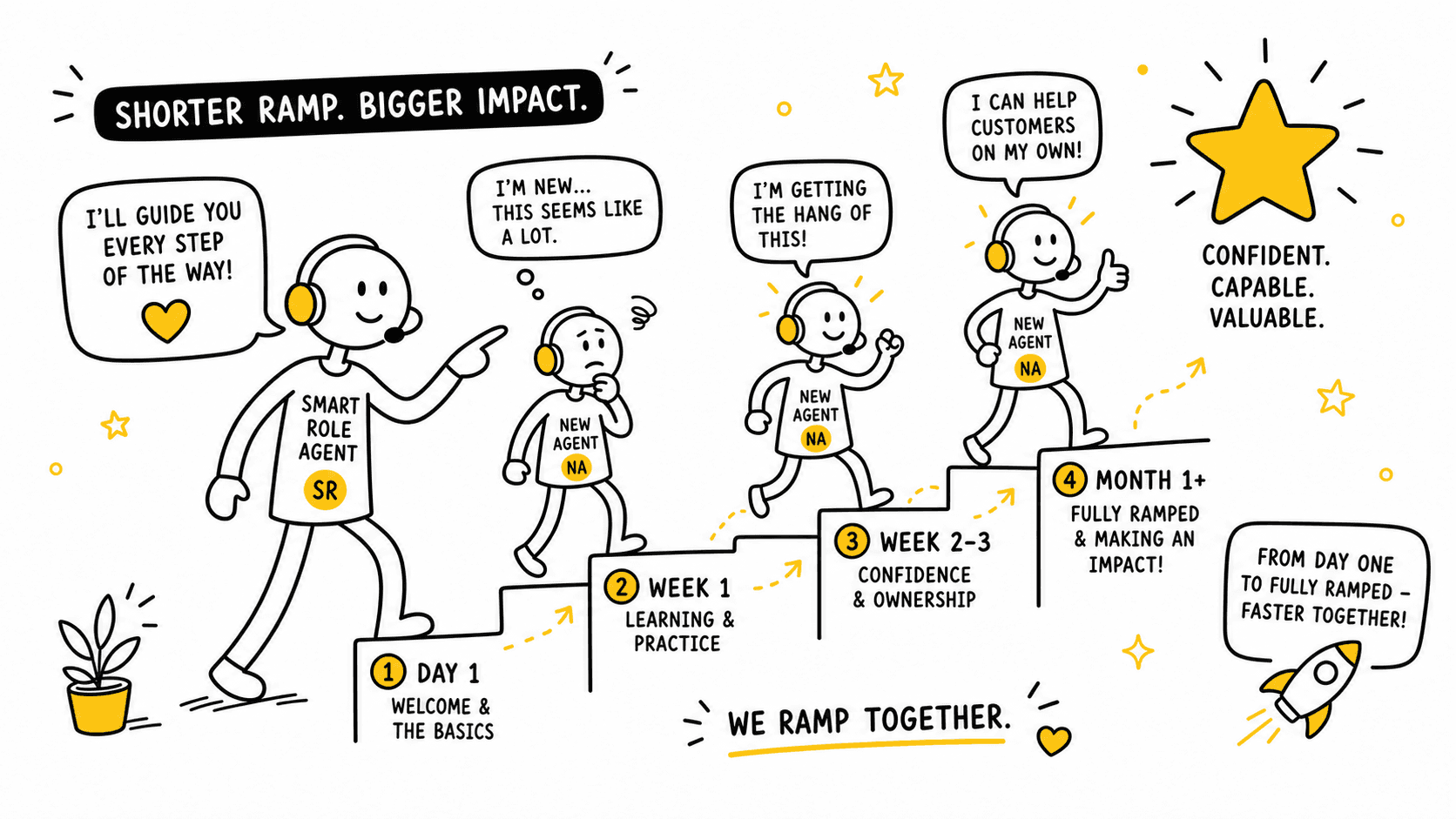
BPO agent onboarding refers to the end-to-end process of preparing newly hired contact centre agents to handle customer interactions independently and consistently.

Many organisations use onboarding and training interchangeably, but they are different:

  • Onboarding: The complete journey from offer acceptance to production readiness.

  • Training: The instructional phase where agents learn products, systems, processes, and soft skills.

  • Nesting: The supervised transition period between training and full production.

Strong onboarding directly influences operational outcomes such as:

  • SLA achievement

  • Customer satisfaction (CSAT)

  • Average handling time (AHT)

  • Quality assurance scores

  • Agent retention

For Caribbean and LATAM BPOs, onboarding quality has become a key differentiator. Clients increasingly expect providers to demonstrate how agents become productive, how readiness is measured, and how quality risks are managed before agents begin handling large volumes of customer interactions.

In many client engagements, onboarding performance becomes one of the earliest indicators of account health. A provider that can consistently launch new programmes, ramp seasonal hiring classes, or support rapid account growth without sacrificing quality often gains a competitive advantage.

Why BPO Agent Onboarding Has Become a Strategic Operations Priority

Client expectations have evolved significantly. Buyers increasingly expect outsourced teams to reach productivity faster while maintaining compliance and customer experience standards.

At the same time, workforce dynamics have become more challenging. Gallup continues to highlight the relationship between employee development, engagement, and performance outcomes.

Source: https://www.gallup.com/workplace

For operations leaders, onboarding affects far more than training costs. Poor onboarding can lead to:

  • Slower revenue generation

  • Missed staffing targets

  • Increased supervisor workload

  • Higher quality failures

  • Increased employee turnover

A strong onboarding experience also helps establish culture, performance expectations, and employee confidence. New hires form early opinions about leadership quality, support availability, and career growth opportunities during their first weeks. If onboarding feels structured and supportive, engagement often improves.

The Hidden Cost of Slow Ramp Times

Ramp time measures how quickly agents achieve expected performance levels. When ramp times extend beyond plan:

  • Productivity remains below forecast.

  • Team leaders spend more time coaching struggling agents.

  • QA teams identify more errors.

  • Workforce management assumptions become inaccurate.

  • Client confidence can decline.

A delayed ramp also creates compounding effects. If a new class underperforms, operations teams may need to hire additional agents simply to maintain service levels.

For BPOs operating in competitive Caribbean and LATAM markets, these inefficiencies can directly affect account profitability.

Why Traditional Classroom Training Is No Longer Enough

Traditional onboarding generally focuses on knowledge transfer. Agents learn products, policies, processes, and systems. However, customer interactions require behavioural execution.

Knowing a process is different from managing an angry customer, handling objections, demonstrating empathy, following compliance requirements under pressure, or navigating multiple systems simultaneously.

Many onboarding programmes provide limited opportunities for realistic practice before agents enter nesting. As a result, the first time agents face complex customer situations is often during live production. This increases risk for both the BPO and the client.

Simulation-based training addresses this gap by creating realistic practice environments where agents can develop confidence and competence before handling actual customers.

Another limitation of classroom-led approaches is variability. Two trainers may deliver the same curriculum differently, emphasise different behaviours, or provide different levels of coaching. Standardised practice environments help reduce these inconsistencies and create a more uniform readiness experience across cohorts.

Related Reading: https://smartrole.ai/blog/call-center-scripts

The Four Stages of an Effective BPO Agent Onboarding Program

High-performing onboarding programmes typically follow four stages.

Stage 1: Preboarding and Hiring Readiness

Preboarding begins before the first day of training. The objective is simple: remove administrative friction and ensure every new hire arrives ready to learn.

Preboarding checklist:

  • Technology access provisioned

  • User accounts configured

  • Equipment tested

  • Compliance documents completed

  • Payroll information submitted

  • Schedules confirmed

  • Attendance expectations communicated

  • Client account overview shared

Common preboarding failures include delayed system access and incomplete documentation. These issues consume valuable training time and create unnecessary frustration.

Many leading BPOs conduct a formal readiness audit 48 to 72 hours before training begins. This review verifies headset functionality, internet connectivity, VPN access, security requirements, and application permissions.

Stage 2: New-Hire Training

New-hire training builds foundational knowledge and skills. Typical components include product training, policy training, CRM navigation, knowledge base usage, soft skills development, compliance requirements, and escalation procedures.

Effective programmes combine instruction with assessment checkpoints. Instead of asking only "Did the agent attend training?", operations leaders should ask: Can the agent demonstrate the required behaviour? Can the agent handle realistic customer scenarios? Can the agent follow compliance requirements consistently?

Many BPOs are shifting from knowledge-based testing to performance-based assessment.

For a deeper breakdown of curriculum design, see: https://smartrole.ai/new-hire-training-call-center/

Training framework: (1) Learn, (2) Observe, (3) Practise, (4) Receive feedback, (5) Reassess, (6) Progress

This structure creates measurable readiness signals before agents enter nesting.

Stage 3: Nesting Period

Nesting is the bridge between training and production. Agents begin handling real customer interactions while receiving enhanced support. Typical nesting activities include live call monitoring, real-time coaching, daily performance reviews, targeted remediation, and readiness scoring against defined criteria.

The goal is to validate that each agent meets minimum readiness standards before being fully integrated into production. An agent graduates from nesting when they consistently meet targets across attendance, schedule adherence, AHT, CSAT, first-contact resolution, and production-readiness criteria.

Related Reading: https://smartrole.ai/product/quality-review

Stage 4: Production Readiness Assessment

Before agents fully transition to production, a formal readiness assessment confirms they meet all performance and compliance standards. This assessment typically covers quality scores, system proficiency, process adherence, and supervisor recommendation.

BPO Agent Onboarding Benchmarks: Ramp Time, Nesting Success, and Early Attrition

Understanding industry benchmarks helps operations leaders assess whether their onboarding programmes are performing competitively.

Source: https://www.smartrole.ai

Ramp Time

Ramp time varies significantly by account complexity, agent background, and training method. Across the industry, ramp times typically range from two to eight weeks depending on product complexity and compliance requirements. Without consistent definitions, ramp-time comparisons across cohorts can become misleading.

Nesting Pass Rate

Nesting pass rate measures the percentage of agents who successfully graduate from nesting into production. It is one of the clearest indicators of onboarding programme quality. Low nesting pass rates signal either poor candidate selection, ineffective training, or insufficient practice before nesting begins.

Early Attrition

Early attrition measures the percentage of agents who leave within their first 90 days. High early attrition is both a financial and operational problem. It signals that agents are either unprepared for the job, dissatisfied with the environment, or both. Exit interviews and stay interviews can provide useful context. Understanding why agents leave, or why successful agents stay, helps organisations refine onboarding content, manager training, and employee support programmes.

Source: https://www.smartrole.ai

How Simulation-Based Training Modernises BPO Agent Onboarding

Simulation technology has evolved significantly. Modern platforms allow BPOs to create realistic customer scenarios, measure agent performance objectively, and provide immediate coaching feedback.

Traditional programmes frequently ask: "Has the agent completed training?" Simulation-based programmes ask: "Can the agent perform successfully?"

Agents can practise billing disputes, technical troubleshooting, complaints, and complex multi-system interactions in a safe environment where mistakes become learning opportunities rather than customer experience failures.

Because scenarios that may occur infrequently during nesting can be built into simulation libraries, onboarding teams can ensure every agent practises critical situations before encountering them in production.

Traditional Onboarding vs Simulation-Based Onboarding

Simulation-based onboarding introduces structured practice before agents reach production. The difference is not simply technology. It is the ability to measure performance before customer exposure.

Area

Traditional Onboarding

Simulation-Based Onboarding

Practice volume

Limited roleplays

High-volume realistic practice

Feedback speed

Trainer-dependent

Immediate coaching and scoring

Readiness measurement

Knowledge tests

Behaviour-based performance data

Supervisor involvement

Heavy manual observation

Focused exception-based coaching

Consistency across cohorts

Trainer-dependent

Standardised scenario delivery

Data visibility

Limited

Real-time readiness dashboards

Scalability and Multilingual Support

For Caribbean and LATAM BPOs, onboarding at scale presents unique challenges, including geographically distributed workforces, high hiring volumes, and seasonal demand fluctuations.

Simulation-based systems help standardise training experiences across locations. Examples include English customer service onboarding, Spanish support programmes, bilingual agent preparation, sales account readiness, and collections training.

Because simulations are repeatable, organisations can maintain consistency across cohorts without requiring proportional increases in trainer resources.

Industry research emphasises the importance of scalable workforce enablement and continuous performance improvement within modern contact centre operations.

How to Evaluate BPO Agent Onboarding Solutions

When comparing onboarding solutions, focus on operational outcomes rather than feature lists alone. Key evaluation criteria include reporting quality, readiness analytics, QA integration, LMS compatibility, multilingual support, simulation realism, scalability, security controls, and compliance capabilities.

Ask vendors: How is readiness measured? Can scores align with QA frameworks? How quickly can new scenarios be created? Can supervisors access coaching insights? Does the platform support multiple languages?

The strongest onboarding platforms connect training, coaching, quality, and performance data into a unified workflow rather than treating them as separate processes.

Implementation Playbook for BPO Operations Leaders

Modernising onboarding does not require replacing every existing process. A practical implementation timeline:

Weeks 1 to 2: Define readiness criteria; align stakeholders.

Weeks 3 to 4: Build simulation scenarios; align QA scorecards.

Weeks 5 to 8: Pilot with one onboarding class; collect feedback.

Weeks 9 to 12: Refine approach; expand rollout.

Change-management considerations: Trainer adoption, supervisor coaching integration, and clear ownership of readiness data are the most common implementation challenges.

Related Reading

FAQ

What is BPO agent onboarding?

BPO agent onboarding is the structured process of preparing newly hired contact centre agents to perform successfully in production. It typically includes preboarding, classroom training, systems instruction, nesting, coaching, and readiness assessments before agents handle customer interactions independently.

How long does BPO agent onboarding typically take?

BPO agent onboarding typically includes several weeks of training followed by a supervised nesting period. The exact duration depends on account complexity, compliance requirements, systems knowledge, and client expectations.

What is the nesting period in a contact centre?

The nesting period is the supervised transition phase between training and independent production work. During nesting, agents handle real customer contacts while receiving enhanced coaching, quality monitoring, and performance support.

How can simulation-based training improve onboarding outcomes?

Simulation-based training improves onboarding outcomes by allowing agents to practise realistic customer interactions before entering production. Organisations can measure readiness earlier, deliver targeted coaching, and reduce performance gaps during nesting.

Which onboarding metrics matter most for BPO leaders?

Ramp time, nesting pass rate, early attrition, quality scores, attendance, and first-live-call performance are the most important onboarding metrics because they directly affect staffing efficiency, customer experience, and profitability.

Ready to Modernise Your BPO Agent Onboarding Programme?

Explore how AI-powered simulations can help your team improve onboarding consistency, measure readiness objectively, and prepare agents for live customer interactions faster.

Try Smart Role free at https://www.smartrole.ai/test-drive

BPO agent onboarding is the structured process of preparing newly hired outsourced contact centre agents to perform successfully in production through training, practice, nesting, coaching, and readiness assessment.

Modern BPO onboarding is no longer just a training function. It is an operational lever that affects service levels, customer satisfaction, staffing forecasts, profitability, and client retention. For Caribbean and LATAM BPO leaders, the challenge is especially acute: clients expect faster ramp-up, multilingual support, consistent quality, and measurable readiness from day one.

The organisations achieving the best outcomes increasingly treat onboarding as a performance system rather than a classroom event. They combine structured training, realistic simulations, QA-aligned coaching, and data-driven progression criteria to reduce risk before agents reach production.

A well-designed onboarding programme also creates alignment across departments. Recruitment, training, operations, quality assurance, workforce management, IT, and client stakeholders all influence whether a new hire succeeds. When these functions operate from a shared readiness framework, performance becomes more predictable and scalable.

TL;DR

  • Effective BPO onboarding includes preboarding, training, nesting, and production readiness assessment.

  • Ramp time, nesting pass rate, early attrition, and first-call quality are the most important onboarding metrics.

  • Traditional classroom training often measures knowledge, not behavioural readiness.

  • Simulation-based training gives agents realistic practice before live customer interactions.

  • BPOs can improve onboarding consistency and scalability by combining AI coaching, simulations, and QA-aligned performance measurement.

What Is BPO Agent Onboarding?

BPO agent onboarding refers to the end-to-end process of preparing newly hired contact centre agents to handle customer interactions independently and consistently.

Many organisations use onboarding and training interchangeably, but they are different:

  • Onboarding: The complete journey from offer acceptance to production readiness.

  • Training: The instructional phase where agents learn products, systems, processes, and soft skills.

  • Nesting: The supervised transition period between training and full production.

Strong onboarding directly influences operational outcomes such as:

  • SLA achievement

  • Customer satisfaction (CSAT)

  • Average handling time (AHT)

  • Quality assurance scores

  • Agent retention

For Caribbean and LATAM BPOs, onboarding quality has become a key differentiator. Clients increasingly expect providers to demonstrate how agents become productive, how readiness is measured, and how quality risks are managed before agents begin handling large volumes of customer interactions.

In many client engagements, onboarding performance becomes one of the earliest indicators of account health. A provider that can consistently launch new programmes, ramp seasonal hiring classes, or support rapid account growth without sacrificing quality often gains a competitive advantage.

Why BPO Agent Onboarding Has Become a Strategic Operations Priority

Client expectations have evolved significantly. Buyers increasingly expect outsourced teams to reach productivity faster while maintaining compliance and customer experience standards.

At the same time, workforce dynamics have become more challenging. Gallup continues to highlight the relationship between employee development, engagement, and performance outcomes.

Source: https://www.gallup.com/workplace

For operations leaders, onboarding affects far more than training costs. Poor onboarding can lead to:

  • Slower revenue generation

  • Missed staffing targets

  • Increased supervisor workload

  • Higher quality failures

  • Increased employee turnover

A strong onboarding experience also helps establish culture, performance expectations, and employee confidence. New hires form early opinions about leadership quality, support availability, and career growth opportunities during their first weeks. If onboarding feels structured and supportive, engagement often improves.

The Hidden Cost of Slow Ramp Times

Ramp time measures how quickly agents achieve expected performance levels. When ramp times extend beyond plan:

  • Productivity remains below forecast.

  • Team leaders spend more time coaching struggling agents.

  • QA teams identify more errors.

  • Workforce management assumptions become inaccurate.

  • Client confidence can decline.

A delayed ramp also creates compounding effects. If a new class underperforms, operations teams may need to hire additional agents simply to maintain service levels.

For BPOs operating in competitive Caribbean and LATAM markets, these inefficiencies can directly affect account profitability.

Why Traditional Classroom Training Is No Longer Enough

Traditional onboarding generally focuses on knowledge transfer. Agents learn products, policies, processes, and systems. However, customer interactions require behavioural execution.

Knowing a process is different from managing an angry customer, handling objections, demonstrating empathy, following compliance requirements under pressure, or navigating multiple systems simultaneously.

Many onboarding programmes provide limited opportunities for realistic practice before agents enter nesting. As a result, the first time agents face complex customer situations is often during live production. This increases risk for both the BPO and the client.

Simulation-based training addresses this gap by creating realistic practice environments where agents can develop confidence and competence before handling actual customers.

Another limitation of classroom-led approaches is variability. Two trainers may deliver the same curriculum differently, emphasise different behaviours, or provide different levels of coaching. Standardised practice environments help reduce these inconsistencies and create a more uniform readiness experience across cohorts.

Related Reading: https://smartrole.ai/blog/call-center-scripts

The Four Stages of an Effective BPO Agent Onboarding Program

High-performing onboarding programmes typically follow four stages.

Stage 1: Preboarding and Hiring Readiness

Preboarding begins before the first day of training. The objective is simple: remove administrative friction and ensure every new hire arrives ready to learn.

Preboarding checklist:

  • Technology access provisioned

  • User accounts configured

  • Equipment tested

  • Compliance documents completed

  • Payroll information submitted

  • Schedules confirmed

  • Attendance expectations communicated

  • Client account overview shared

Common preboarding failures include delayed system access and incomplete documentation. These issues consume valuable training time and create unnecessary frustration.

Many leading BPOs conduct a formal readiness audit 48 to 72 hours before training begins. This review verifies headset functionality, internet connectivity, VPN access, security requirements, and application permissions.

Stage 2: New-Hire Training

New-hire training builds foundational knowledge and skills. Typical components include product training, policy training, CRM navigation, knowledge base usage, soft skills development, compliance requirements, and escalation procedures.

Effective programmes combine instruction with assessment checkpoints. Instead of asking only "Did the agent attend training?", operations leaders should ask: Can the agent demonstrate the required behaviour? Can the agent handle realistic customer scenarios? Can the agent follow compliance requirements consistently?

Many BPOs are shifting from knowledge-based testing to performance-based assessment.

For a deeper breakdown of curriculum design, see: https://smartrole.ai/new-hire-training-call-center/

Training framework: (1) Learn, (2) Observe, (3) Practise, (4) Receive feedback, (5) Reassess, (6) Progress

This structure creates measurable readiness signals before agents enter nesting.

Stage 3: Nesting Period

Nesting is the bridge between training and production. Agents begin handling real customer interactions while receiving enhanced support. Typical nesting activities include live call monitoring, real-time coaching, daily performance reviews, targeted remediation, and readiness scoring against defined criteria.

The goal is to validate that each agent meets minimum readiness standards before being fully integrated into production. An agent graduates from nesting when they consistently meet targets across attendance, schedule adherence, AHT, CSAT, first-contact resolution, and production-readiness criteria.

Related Reading: https://smartrole.ai/product/quality-review

Stage 4: Production Readiness Assessment

Before agents fully transition to production, a formal readiness assessment confirms they meet all performance and compliance standards. This assessment typically covers quality scores, system proficiency, process adherence, and supervisor recommendation.

BPO Agent Onboarding Benchmarks: Ramp Time, Nesting Success, and Early Attrition

Understanding industry benchmarks helps operations leaders assess whether their onboarding programmes are performing competitively.

Source: https://www.smartrole.ai

Ramp Time

Ramp time varies significantly by account complexity, agent background, and training method. Across the industry, ramp times typically range from two to eight weeks depending on product complexity and compliance requirements. Without consistent definitions, ramp-time comparisons across cohorts can become misleading.

Nesting Pass Rate

Nesting pass rate measures the percentage of agents who successfully graduate from nesting into production. It is one of the clearest indicators of onboarding programme quality. Low nesting pass rates signal either poor candidate selection, ineffective training, or insufficient practice before nesting begins.

Early Attrition

Early attrition measures the percentage of agents who leave within their first 90 days. High early attrition is both a financial and operational problem. It signals that agents are either unprepared for the job, dissatisfied with the environment, or both. Exit interviews and stay interviews can provide useful context. Understanding why agents leave, or why successful agents stay, helps organisations refine onboarding content, manager training, and employee support programmes.

Source: https://www.smartrole.ai

How Simulation-Based Training Modernises BPO Agent Onboarding

Simulation technology has evolved significantly. Modern platforms allow BPOs to create realistic customer scenarios, measure agent performance objectively, and provide immediate coaching feedback.

Traditional programmes frequently ask: "Has the agent completed training?" Simulation-based programmes ask: "Can the agent perform successfully?"

Agents can practise billing disputes, technical troubleshooting, complaints, and complex multi-system interactions in a safe environment where mistakes become learning opportunities rather than customer experience failures.

Because scenarios that may occur infrequently during nesting can be built into simulation libraries, onboarding teams can ensure every agent practises critical situations before encountering them in production.

Traditional Onboarding vs Simulation-Based Onboarding

Simulation-based onboarding introduces structured practice before agents reach production. The difference is not simply technology. It is the ability to measure performance before customer exposure.

Area

Traditional Onboarding

Simulation-Based Onboarding

Practice volume

Limited roleplays

High-volume realistic practice

Feedback speed

Trainer-dependent

Immediate coaching and scoring

Readiness measurement

Knowledge tests

Behaviour-based performance data

Supervisor involvement

Heavy manual observation

Focused exception-based coaching

Consistency across cohorts

Trainer-dependent

Standardised scenario delivery

Data visibility

Limited

Real-time readiness dashboards

Scalability and Multilingual Support

For Caribbean and LATAM BPOs, onboarding at scale presents unique challenges, including geographically distributed workforces, high hiring volumes, and seasonal demand fluctuations.

Simulation-based systems help standardise training experiences across locations. Examples include English customer service onboarding, Spanish support programmes, bilingual agent preparation, sales account readiness, and collections training.

Because simulations are repeatable, organisations can maintain consistency across cohorts without requiring proportional increases in trainer resources.

Industry research emphasises the importance of scalable workforce enablement and continuous performance improvement within modern contact centre operations.

How to Evaluate BPO Agent Onboarding Solutions

When comparing onboarding solutions, focus on operational outcomes rather than feature lists alone. Key evaluation criteria include reporting quality, readiness analytics, QA integration, LMS compatibility, multilingual support, simulation realism, scalability, security controls, and compliance capabilities.

Ask vendors: How is readiness measured? Can scores align with QA frameworks? How quickly can new scenarios be created? Can supervisors access coaching insights? Does the platform support multiple languages?

The strongest onboarding platforms connect training, coaching, quality, and performance data into a unified workflow rather than treating them as separate processes.

Implementation Playbook for BPO Operations Leaders

Modernising onboarding does not require replacing every existing process. A practical implementation timeline:

Weeks 1 to 2: Define readiness criteria; align stakeholders.

Weeks 3 to 4: Build simulation scenarios; align QA scorecards.

Weeks 5 to 8: Pilot with one onboarding class; collect feedback.

Weeks 9 to 12: Refine approach; expand rollout.

Change-management considerations: Trainer adoption, supervisor coaching integration, and clear ownership of readiness data are the most common implementation challenges.

Related Reading

FAQ

What is BPO agent onboarding?

BPO agent onboarding is the structured process of preparing newly hired contact centre agents to perform successfully in production. It typically includes preboarding, classroom training, systems instruction, nesting, coaching, and readiness assessments before agents handle customer interactions independently.

How long does BPO agent onboarding typically take?

BPO agent onboarding typically includes several weeks of training followed by a supervised nesting period. The exact duration depends on account complexity, compliance requirements, systems knowledge, and client expectations.

What is the nesting period in a contact centre?

The nesting period is the supervised transition phase between training and independent production work. During nesting, agents handle real customer contacts while receiving enhanced coaching, quality monitoring, and performance support.

How can simulation-based training improve onboarding outcomes?

Simulation-based training improves onboarding outcomes by allowing agents to practise realistic customer interactions before entering production. Organisations can measure readiness earlier, deliver targeted coaching, and reduce performance gaps during nesting.

Which onboarding metrics matter most for BPO leaders?

Ramp time, nesting pass rate, early attrition, quality scores, attendance, and first-live-call performance are the most important onboarding metrics because they directly affect staffing efficiency, customer experience, and profitability.

Ready to Modernise Your BPO Agent Onboarding Programme?

Explore how AI-powered simulations can help your team improve onboarding consistency, measure readiness objectively, and prepare agents for live customer interactions faster.

Try Smart Role free at https://www.smartrole.ai/test-drive

Rejoignez la newsletter Smart Role

Le succès en service client repose à 10 % sur les connaissances et à 90 % sur la manière dont vous les appliquez dans des situations réelles.

Rejoignez la newsletter Smart Role

Le succès en service client repose à 10 % sur les connaissances et à 90 % sur la manière dont vous les appliquez dans des situations réelles.

Rejoignez la newsletter Smart Role

Le succès en service client repose à 10 % sur les connaissances et à 90 % sur la manière dont vous les appliquez dans des situations réelles.

Smart Role est une plateforme qui transforme le recrutement, l'intégration et la formation en service client. Notre technologie aide les entreprises à rationaliser le processus et à réduire les coûts.

Demandez à l'IA un résumé de Smart Role
French

Smart Role est une plateforme qui transforme le recrutement, l'intégration et la formation en service client. Notre technologie aide les entreprises à rationaliser le processus et à réduire les coûts.

Demandez à l'IA un résumé de Smart Role
French

Smart Role est une plateforme qui transforme le recrutement, l'intégration et la formation en service client. Notre technologie aide les entreprises à rationaliser le processus et à réduire les coûts.

Demandez à l'IA un résumé de Smart Role
French