
Training
Training
Training
12 Customer Service Role Play Scenarios for Chat Support Teams
/ / / / / / / /
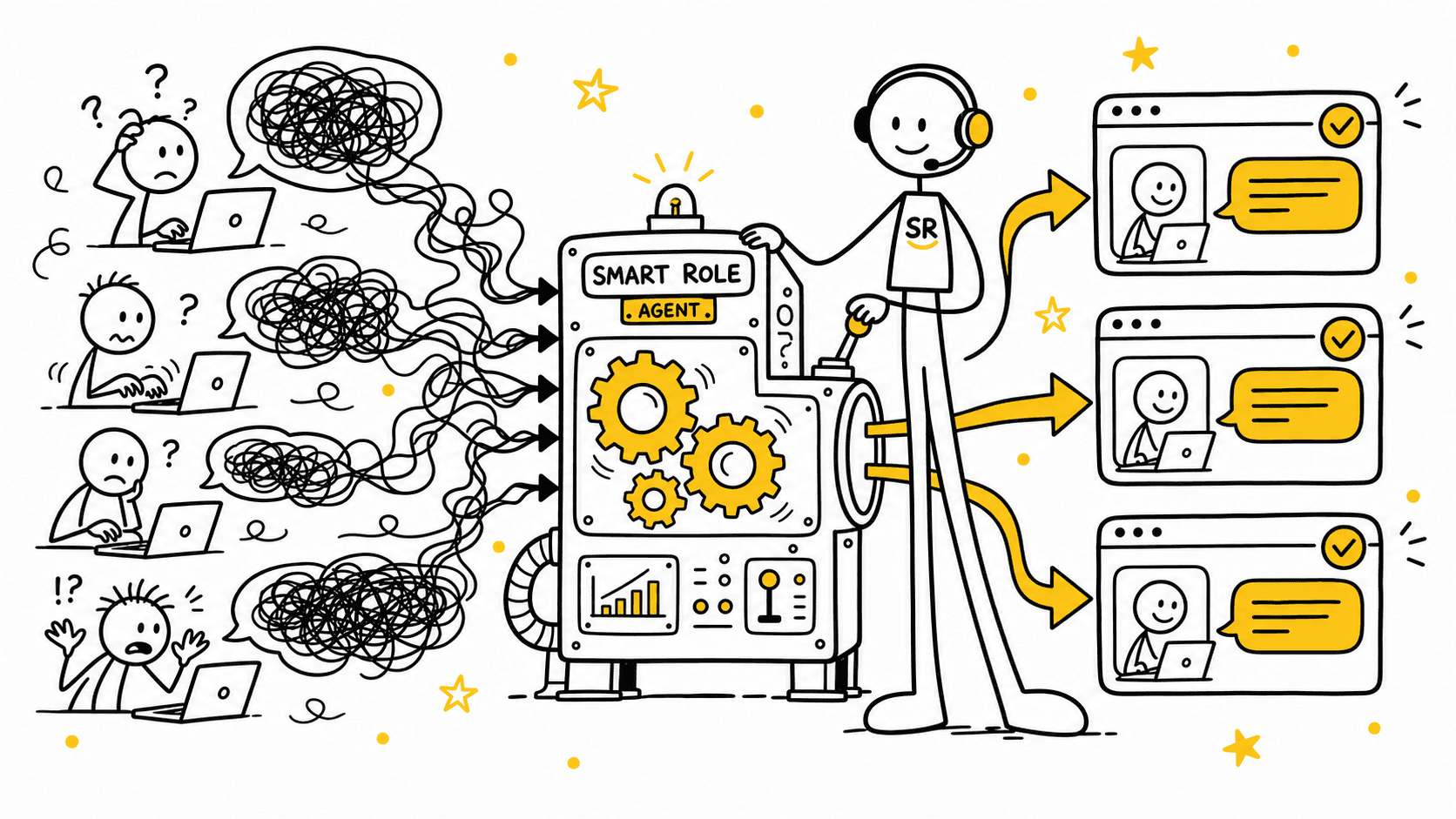
Customer service role play scenarios for chat are simulated text-based support conversations used to train agents in handling customer enquiries, complaints, escalations, and sales interactions in live chat environments.
12 Customer Service Role Play Scenarios for Chat Support Teams
Chat support has become a primary service channel for ecommerce, SaaS, fintech, telecoms, and BPO operations. Customers expect fast responses, accurate answers, and a professional tone, often within seconds. According to Zendesk's Customer Experience Trends Report, customers increasingly expect conversational support that feels immediate and personalised (Source: Zendesk, 2025).
Unlike phone support, chat agents manage multiple conversations at once while relying entirely on written communication. That changes how teams should train. Static scripts still help with onboarding, but many support leaders now use AI-generated simulations to create more realistic practice environments with dynamic customer behaviour and instant coaching feedback.
Related: Call Center Scripts Guide
TL;DR
Chat support training requires specialised role play scenarios built for written communication.
Agents must practice empathy, multitasking, de-escalation, and knowledge-base navigation.
Static scripts help with consistency, but AI simulations create more realistic practice.
Chat role plays work best when teams measure response quality, policy accuracy, and resolution outcomes.
AI-powered coaching enables scalable practice across onboarding, QA, and ongoing development.
Why Chat Support Requires Specialised Role Play Training
Chat support differs from voice support in both pace and structure. Customers expect shorter wait times and concise responses. Intercom benchmarking research shows customers often expect a first response within minutes for live chat interactions (Source: Intercom, 2025).
Agents also lose vocal cues that normally help communicate empathy or urgency. A sentence that sounds neutral over the phone can appear cold or dismissive in text. As a result, written clarity becomes a core customer service skill.
Key skills that chat teams must practice include:
Typing speed and accuracy
Written empathy
Managing concurrent conversations
Fast knowledge-base navigation
Handling escalations without vocal tone
Summarising complex information clearly
Switching between workflows quickly
Salesforce research found that customers value consistency and connected interactions across digital channels (Source: Salesforce, 2025). Training should therefore reflect realistic digital behaviours, including incomplete information, frustrated customers, and multitasking pressure.
Traditional workshops often rely on static scripts that agents memorise. Modern AI-powered simulations create adaptive conversations that react to agent responses in real time. This better reflects the unpredictability of real chat queues.
For enterprise support environments, training should also mirror operational complexity. Agents may need to switch between CRM tools, order management systems, authentication workflows, and internal escalation channels while maintaining a smooth customer conversation. Role play scenarios become significantly more effective when they include these workflow interruptions instead of focusing only on ideal conversations.
Common Challenges in Chat-Based Customer Service
Common chat support problems appear simple but create operational strain quickly.
Examples include:
Customers becoming frustrated during slow response times
Tone being misinterpreted in short written replies
Agents overusing copy-paste templates
Escalations becoming harder without verbal reassurance
Simultaneous chats increasing cognitive load
Long troubleshooting flows causing customer drop-off
These issues affect both customer satisfaction and agent confidence. McKinsey notes that digital-first customer care increasingly depends on operational efficiency and personalised interactions at scale (Source: McKinsey, 2024).
Traditional Scripts vs AI Chat Simulations
Static scripts remain useful for onboarding and policy training, but they have limits. They rarely reflect how customers actually behave in live chat.
AI-powered simulations add variability, realistic pacing, and personalised coaching. Instead of following a fixed script, agents practice responding to changing customer emotions, incomplete information, and unexpected objections.
Training Element | Static Role Play Scripts | AI-Powered Chat Simulations |
|---|---|---|
Realism | Fixed conversation flow | Dynamic customer behaviour |
Personalisation | Same scenario for all agents | Difficulty adapts to skill level |
Feedback speed | Manual review required | Instant scoring and coaching |
Scalability | Limited by trainer availability | Unlimited practice sessions |
Multilingual support | Separate manual scripts needed | Real-time language adaptation |
Performance analytics | Basic observation notes | Detailed transcript analytics |
Escalation practice | Predictable outcomes | Variable customer reactions |
Knowledge testing | Limited branching | Scenario-based decision testing |
AI simulations also help QA and coaching teams identify repeat issues faster. Platforms such as Smart Role use simulation data to highlight policy gaps, tone inconsistencies, and escalation risks across teams.
What Good Chat Training Should Include
Realistic customer language
Time-pressure simulations
Multiple conversation paths
Escalation handling
Coaching feedback
Quality scoring rubrics
Transcript reviews
Repeatable practice sessions
Many BPOs also build tiered simulations for different experience levels. New hires may begin with basic account enquiries, while senior agents handle high-risk billing complaints, VIP customer escalations, or compliance-sensitive conversations. This progression helps maintain training relevance across large support organisations.
Related: Quality Review Workflows
12 Customer Service Role Play Scenarios for Chat Teams
These scenarios can be used in onboarding, QA calibration, team coaching, or AI-driven simulation platforms.
1. Delayed Order Complaint
Situation: A customer is angry because a package has not arrived on time.
Customer objective: Get an immediate update or compensation.
Agent challenge: Calm frustration while checking logistics information.
Key skill practiced: Written empathy and expectation setting.
Example opening message: "My order was supposed to arrive yesterday. Where is it?"
2. Refund Policy Dispute
Situation: A customer demands a refund outside the stated policy window.
Customer objective: Receive an exception.
Agent challenge: Maintain policy compliance without sounding robotic.
Key skill practiced: Policy explanation and de-escalation.
Example opening message: "I only used the product once. Why can't I get a refund?"
3. Technical Troubleshooting Chat
Situation: A user cannot access a feature in a SaaS platform.
Customer objective: Fix the issue quickly.
Agent challenge: Guide troubleshooting through text only.
Key skill practiced: Step-by-step communication.
Example opening message: "The app keeps crashing every time I upload a file."
4. Subscription Cancellation Request
Situation: A customer wants to cancel a recurring plan.
Customer objective: Stop billing immediately.
Agent challenge: Explore retention opportunities without pressure.
Key skill practiced: Active listening and concise retention messaging.
Example opening message: "I want to cancel before I'm charged again."
5. Billing Error Escalation
Situation: A customer sees duplicate charges on an invoice.
Customer objective: Get reassurance and resolution.
Agent challenge: Handle financial anxiety professionally.
Key skill practiced: Escalation handling and ownership language.
Example opening message: "You charged me twice this month. Fix this now."
6. Angry Customer Demanding a Supervisor
Situation: A customer refuses to continue with a frontline agent and demands to speak to a manager.
Customer objective: Escalate to someone with more authority.
Agent challenge: De-escalate before escalating, and handle the handoff professionally.
Key skill practiced: Escalation management and professional composure.
Example opening message: "I don't want to talk to you anymore. Get me your manager right now."
7. Product Mismatch / Wrong Item Received
Situation: A customer received a different product from the one ordered.
Customer objective: Get the correct item sent or a full refund.
Agent challenge: Apologise authentically, verify the issue, and initiate the resolution process.
Key skill practiced: Ownership language and resolution-first communication.
Example opening message: "I ordered a blue medium and you sent me a red large. This is unacceptable."
8. Account Access / Password Reset Issue
Situation: A customer cannot log into their account and has tried resetting their password multiple times.
Customer objective: Regain access immediately.
Agent challenge: Follow authentication protocols while minimising customer frustration.
Key skill practiced: Security-conscious communication and step-by-step guidance.
Example opening message: "I've reset my password three times and still can't get in. I have a meeting in ten minutes."
9. Long Wait Time Complaint
Situation: A customer opens a chat angry about how long they have been waiting in a queue.
Customer objective: Get help immediately and feel acknowledged.
Agent challenge: Open the conversation with empathy despite a backlogged queue.
Key skill practiced: First-message tone and customer acknowledgement.
Example opening message: "I've been waiting 25 minutes. This is terrible service."
10. Upsell Opportunity During Support Interaction
Situation: A customer contacts support about a basic feature limitation and is unaware of a premium tier that solves their problem.
Customer objective: Solve the limitation they've encountered.
Agent challenge: Introduce the upsell naturally without appearing pushy during a support context.
Key skill practiced: Consultative selling within a service interaction.
Example opening message: "The export limit is too low for what I need. Is there any way around it?"
11. Service Outage Notification
Situation: A customer contacts support during a known service outage and is demanding answers.
Customer objective: Find out when the service will be restored and whether they are entitled to compensation.
Agent challenge: Communicate transparently about an ongoing issue without overpromising resolution times.
Key skill practiced: Proactive communication and expectation management under pressure.
Example opening message: "Your platform has been down for two hours. My whole team is affected. What's going on?"
12. VIP Customer Expressing Dissatisfaction
Situation: A high-value customer is threatening to leave after a series of service issues.
Customer objective: Feel valued and receive a concrete resolution plan.
Agent challenge: Balance empathy, retention priority, and accurate promises in a high-stakes written conversation.
Key skill practiced: High-stakes empathy, retention language, and escalation judgement.
Example opening message: "I've been a customer for four years and this is the third issue this quarter. I'm seriously considering leaving."
FAQ: Customer Service Role Play Scenarios for Chat
How many chat role play scenarios does a team need for training?
Most support teams benefit from a minimum of 10 to 15 core scenarios covering their most common contact reasons. This should include complaint handling, technical troubleshooting, billing disputes, cancellation requests, and escalation situations. Larger teams often build scenario libraries of 30 or more, segmented by product line, customer tier, or channel type.
How often should chat role play scenarios be updated?
Scenarios should be reviewed quarterly and updated whenever there are changes to product features, pricing, refund policies, or service processes. Using outdated scripts creates a gap between training and live performance.
Can AI simulations replace human role play coaches?
AI simulations are highly effective for repetitive practice, instant feedback, and scaling training across large teams. Human coaches remain valuable for nuanced feedback, tone calibration, and high-stakes scenario debrief sessions. Most high-performing teams use both.
What metrics should be tracked in chat role play training?
Key training metrics include: first response time, resolution rate, escalation rate, tone and empathy score, policy accuracy, and CSAT from simulation sessions. AI platforms can automate most of these measurements.
Are these scenarios suitable for BPO environments?
Yes. These scenarios are designed to reflect realistic chat support environments across ecommerce, SaaS, fintech, and telecoms. They can be adapted for any industry by adjusting the product context, policy details, and customer profile.
How to Run Effective Chat Role Play Sessions
Effective chat role play requires more than handing agents a script. Teams see better outcomes when training is structured, coached, and measured.
Recommended session structure:
Brief: Review the scenario context, the customer profile, and the desired resolution outcome.
Simulate: Agent handles the chat interaction, either with a trainer or AI simulation tool.
Review: Transcript is reviewed against a quality rubric covering tone, policy accuracy, and resolution approach.
Coach: Specific feedback is given on language choices, empathy signals, and response timing.
Repeat: Agent retries the scenario incorporating the coaching feedback.
Teams using AI simulation platforms can compress this cycle significantly, running multiple sessions in the time a traditional role play takes to complete once.
Practice These Scenarios with AI-Powered Simulations
Smart Role lets support teams run these exact scenarios inside an AI simulation environment. Agents practice in realistic chat conversations, receive instant feedback, and managers track performance across the full team.
Book a demo to see how Smart Role works for chat support training
Chat support training only works when it reflects the real challenges agents face: frustrated customers, policy edge cases, technical breakdowns, and high-stakes escalations. These 12 role play scenarios give teams a practical foundation to build from.
Whether you use them in manual workshops, peer role plays, or AI-powered simulations, the goal is the same: agents who can handle any chat conversation with clarity, empathy, and confidence.
For teams managing scale, AI simulation platforms like Smart Role remove the ceiling on how often agents can practice, while providing the data needed to improve training quality over time.
Customer service role play scenarios for chat are simulated text-based support conversations used to train agents in handling customer enquiries, complaints, escalations, and sales interactions in live chat environments.
12 Customer Service Role Play Scenarios for Chat Support Teams
Chat support has become a primary service channel for ecommerce, SaaS, fintech, telecoms, and BPO operations. Customers expect fast responses, accurate answers, and a professional tone, often within seconds. According to Zendesk's Customer Experience Trends Report, customers increasingly expect conversational support that feels immediate and personalised (Source: Zendesk, 2025).
Unlike phone support, chat agents manage multiple conversations at once while relying entirely on written communication. That changes how teams should train. Static scripts still help with onboarding, but many support leaders now use AI-generated simulations to create more realistic practice environments with dynamic customer behaviour and instant coaching feedback.
Related: Call Center Scripts Guide
TL;DR
Chat support training requires specialised role play scenarios built for written communication.
Agents must practice empathy, multitasking, de-escalation, and knowledge-base navigation.
Static scripts help with consistency, but AI simulations create more realistic practice.
Chat role plays work best when teams measure response quality, policy accuracy, and resolution outcomes.
AI-powered coaching enables scalable practice across onboarding, QA, and ongoing development.
Why Chat Support Requires Specialised Role Play Training
Chat support differs from voice support in both pace and structure. Customers expect shorter wait times and concise responses. Intercom benchmarking research shows customers often expect a first response within minutes for live chat interactions (Source: Intercom, 2025).
Agents also lose vocal cues that normally help communicate empathy or urgency. A sentence that sounds neutral over the phone can appear cold or dismissive in text. As a result, written clarity becomes a core customer service skill.
Key skills that chat teams must practice include:
Typing speed and accuracy
Written empathy
Managing concurrent conversations
Fast knowledge-base navigation
Handling escalations without vocal tone
Summarising complex information clearly
Switching between workflows quickly
Salesforce research found that customers value consistency and connected interactions across digital channels (Source: Salesforce, 2025). Training should therefore reflect realistic digital behaviours, including incomplete information, frustrated customers, and multitasking pressure.
Traditional workshops often rely on static scripts that agents memorise. Modern AI-powered simulations create adaptive conversations that react to agent responses in real time. This better reflects the unpredictability of real chat queues.
For enterprise support environments, training should also mirror operational complexity. Agents may need to switch between CRM tools, order management systems, authentication workflows, and internal escalation channels while maintaining a smooth customer conversation. Role play scenarios become significantly more effective when they include these workflow interruptions instead of focusing only on ideal conversations.
Common Challenges in Chat-Based Customer Service
Common chat support problems appear simple but create operational strain quickly.
Examples include:
Customers becoming frustrated during slow response times
Tone being misinterpreted in short written replies
Agents overusing copy-paste templates
Escalations becoming harder without verbal reassurance
Simultaneous chats increasing cognitive load
Long troubleshooting flows causing customer drop-off
These issues affect both customer satisfaction and agent confidence. McKinsey notes that digital-first customer care increasingly depends on operational efficiency and personalised interactions at scale (Source: McKinsey, 2024).
Traditional Scripts vs AI Chat Simulations
Static scripts remain useful for onboarding and policy training, but they have limits. They rarely reflect how customers actually behave in live chat.
AI-powered simulations add variability, realistic pacing, and personalised coaching. Instead of following a fixed script, agents practice responding to changing customer emotions, incomplete information, and unexpected objections.
Training Element | Static Role Play Scripts | AI-Powered Chat Simulations |
|---|---|---|
Realism | Fixed conversation flow | Dynamic customer behaviour |
Personalisation | Same scenario for all agents | Difficulty adapts to skill level |
Feedback speed | Manual review required | Instant scoring and coaching |
Scalability | Limited by trainer availability | Unlimited practice sessions |
Multilingual support | Separate manual scripts needed | Real-time language adaptation |
Performance analytics | Basic observation notes | Detailed transcript analytics |
Escalation practice | Predictable outcomes | Variable customer reactions |
Knowledge testing | Limited branching | Scenario-based decision testing |
AI simulations also help QA and coaching teams identify repeat issues faster. Platforms such as Smart Role use simulation data to highlight policy gaps, tone inconsistencies, and escalation risks across teams.
What Good Chat Training Should Include
Realistic customer language
Time-pressure simulations
Multiple conversation paths
Escalation handling
Coaching feedback
Quality scoring rubrics
Transcript reviews
Repeatable practice sessions
Many BPOs also build tiered simulations for different experience levels. New hires may begin with basic account enquiries, while senior agents handle high-risk billing complaints, VIP customer escalations, or compliance-sensitive conversations. This progression helps maintain training relevance across large support organisations.
Related: Quality Review Workflows
12 Customer Service Role Play Scenarios for Chat Teams
These scenarios can be used in onboarding, QA calibration, team coaching, or AI-driven simulation platforms.
1. Delayed Order Complaint
Situation: A customer is angry because a package has not arrived on time.
Customer objective: Get an immediate update or compensation.
Agent challenge: Calm frustration while checking logistics information.
Key skill practiced: Written empathy and expectation setting.
Example opening message: "My order was supposed to arrive yesterday. Where is it?"
2. Refund Policy Dispute
Situation: A customer demands a refund outside the stated policy window.
Customer objective: Receive an exception.
Agent challenge: Maintain policy compliance without sounding robotic.
Key skill practiced: Policy explanation and de-escalation.
Example opening message: "I only used the product once. Why can't I get a refund?"
3. Technical Troubleshooting Chat
Situation: A user cannot access a feature in a SaaS platform.
Customer objective: Fix the issue quickly.
Agent challenge: Guide troubleshooting through text only.
Key skill practiced: Step-by-step communication.
Example opening message: "The app keeps crashing every time I upload a file."
4. Subscription Cancellation Request
Situation: A customer wants to cancel a recurring plan.
Customer objective: Stop billing immediately.
Agent challenge: Explore retention opportunities without pressure.
Key skill practiced: Active listening and concise retention messaging.
Example opening message: "I want to cancel before I'm charged again."
5. Billing Error Escalation
Situation: A customer sees duplicate charges on an invoice.
Customer objective: Get reassurance and resolution.
Agent challenge: Handle financial anxiety professionally.
Key skill practiced: Escalation handling and ownership language.
Example opening message: "You charged me twice this month. Fix this now."
6. Angry Customer Demanding a Supervisor
Situation: A customer refuses to continue with a frontline agent and demands to speak to a manager.
Customer objective: Escalate to someone with more authority.
Agent challenge: De-escalate before escalating, and handle the handoff professionally.
Key skill practiced: Escalation management and professional composure.
Example opening message: "I don't want to talk to you anymore. Get me your manager right now."
7. Product Mismatch / Wrong Item Received
Situation: A customer received a different product from the one ordered.
Customer objective: Get the correct item sent or a full refund.
Agent challenge: Apologise authentically, verify the issue, and initiate the resolution process.
Key skill practiced: Ownership language and resolution-first communication.
Example opening message: "I ordered a blue medium and you sent me a red large. This is unacceptable."
8. Account Access / Password Reset Issue
Situation: A customer cannot log into their account and has tried resetting their password multiple times.
Customer objective: Regain access immediately.
Agent challenge: Follow authentication protocols while minimising customer frustration.
Key skill practiced: Security-conscious communication and step-by-step guidance.
Example opening message: "I've reset my password three times and still can't get in. I have a meeting in ten minutes."
9. Long Wait Time Complaint
Situation: A customer opens a chat angry about how long they have been waiting in a queue.
Customer objective: Get help immediately and feel acknowledged.
Agent challenge: Open the conversation with empathy despite a backlogged queue.
Key skill practiced: First-message tone and customer acknowledgement.
Example opening message: "I've been waiting 25 minutes. This is terrible service."
10. Upsell Opportunity During Support Interaction
Situation: A customer contacts support about a basic feature limitation and is unaware of a premium tier that solves their problem.
Customer objective: Solve the limitation they've encountered.
Agent challenge: Introduce the upsell naturally without appearing pushy during a support context.
Key skill practiced: Consultative selling within a service interaction.
Example opening message: "The export limit is too low for what I need. Is there any way around it?"
11. Service Outage Notification
Situation: A customer contacts support during a known service outage and is demanding answers.
Customer objective: Find out when the service will be restored and whether they are entitled to compensation.
Agent challenge: Communicate transparently about an ongoing issue without overpromising resolution times.
Key skill practiced: Proactive communication and expectation management under pressure.
Example opening message: "Your platform has been down for two hours. My whole team is affected. What's going on?"
12. VIP Customer Expressing Dissatisfaction
Situation: A high-value customer is threatening to leave after a series of service issues.
Customer objective: Feel valued and receive a concrete resolution plan.
Agent challenge: Balance empathy, retention priority, and accurate promises in a high-stakes written conversation.
Key skill practiced: High-stakes empathy, retention language, and escalation judgement.
Example opening message: "I've been a customer for four years and this is the third issue this quarter. I'm seriously considering leaving."
FAQ: Customer Service Role Play Scenarios for Chat
How many chat role play scenarios does a team need for training?
Most support teams benefit from a minimum of 10 to 15 core scenarios covering their most common contact reasons. This should include complaint handling, technical troubleshooting, billing disputes, cancellation requests, and escalation situations. Larger teams often build scenario libraries of 30 or more, segmented by product line, customer tier, or channel type.
How often should chat role play scenarios be updated?
Scenarios should be reviewed quarterly and updated whenever there are changes to product features, pricing, refund policies, or service processes. Using outdated scripts creates a gap between training and live performance.
Can AI simulations replace human role play coaches?
AI simulations are highly effective for repetitive practice, instant feedback, and scaling training across large teams. Human coaches remain valuable for nuanced feedback, tone calibration, and high-stakes scenario debrief sessions. Most high-performing teams use both.
What metrics should be tracked in chat role play training?
Key training metrics include: first response time, resolution rate, escalation rate, tone and empathy score, policy accuracy, and CSAT from simulation sessions. AI platforms can automate most of these measurements.
Are these scenarios suitable for BPO environments?
Yes. These scenarios are designed to reflect realistic chat support environments across ecommerce, SaaS, fintech, and telecoms. They can be adapted for any industry by adjusting the product context, policy details, and customer profile.
How to Run Effective Chat Role Play Sessions
Effective chat role play requires more than handing agents a script. Teams see better outcomes when training is structured, coached, and measured.
Recommended session structure:
Brief: Review the scenario context, the customer profile, and the desired resolution outcome.
Simulate: Agent handles the chat interaction, either with a trainer or AI simulation tool.
Review: Transcript is reviewed against a quality rubric covering tone, policy accuracy, and resolution approach.
Coach: Specific feedback is given on language choices, empathy signals, and response timing.
Repeat: Agent retries the scenario incorporating the coaching feedback.
Teams using AI simulation platforms can compress this cycle significantly, running multiple sessions in the time a traditional role play takes to complete once.
Practice These Scenarios with AI-Powered Simulations
Smart Role lets support teams run these exact scenarios inside an AI simulation environment. Agents practice in realistic chat conversations, receive instant feedback, and managers track performance across the full team.
Book a demo to see how Smart Role works for chat support training
Chat support training only works when it reflects the real challenges agents face: frustrated customers, policy edge cases, technical breakdowns, and high-stakes escalations. These 12 role play scenarios give teams a practical foundation to build from.
Whether you use them in manual workshops, peer role plays, or AI-powered simulations, the goal is the same: agents who can handle any chat conversation with clarity, empathy, and confidence.
For teams managing scale, AI simulation platforms like Smart Role remove the ceiling on how often agents can practice, while providing the data needed to improve training quality over time.
Rejoignez la newsletter Smart Role

Le succès en service client repose à 10 % sur les connaissances et à 90 % sur la manière dont vous les appliquez dans des situations réelles.
Rejoignez la newsletter Smart Role
Le succès en service client repose à 10 % sur les connaissances et à 90 % sur la manière dont vous les appliquez dans des situations réelles.
Rejoignez la newsletter Smart Role
Le succès en service client repose à 10 % sur les connaissances et à 90 % sur la manière dont vous les appliquez dans des situations réelles.
Smart Role est une plateforme qui transforme le recrutement, l'intégration et la formation en service client. Notre technologie aide les entreprises à rationaliser le processus et à réduire les coûts.


Demandez à l'IA un résumé de Smart Role



Smart Role est une plateforme qui transforme le recrutement, l'intégration et la formation en service client. Notre technologie aide les entreprises à rationaliser le processus et à réduire les coûts.
Demandez à l'IA un résumé de Smart Role
Smart Role est une plateforme qui transforme le recrutement, l'intégration et la formation en service client. Notre technologie aide les entreprises à rationaliser le processus et à réduire les coûts.
Demandez à l'IA un résumé de Smart Role