AI Trends
AI Trends
AI Trends
Gartner Predicts Customer Service Rehiring by 2027
/ / / / / / / /
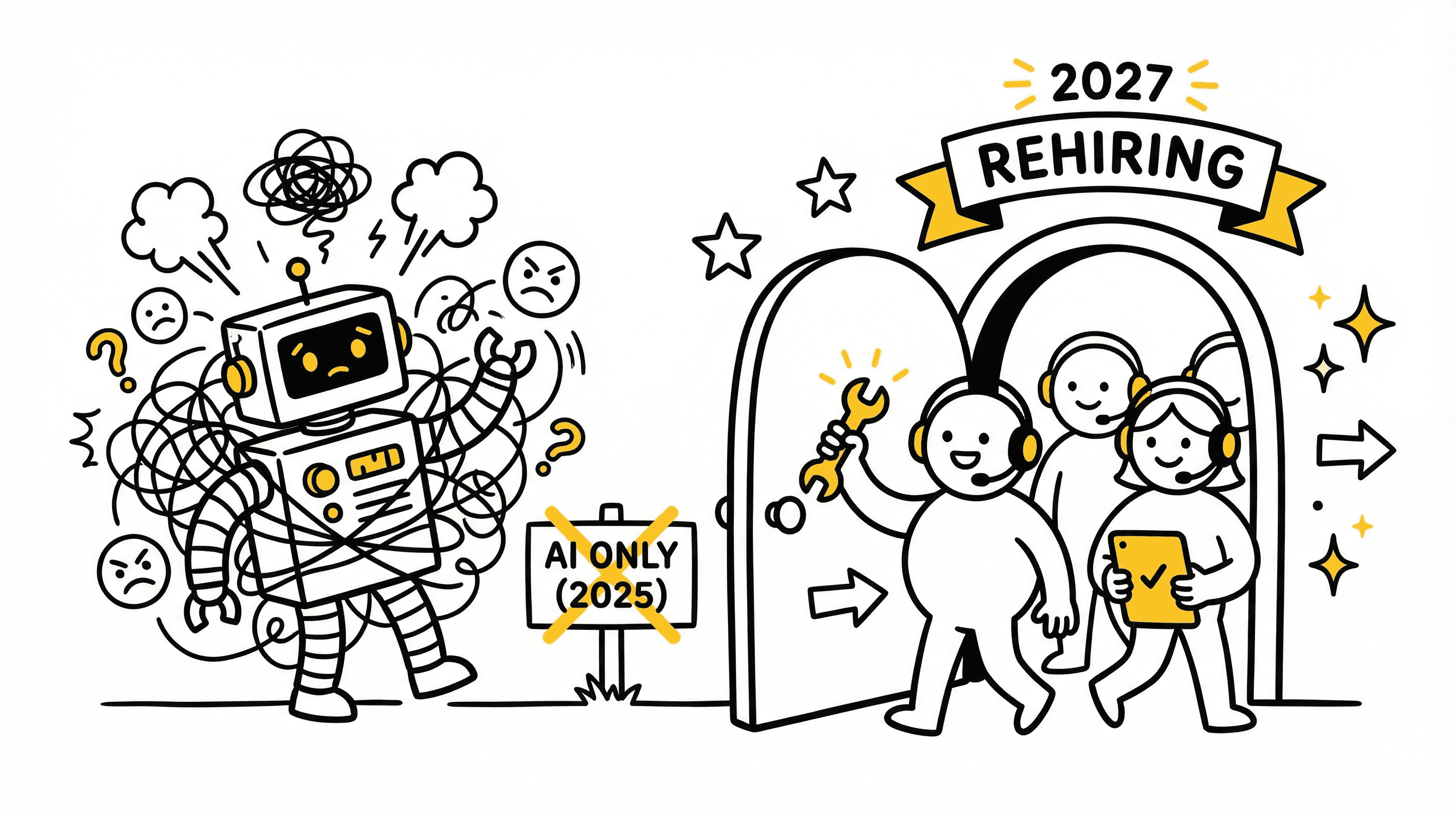
In a landmark forecast, Gartner predicts that by 2027, half of all companies that reduced customer service headcount due to AI will be forced to rehire staff to maintain service quality and meet customer expectations (https://www.gartner.com/en/newsroom/press-releases/2026-02-02-gartner-predicts-half-of-companies-that-cut-customer-service-staff-due-to-ai-will-rehire-by-2027). This projection comes as organisations grapple with the realities of AI’s capabilities and the enduring importance of human expertise in customer support.
TL;DR
• Gartner: 50% of firms that cut support jobs for AI will rehire by 2027.
• Only 20% of layoffs were directly due to AI; most were economic.
• AI lacks empathy, expertise, and judgment for complex cases.
• Over-automation risks customer satisfaction and brand trust.
• Leaders must balance automation with upskilling and QA.
The Reality Behind AI-Driven Layoffs
Gartner’s research reveals that the narrative around AI-driven layoffs is often overstated. In fact, only 20% of companies that reduced customer service headcount did so primarily because of AI or automation. The majority cited economic pressures and cost-cutting as the main drivers (https://www.gartner.com/en/newsroom/press-releases/2026-02-02-gartner-predicts-half-of-companies-that-cut-customer-service-staff-due-to-ai-will-rehire-by-2027). This distinction is crucial for support leaders planning their workforce strategy.
Why AI Alone Isn’t Enough for Customer Service
The Limits of AI in Customer Experience
Kathy Ross, VP Analyst at Gartner, notes: “AI can handle simple, repetitive tasks, but it cannot replicate the expertise, empathy, and judgment that human agents provide.” Emily Potosky, Director Analyst, adds that customers increasingly expect nuanced, context-aware support—something current AI tools struggle to deliver (https://www.gartner.com/en/newsroom/press-releases/2026-02-02-gartner-predicts-half-of-companies-that-cut-customer-service-staff-due-to-ai-will-rehire-by-2027).
Risks of Over-Reliance on Automation
Premature or excessive automation can backfire. Gartner warns that over-reliance on AI may lead to:
• Declining customer satisfaction (CSAT)
• Increased escalations and unresolved issues
• Brand reputation risks
A robust quality assurance (QA) process and ongoing agent training are essential to mitigate these risks. Internal: /product/quality-review
Implications for Support Operations Leaders
Gartner’s findings have direct implications for support operations, both in-house and for BPOs.
Workforce Planning and Talent Strategy
Leaders should avoid a binary “AI vs. human” mindset. Instead, adopt a flexible approach:
• Use AI for routine queries and data retrieval
• Retain and upskill agents for complex, high-value interactions
• Plan for cyclical rehiring as customer needs evolve
Checklist: Balanced Workforce Planning
• Map support tasks by complexity and automation suitability
• Identify roles requiring human expertise
• Develop a rehiring and upskilling plan for 2025–2027
Training, Coaching, and Quality Assurance in the AI Era
As AI takes over basic tasks, agent roles become more specialised. Upskilling is critical:
• Train agents in advanced problem-solving and emotional intelligence
• Use AI-powered simulation training for real-world scenarios. Internal: /blog/call-center-scripts
• Implement continuous QA and feedback loops
Framework: Modern Agent Development
1) Baseline skills assessment
2) Simulation-based training (AI-driven)
3) Regular QA reviews
4) Personalised coaching and feedback
Rethinking AI Rollout and Change Management
Successful AI integration requires careful change management:
• Set realistic expectations with stakeholders
• Pilot AI in low-risk areas before scaling
• Monitor impact on CSAT and agent workload
What Support Leaders Should Do Next
Gartner’s recommendations and industry best practices point to a balanced, data-driven approach.
Prioritize Long-Term Growth Over Short-Term Cost Cuts
Short-term staff reductions may undermine long-term service quality. Advocate for:
• Sustainable investment in human talent
• Reinvestment in training and coaching
• A culture of continuous improvement
Monitor and Measure AI Impact Continuously
Track the real effects of AI on your operations:
• Headcount changes (planned vs. actual)
• CSAT and NPS trends
• Efficiency and resolution rates
Regular measurement enables timely course correction and ensures AI delivers value without eroding customer trust.
Industry Perspectives and Additional Insights
Analyst and Industry Reports
• McKinsey: Most companies use AI to augment—not replace—human agents (https://www.mckinsey.com/capabilities/quantumblack/our-insights/the-state-of-ai-in-2023).
• Forrester: Predicts hybrid models will dominate, with AI handling routine tasks and humans managing complex cases (https://www.forrester.com/report/the-future-of-customer-service/RES137042).
• Harvard Business Review: Warns against automating the “wrong things,” emphasising the need for human judgment (https://hbr.org/2023/04/ai-can-help-reduce-customer-service-costs-but-dont-automate-the-wrong-things).
• Deloitte: Finds that customer experience leaders invest heavily in agent training and QA alongside automation (https://www2.deloitte.com/us/en/insights/industry/technology/global-contact-center-survey.html).
Related reading
• The Future of Customer Service with AI — https://smartrole.ai/blog/the-future-of-customer-service-with-ai
• AI Limitations in Customer Support — https://smartrole.ai/blog/ai-limitations-in-customer-support
• Balancing AI and Human Support — https://smartrole.ai/blog/balancing-ai-and-human-support
• Customer Service Automation Audit — https://smartrole.ai/case-studies/customer-service-automation-audit
• Quality Assurance in Automated Support — https://smartrole.ai/blog/quality-assurance-in-automated-support
• Customer Experience Transformation — https://smartrole.ai/blog/customer-experience-transformation
• Customer Satisfaction Metrics — https://smartrole.ai/blog/customer-satisfaction-metrics
• Training and Upskilling Services — https://smartrole.ai/services/training-and-upskilling
FAQ
Why does Gartner predict companies will rehire customer service staff by 2027?
Gartner expects that as AI’s limitations become clear and customer expectations rise, 50% of firms that reduced support headcount for AI will need to rehire to maintain service quality.
What are the main limitations of AI in customer service today?
AI struggles with complex, context-rich, or emotionally sensitive interactions. It cannot fully replicate human empathy, expertise, or judgment.
How should support leaders balance AI and human agents in their workforce strategy?
Leaders should automate routine tasks with AI and invest in upskilling agents for complex cases, ensuring a flexible, hybrid workforce.
What steps can organizations take to ensure service quality during AI adoption?
Prioritise continuous training, robust QA, and regular monitoring of AI’s impact on customer satisfaction and agent performance.
About the author
Thibaut Martin is the COO of Smart Role, a leader in AI-powered training for support agents and BPOs. With previous roles at Google and Otrium, Thibaut brings over a decade of experience in customer experience and support operations. He is passionate about helping organisations balance automation with human expertise to deliver exceptional service. Smart Role is SOC 2 Type 2 and ISO certified.
Sources
1) Gartner Predicts Half of Companies That Cut Customer Service Staff Due to AI Will Rehire by 2027 — https://www.gartner.com/en/newsroom/press-releases/2026-02-02-gartner-predicts-half-of-companies-that-cut-customer-service-staff-due-to-ai-will-rehire-by-2027
2) McKinsey: The State of AI in 2023 — https://www.mckinsey.com/capabilities/quantumblack/our-insights/the-state-of-ai-in-2023
3) Forrester: The Future of Customer Service — https://www.forrester.com/report/the-future-of-customer-service/RES137042
4) Harvard Business Review: AI Can Help Reduce Customer Service Costs — https://hbr.org/2023/04/ai-can-help-reduce-customer-service-costs-but-dont-automate-the-wrong-things
5) Deloitte: 2024 Global Contact Center Survey — https://www2.deloitte.com/us/en/insights/industry/technology/global-contact-center-survey.html

In a landmark forecast, Gartner predicts that by 2027, half of all companies that reduced customer service headcount due to AI will be forced to rehire staff to maintain service quality and meet customer expectations (https://www.gartner.com/en/newsroom/press-releases/2026-02-02-gartner-predicts-half-of-companies-that-cut-customer-service-staff-due-to-ai-will-rehire-by-2027). This projection comes as organisations grapple with the realities of AI’s capabilities and the enduring importance of human expertise in customer support.
TL;DR
• Gartner: 50% of firms that cut support jobs for AI will rehire by 2027.
• Only 20% of layoffs were directly due to AI; most were economic.
• AI lacks empathy, expertise, and judgment for complex cases.
• Over-automation risks customer satisfaction and brand trust.
• Leaders must balance automation with upskilling and QA.
The Reality Behind AI-Driven Layoffs
Gartner’s research reveals that the narrative around AI-driven layoffs is often overstated. In fact, only 20% of companies that reduced customer service headcount did so primarily because of AI or automation. The majority cited economic pressures and cost-cutting as the main drivers (https://www.gartner.com/en/newsroom/press-releases/2026-02-02-gartner-predicts-half-of-companies-that-cut-customer-service-staff-due-to-ai-will-rehire-by-2027). This distinction is crucial for support leaders planning their workforce strategy.
Why AI Alone Isn’t Enough for Customer Service
The Limits of AI in Customer Experience
Kathy Ross, VP Analyst at Gartner, notes: “AI can handle simple, repetitive tasks, but it cannot replicate the expertise, empathy, and judgment that human agents provide.” Emily Potosky, Director Analyst, adds that customers increasingly expect nuanced, context-aware support—something current AI tools struggle to deliver (https://www.gartner.com/en/newsroom/press-releases/2026-02-02-gartner-predicts-half-of-companies-that-cut-customer-service-staff-due-to-ai-will-rehire-by-2027).
Risks of Over-Reliance on Automation
Premature or excessive automation can backfire. Gartner warns that over-reliance on AI may lead to:
• Declining customer satisfaction (CSAT)
• Increased escalations and unresolved issues
• Brand reputation risks
A robust quality assurance (QA) process and ongoing agent training are essential to mitigate these risks. Internal: /product/quality-review
Implications for Support Operations Leaders
Gartner’s findings have direct implications for support operations, both in-house and for BPOs.
Workforce Planning and Talent Strategy
Leaders should avoid a binary “AI vs. human” mindset. Instead, adopt a flexible approach:
• Use AI for routine queries and data retrieval
• Retain and upskill agents for complex, high-value interactions
• Plan for cyclical rehiring as customer needs evolve
Checklist: Balanced Workforce Planning
• Map support tasks by complexity and automation suitability
• Identify roles requiring human expertise
• Develop a rehiring and upskilling plan for 2025–2027
Training, Coaching, and Quality Assurance in the AI Era
As AI takes over basic tasks, agent roles become more specialised. Upskilling is critical:
• Train agents in advanced problem-solving and emotional intelligence
• Use AI-powered simulation training for real-world scenarios. Internal: /blog/call-center-scripts
• Implement continuous QA and feedback loops
Framework: Modern Agent Development
1) Baseline skills assessment
2) Simulation-based training (AI-driven)
3) Regular QA reviews
4) Personalised coaching and feedback
Rethinking AI Rollout and Change Management
Successful AI integration requires careful change management:
• Set realistic expectations with stakeholders
• Pilot AI in low-risk areas before scaling
• Monitor impact on CSAT and agent workload
What Support Leaders Should Do Next
Gartner’s recommendations and industry best practices point to a balanced, data-driven approach.
Prioritize Long-Term Growth Over Short-Term Cost Cuts
Short-term staff reductions may undermine long-term service quality. Advocate for:
• Sustainable investment in human talent
• Reinvestment in training and coaching
• A culture of continuous improvement
Monitor and Measure AI Impact Continuously
Track the real effects of AI on your operations:
• Headcount changes (planned vs. actual)
• CSAT and NPS trends
• Efficiency and resolution rates
Regular measurement enables timely course correction and ensures AI delivers value without eroding customer trust.
Industry Perspectives and Additional Insights
Analyst and Industry Reports
• McKinsey: Most companies use AI to augment—not replace—human agents (https://www.mckinsey.com/capabilities/quantumblack/our-insights/the-state-of-ai-in-2023).
• Forrester: Predicts hybrid models will dominate, with AI handling routine tasks and humans managing complex cases (https://www.forrester.com/report/the-future-of-customer-service/RES137042).
• Harvard Business Review: Warns against automating the “wrong things,” emphasising the need for human judgment (https://hbr.org/2023/04/ai-can-help-reduce-customer-service-costs-but-dont-automate-the-wrong-things).
• Deloitte: Finds that customer experience leaders invest heavily in agent training and QA alongside automation (https://www2.deloitte.com/us/en/insights/industry/technology/global-contact-center-survey.html).
Related reading
• The Future of Customer Service with AI — https://smartrole.ai/blog/the-future-of-customer-service-with-ai
• AI Limitations in Customer Support — https://smartrole.ai/blog/ai-limitations-in-customer-support
• Balancing AI and Human Support — https://smartrole.ai/blog/balancing-ai-and-human-support
• Customer Service Automation Audit — https://smartrole.ai/case-studies/customer-service-automation-audit
• Quality Assurance in Automated Support — https://smartrole.ai/blog/quality-assurance-in-automated-support
• Customer Experience Transformation — https://smartrole.ai/blog/customer-experience-transformation
• Customer Satisfaction Metrics — https://smartrole.ai/blog/customer-satisfaction-metrics
• Training and Upskilling Services — https://smartrole.ai/services/training-and-upskilling
FAQ
Why does Gartner predict companies will rehire customer service staff by 2027?
Gartner expects that as AI’s limitations become clear and customer expectations rise, 50% of firms that reduced support headcount for AI will need to rehire to maintain service quality.
What are the main limitations of AI in customer service today?
AI struggles with complex, context-rich, or emotionally sensitive interactions. It cannot fully replicate human empathy, expertise, or judgment.
How should support leaders balance AI and human agents in their workforce strategy?
Leaders should automate routine tasks with AI and invest in upskilling agents for complex cases, ensuring a flexible, hybrid workforce.
What steps can organizations take to ensure service quality during AI adoption?
Prioritise continuous training, robust QA, and regular monitoring of AI’s impact on customer satisfaction and agent performance.
About the author
Thibaut Martin is the COO of Smart Role, a leader in AI-powered training for support agents and BPOs. With previous roles at Google and Otrium, Thibaut brings over a decade of experience in customer experience and support operations. He is passionate about helping organisations balance automation with human expertise to deliver exceptional service. Smart Role is SOC 2 Type 2 and ISO certified.
Sources
1) Gartner Predicts Half of Companies That Cut Customer Service Staff Due to AI Will Rehire by 2027 — https://www.gartner.com/en/newsroom/press-releases/2026-02-02-gartner-predicts-half-of-companies-that-cut-customer-service-staff-due-to-ai-will-rehire-by-2027
2) McKinsey: The State of AI in 2023 — https://www.mckinsey.com/capabilities/quantumblack/our-insights/the-state-of-ai-in-2023
3) Forrester: The Future of Customer Service — https://www.forrester.com/report/the-future-of-customer-service/RES137042
4) Harvard Business Review: AI Can Help Reduce Customer Service Costs — https://hbr.org/2023/04/ai-can-help-reduce-customer-service-costs-but-dont-automate-the-wrong-things
5) Deloitte: 2024 Global Contact Center Survey — https://www2.deloitte.com/us/en/insights/industry/technology/global-contact-center-survey.html

In a landmark forecast, Gartner predicts that by 2027, half of all companies that reduced customer service headcount due to AI will be forced to rehire staff to maintain service quality and meet customer expectations (https://www.gartner.com/en/newsroom/press-releases/2026-02-02-gartner-predicts-half-of-companies-that-cut-customer-service-staff-due-to-ai-will-rehire-by-2027). This projection comes as organisations grapple with the realities of AI’s capabilities and the enduring importance of human expertise in customer support.
TL;DR
• Gartner: 50% of firms that cut support jobs for AI will rehire by 2027.
• Only 20% of layoffs were directly due to AI; most were economic.
• AI lacks empathy, expertise, and judgment for complex cases.
• Over-automation risks customer satisfaction and brand trust.
• Leaders must balance automation with upskilling and QA.
The Reality Behind AI-Driven Layoffs
Gartner’s research reveals that the narrative around AI-driven layoffs is often overstated. In fact, only 20% of companies that reduced customer service headcount did so primarily because of AI or automation. The majority cited economic pressures and cost-cutting as the main drivers (https://www.gartner.com/en/newsroom/press-releases/2026-02-02-gartner-predicts-half-of-companies-that-cut-customer-service-staff-due-to-ai-will-rehire-by-2027). This distinction is crucial for support leaders planning their workforce strategy.
Why AI Alone Isn’t Enough for Customer Service
The Limits of AI in Customer Experience
Kathy Ross, VP Analyst at Gartner, notes: “AI can handle simple, repetitive tasks, but it cannot replicate the expertise, empathy, and judgment that human agents provide.” Emily Potosky, Director Analyst, adds that customers increasingly expect nuanced, context-aware support—something current AI tools struggle to deliver (https://www.gartner.com/en/newsroom/press-releases/2026-02-02-gartner-predicts-half-of-companies-that-cut-customer-service-staff-due-to-ai-will-rehire-by-2027).
Risks of Over-Reliance on Automation
Premature or excessive automation can backfire. Gartner warns that over-reliance on AI may lead to:
• Declining customer satisfaction (CSAT)
• Increased escalations and unresolved issues
• Brand reputation risks
A robust quality assurance (QA) process and ongoing agent training are essential to mitigate these risks. Internal: /product/quality-review
Implications for Support Operations Leaders
Gartner’s findings have direct implications for support operations, both in-house and for BPOs.
Workforce Planning and Talent Strategy
Leaders should avoid a binary “AI vs. human” mindset. Instead, adopt a flexible approach:
• Use AI for routine queries and data retrieval
• Retain and upskill agents for complex, high-value interactions
• Plan for cyclical rehiring as customer needs evolve
Checklist: Balanced Workforce Planning
• Map support tasks by complexity and automation suitability
• Identify roles requiring human expertise
• Develop a rehiring and upskilling plan for 2025–2027
Training, Coaching, and Quality Assurance in the AI Era
As AI takes over basic tasks, agent roles become more specialised. Upskilling is critical:
• Train agents in advanced problem-solving and emotional intelligence
• Use AI-powered simulation training for real-world scenarios. Internal: /blog/call-center-scripts
• Implement continuous QA and feedback loops
Framework: Modern Agent Development
1) Baseline skills assessment
2) Simulation-based training (AI-driven)
3) Regular QA reviews
4) Personalised coaching and feedback
Rethinking AI Rollout and Change Management
Successful AI integration requires careful change management:
• Set realistic expectations with stakeholders
• Pilot AI in low-risk areas before scaling
• Monitor impact on CSAT and agent workload
What Support Leaders Should Do Next
Gartner’s recommendations and industry best practices point to a balanced, data-driven approach.
Prioritize Long-Term Growth Over Short-Term Cost Cuts
Short-term staff reductions may undermine long-term service quality. Advocate for:
• Sustainable investment in human talent
• Reinvestment in training and coaching
• A culture of continuous improvement
Monitor and Measure AI Impact Continuously
Track the real effects of AI on your operations:
• Headcount changes (planned vs. actual)
• CSAT and NPS trends
• Efficiency and resolution rates
Regular measurement enables timely course correction and ensures AI delivers value without eroding customer trust.
Industry Perspectives and Additional Insights
Analyst and Industry Reports
• McKinsey: Most companies use AI to augment—not replace—human agents (https://www.mckinsey.com/capabilities/quantumblack/our-insights/the-state-of-ai-in-2023).
• Forrester: Predicts hybrid models will dominate, with AI handling routine tasks and humans managing complex cases (https://www.forrester.com/report/the-future-of-customer-service/RES137042).
• Harvard Business Review: Warns against automating the “wrong things,” emphasising the need for human judgment (https://hbr.org/2023/04/ai-can-help-reduce-customer-service-costs-but-dont-automate-the-wrong-things).
• Deloitte: Finds that customer experience leaders invest heavily in agent training and QA alongside automation (https://www2.deloitte.com/us/en/insights/industry/technology/global-contact-center-survey.html).
Related reading
• The Future of Customer Service with AI — https://smartrole.ai/blog/the-future-of-customer-service-with-ai
• AI Limitations in Customer Support — https://smartrole.ai/blog/ai-limitations-in-customer-support
• Balancing AI and Human Support — https://smartrole.ai/blog/balancing-ai-and-human-support
• Customer Service Automation Audit — https://smartrole.ai/case-studies/customer-service-automation-audit
• Quality Assurance in Automated Support — https://smartrole.ai/blog/quality-assurance-in-automated-support
• Customer Experience Transformation — https://smartrole.ai/blog/customer-experience-transformation
• Customer Satisfaction Metrics — https://smartrole.ai/blog/customer-satisfaction-metrics
• Training and Upskilling Services — https://smartrole.ai/services/training-and-upskilling
FAQ
Why does Gartner predict companies will rehire customer service staff by 2027?
Gartner expects that as AI’s limitations become clear and customer expectations rise, 50% of firms that reduced support headcount for AI will need to rehire to maintain service quality.
What are the main limitations of AI in customer service today?
AI struggles with complex, context-rich, or emotionally sensitive interactions. It cannot fully replicate human empathy, expertise, or judgment.
How should support leaders balance AI and human agents in their workforce strategy?
Leaders should automate routine tasks with AI and invest in upskilling agents for complex cases, ensuring a flexible, hybrid workforce.
What steps can organizations take to ensure service quality during AI adoption?
Prioritise continuous training, robust QA, and regular monitoring of AI’s impact on customer satisfaction and agent performance.
About the author
Thibaut Martin is the COO of Smart Role, a leader in AI-powered training for support agents and BPOs. With previous roles at Google and Otrium, Thibaut brings over a decade of experience in customer experience and support operations. He is passionate about helping organisations balance automation with human expertise to deliver exceptional service. Smart Role is SOC 2 Type 2 and ISO certified.
Sources
1) Gartner Predicts Half of Companies That Cut Customer Service Staff Due to AI Will Rehire by 2027 — https://www.gartner.com/en/newsroom/press-releases/2026-02-02-gartner-predicts-half-of-companies-that-cut-customer-service-staff-due-to-ai-will-rehire-by-2027
2) McKinsey: The State of AI in 2023 — https://www.mckinsey.com/capabilities/quantumblack/our-insights/the-state-of-ai-in-2023
3) Forrester: The Future of Customer Service — https://www.forrester.com/report/the-future-of-customer-service/RES137042
4) Harvard Business Review: AI Can Help Reduce Customer Service Costs — https://hbr.org/2023/04/ai-can-help-reduce-customer-service-costs-but-dont-automate-the-wrong-things
5) Deloitte: 2024 Global Contact Center Survey — https://www2.deloitte.com/us/en/insights/industry/technology/global-contact-center-survey.html
In a landmark forecast, Gartner predicts that by 2027, half of all companies that reduced customer service headcount due to AI will be forced to rehire staff to maintain service quality and meet customer expectations (https://www.gartner.com/en/newsroom/press-releases/2026-02-02-gartner-predicts-half-of-companies-that-cut-customer-service-staff-due-to-ai-will-rehire-by-2027). This projection comes as organisations grapple with the realities of AI’s capabilities and the enduring importance of human expertise in customer support.
TL;DR
• Gartner: 50% of firms that cut support jobs for AI will rehire by 2027.
• Only 20% of layoffs were directly due to AI; most were economic.
• AI lacks empathy, expertise, and judgment for complex cases.
• Over-automation risks customer satisfaction and brand trust.
• Leaders must balance automation with upskilling and QA.
The Reality Behind AI-Driven Layoffs
Gartner’s research reveals that the narrative around AI-driven layoffs is often overstated. In fact, only 20% of companies that reduced customer service headcount did so primarily because of AI or automation. The majority cited economic pressures and cost-cutting as the main drivers (https://www.gartner.com/en/newsroom/press-releases/2026-02-02-gartner-predicts-half-of-companies-that-cut-customer-service-staff-due-to-ai-will-rehire-by-2027). This distinction is crucial for support leaders planning their workforce strategy.
Why AI Alone Isn’t Enough for Customer Service
The Limits of AI in Customer Experience
Kathy Ross, VP Analyst at Gartner, notes: “AI can handle simple, repetitive tasks, but it cannot replicate the expertise, empathy, and judgment that human agents provide.” Emily Potosky, Director Analyst, adds that customers increasingly expect nuanced, context-aware support—something current AI tools struggle to deliver (https://www.gartner.com/en/newsroom/press-releases/2026-02-02-gartner-predicts-half-of-companies-that-cut-customer-service-staff-due-to-ai-will-rehire-by-2027).
Risks of Over-Reliance on Automation
Premature or excessive automation can backfire. Gartner warns that over-reliance on AI may lead to:
• Declining customer satisfaction (CSAT)
• Increased escalations and unresolved issues
• Brand reputation risks
A robust quality assurance (QA) process and ongoing agent training are essential to mitigate these risks. Internal: /product/quality-review
Implications for Support Operations Leaders
Gartner’s findings have direct implications for support operations, both in-house and for BPOs.
Workforce Planning and Talent Strategy
Leaders should avoid a binary “AI vs. human” mindset. Instead, adopt a flexible approach:
• Use AI for routine queries and data retrieval
• Retain and upskill agents for complex, high-value interactions
• Plan for cyclical rehiring as customer needs evolve
Checklist: Balanced Workforce Planning
• Map support tasks by complexity and automation suitability
• Identify roles requiring human expertise
• Develop a rehiring and upskilling plan for 2025–2027
Training, Coaching, and Quality Assurance in the AI Era
As AI takes over basic tasks, agent roles become more specialised. Upskilling is critical:
• Train agents in advanced problem-solving and emotional intelligence
• Use AI-powered simulation training for real-world scenarios. Internal: /blog/call-center-scripts
• Implement continuous QA and feedback loops
Framework: Modern Agent Development
1) Baseline skills assessment
2) Simulation-based training (AI-driven)
3) Regular QA reviews
4) Personalised coaching and feedback
Rethinking AI Rollout and Change Management
Successful AI integration requires careful change management:
• Set realistic expectations with stakeholders
• Pilot AI in low-risk areas before scaling
• Monitor impact on CSAT and agent workload
What Support Leaders Should Do Next
Gartner’s recommendations and industry best practices point to a balanced, data-driven approach.
Prioritize Long-Term Growth Over Short-Term Cost Cuts
Short-term staff reductions may undermine long-term service quality. Advocate for:
• Sustainable investment in human talent
• Reinvestment in training and coaching
• A culture of continuous improvement
Monitor and Measure AI Impact Continuously
Track the real effects of AI on your operations:
• Headcount changes (planned vs. actual)
• CSAT and NPS trends
• Efficiency and resolution rates
Regular measurement enables timely course correction and ensures AI delivers value without eroding customer trust.
Industry Perspectives and Additional Insights
Analyst and Industry Reports
• McKinsey: Most companies use AI to augment—not replace—human agents (https://www.mckinsey.com/capabilities/quantumblack/our-insights/the-state-of-ai-in-2023).
• Forrester: Predicts hybrid models will dominate, with AI handling routine tasks and humans managing complex cases (https://www.forrester.com/report/the-future-of-customer-service/RES137042).
• Harvard Business Review: Warns against automating the “wrong things,” emphasising the need for human judgment (https://hbr.org/2023/04/ai-can-help-reduce-customer-service-costs-but-dont-automate-the-wrong-things).
• Deloitte: Finds that customer experience leaders invest heavily in agent training and QA alongside automation (https://www2.deloitte.com/us/en/insights/industry/technology/global-contact-center-survey.html).
Related reading
• The Future of Customer Service with AI — https://smartrole.ai/blog/the-future-of-customer-service-with-ai
• AI Limitations in Customer Support — https://smartrole.ai/blog/ai-limitations-in-customer-support
• Balancing AI and Human Support — https://smartrole.ai/blog/balancing-ai-and-human-support
• Customer Service Automation Audit — https://smartrole.ai/case-studies/customer-service-automation-audit
• Quality Assurance in Automated Support — https://smartrole.ai/blog/quality-assurance-in-automated-support
• Customer Experience Transformation — https://smartrole.ai/blog/customer-experience-transformation
• Customer Satisfaction Metrics — https://smartrole.ai/blog/customer-satisfaction-metrics
• Training and Upskilling Services — https://smartrole.ai/services/training-and-upskilling
FAQ
Why does Gartner predict companies will rehire customer service staff by 2027?
Gartner expects that as AI’s limitations become clear and customer expectations rise, 50% of firms that reduced support headcount for AI will need to rehire to maintain service quality.
What are the main limitations of AI in customer service today?
AI struggles with complex, context-rich, or emotionally sensitive interactions. It cannot fully replicate human empathy, expertise, or judgment.
How should support leaders balance AI and human agents in their workforce strategy?
Leaders should automate routine tasks with AI and invest in upskilling agents for complex cases, ensuring a flexible, hybrid workforce.
What steps can organizations take to ensure service quality during AI adoption?
Prioritise continuous training, robust QA, and regular monitoring of AI’s impact on customer satisfaction and agent performance.
About the author
Thibaut Martin is the COO of Smart Role, a leader in AI-powered training for support agents and BPOs. With previous roles at Google and Otrium, Thibaut brings over a decade of experience in customer experience and support operations. He is passionate about helping organisations balance automation with human expertise to deliver exceptional service. Smart Role is SOC 2 Type 2 and ISO certified.
Sources
1) Gartner Predicts Half of Companies That Cut Customer Service Staff Due to AI Will Rehire by 2027 — https://www.gartner.com/en/newsroom/press-releases/2026-02-02-gartner-predicts-half-of-companies-that-cut-customer-service-staff-due-to-ai-will-rehire-by-2027
2) McKinsey: The State of AI in 2023 — https://www.mckinsey.com/capabilities/quantumblack/our-insights/the-state-of-ai-in-2023
3) Forrester: The Future of Customer Service — https://www.forrester.com/report/the-future-of-customer-service/RES137042
4) Harvard Business Review: AI Can Help Reduce Customer Service Costs — https://hbr.org/2023/04/ai-can-help-reduce-customer-service-costs-but-dont-automate-the-wrong-things
5) Deloitte: 2024 Global Contact Center Survey — https://www2.deloitte.com/us/en/insights/industry/technology/global-contact-center-survey.html

Rejoignez la newsletter Smart Role

Le succès en service client repose à 10 % sur les connaissances et à 90 % sur la manière dont vous les appliquez dans des situations réelles.
Rejoignez la newsletter Smart Role

Le succès en service client repose à 10 % sur les connaissances et à 90 % sur la manière dont vous les appliquez dans des situations réelles.
Rejoignez la newsletter Smart Role

Le succès en service client repose à 10 % sur les connaissances et à 90 % sur la manière dont vous les appliquez dans des situations réelles.

Smart Role est une plateforme qui transforme le recrutement, l'intégration et la formation en service client. Notre technologie aide les entreprises à rationaliser le processus et à réduire les coûts.


Smart Role est une plateforme qui transforme le recrutement, l'intégration et la formation en service client. Notre technologie aide les entreprises à rationaliser le processus et à réduire les coûts.


Smart Role est une plateforme qui transforme le recrutement, l'intégration et la formation en service client. Notre technologie aide les entreprises à rationaliser le processus et à réduire les coûts.