
Hiring
Hiring
Hiring
Hospitality Customer Service Interview Questions
/ / / / / / / /
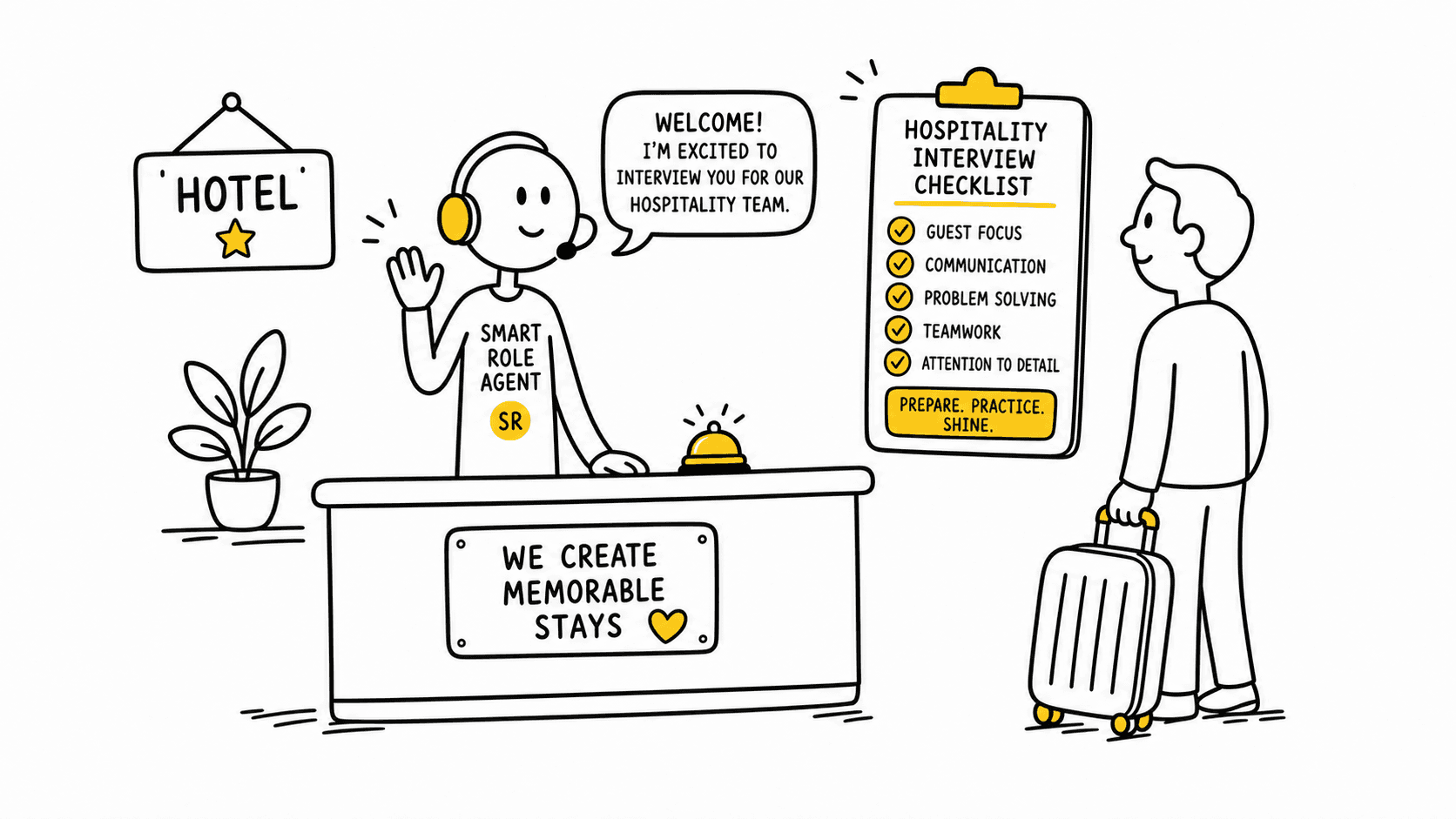
Hospitality customer service interview questions assess how candidates communicate with guests, solve problems, handle complaints, and create positive service experiences in travel and hospitality roles.
25 Hospitality Customer Service Interview Questions With Sample Answers
Hospitality employers hire people who can stay calm, communicate clearly, and deliver excellent guest experiences even when things go wrong. Whether you are applying for a hotel front desk role, airline customer support position, resort guest services job, concierge role, reservations team, or travel customer care position, interviews often focus on real situations rather than technical knowledge alone.
Employers want evidence that you can listen actively, show empathy, take ownership, and protect the guest experience. According to Forbes Travel Guide, personalised service, anticipation of guest needs, and professional communication remain core hospitality standards.
This guide covers 25 of the most common hospitality customer service interview questions, what interviewers are looking for, and strong sample answers you can adapt to your own experience.
TL;DR
Hospitality interviews focus on empathy, communication, ownership, and problem solving.
Use specific examples and guest focused outcomes in your answers.
Structure behavioural answers using the STAR method.
Show how you stay professional under pressure.
Practise realistic travel and hospitality scenarios aloud before your interview.
What Are Hospitality Customer Service Interview Questions?
Hospitality customer service interview questions are questions designed to evaluate how well candidates interact with guests, resolve issues, communicate professionally, and represent a hospitality brand.
Employers use these questions because guest experience directly affects satisfaction, loyalty, reviews, and reputation. Research from Qualtrics XM Institute highlights that customer experience remains a major driver of loyalty and retention.
What Interviewers Look For
Customer empathy
Guests want to feel heard and understood. Strong candidates acknowledge emotions before discussing solutions.
Active listening
Interviewers look for candidates who gather information carefully before acting.
Problem resolution
Hospitality professionals deal with delays, booking issues, room concerns, and service complaints.
Communication skills
Clear communication is essential in person, on the phone, through email, and in chat channels.
Ownership and accountability
Strong candidates take ownership until the issue is resolved or properly handed over.
Professionalism under pressure
Employers want people who remain calm and respectful under pressure.
According to Zendesk Customer Experience Trends, positive service interactions are closely linked to loyalty and retention outcomes.
The Difference Between a Good Answer and a Great Answer
Interview Focus | Weak Answer | Strong Answer |
|---|---|---|
Empathy | Acknowledges issue | Demonstrates understanding and reassurance |
Problem Solving | Gives generic solution | Explains a clear action plan |
Ownership | Passes responsibility | Takes accountability |
Communication | Short response | Structured and guest focused response |
Follow Up | No follow up | Confirms guest satisfaction |
See also: Call center script templates for frontline service teams
25 Questions With Sample Answers
1) What does excellent customer service mean in hospitality?
"Excellent customer service means making guests feel valued, respected, and supported throughout their experience. It involves listening carefully, responding promptly, and taking ownership of issues."
2) How would you greet and assist a guest who seems frustrated?
"I would greet the guest warmly, introduce myself, and ask how I can help. If they seem frustrated, I would listen without interrupting and acknowledge their concerns."
3) Tell me about a time you exceeded a customer's expectations.
"A customer travelling for a special occasion mentioned they were celebrating an anniversary. I arranged a personalised welcome note and coordinated with colleagues to make their experience more memorable."
4) How do you handle multiple guests needing help at the same time?
"I stay organised and assess urgency first. I acknowledge everyone waiting, so they know they have been noticed. Then I address the most time sensitive issues while keeping guests informed."
5) Why do you want to work in hospitality customer service?
"I enjoy helping people and creating positive experiences. Hospitality combines communication, problem solving, and service. I find it rewarding to assist guests during important moments."
Difficult Guest and Complaint Handling Questions
6) Describe a time you dealt with an angry customer.
"A customer was upset because of a booking issue. I listened carefully, acknowledged their frustration, and apologised for the inconvenience. After reviewing the reservation, I found an alternative solution and kept the customer informed."
7) What would you do if a guest complained about their room?
"I would listen carefully and thank the guest for bringing the issue to my attention. I would apologise, investigate the concern, and offer appropriate solutions such as a room change or maintenance support."
8) How would you respond if a guest demanded compensation?
"I would first understand why the guest feels compensation is appropriate. If compensation is justified within company guidelines, I would explain the available options. If not, I would focus on alternative solutions while remaining respectful and transparent."
9) What would you do if you could not immediately solve a guest's problem?
"I would be honest about the situation while reassuring the guest that I am actively working on a solution. I would explain the next steps and remain their point of contact until the issue is resolved."
10) Tell me about a conflict with a customer and how you resolved it.
"A customer disagreed with a service charge. I listened to their concerns, explained the details clearly, and reviewed the account with them. We identified a misunderstanding and clarified the charge."
Travel and Hospitality Scenario Based Questions
11) A guest arrives and the hotel is overbooked. What do you do?
"I would apologise sincerely and acknowledge the inconvenience. I would immediately review alternative accommodation options, explain the available solutions clearly, and arrange transportation if necessary."
12) A traveller misses a flight connection due to a delay. How would you help?
"I would first recognise how stressful the situation is. Then I would review available rebooking options, explain alternatives clearly, and provide guidance on any accommodation or travel support policies."
13) A guest's luggage is missing. What steps would you take?
"I would reassure the guest that I will assist them throughout the process. I would gather details, report the missing luggage through the correct system, explain the expected timeline, and provide updates."
14) A resort guest says their vacation has been ruined. How do you respond?
"I would acknowledge their disappointment and give them space to explain the issue fully. My goal would be to rebuild trust and show that their concerns are being taken seriously."
15) A guest wants an exception to company policy. What would you do?
"I would listen carefully and understand why the guest is requesting an exception. If flexibility is possible within guidelines, I would explore available options."
16) A VIP guest is unhappy with their experience. How would you handle it?
"I would respond quickly, listen carefully, and understand the root cause of the concern. I would take ownership, coordinate with relevant teams, and communicate progress clearly."
Teamwork and Workplace Questions
17) Tell me about a time you worked with a difficult colleague.
"I focused on communication and finding common goals. By discussing expectations openly and maintaining a professional attitude, we improved our working relationship and delivered better service."
18) How do you communicate important information during shift handovers?
"I document key information clearly and highlight any unresolved issues, guest requests, or operational concerns. I also confirm understanding with the incoming team to reduce errors."
19) What would you do if you noticed a teammate providing poor service?
"I would address the situation professionally and constructively. If appropriate, I would provide support or guidance directly. If the issue continued or affected guests significantly, I would involve a supervisor."
See also: Smart Role Quality Review for frontline service teams
Behavioral and Performance Questions
20) How do you stay calm under pressure?
"I focus on priorities, communicate clearly, and break challenges into manageable steps. Staying organised helps me maintain professionalism."
21) Describe a mistake you made and what you learned.
"I once overlooked an important detail during a customer interaction. After correcting the issue, I created a personal checklist process to improve accuracy."
22) How do you measure success in a customer service role?
"I measure success through guest satisfaction, problem resolution, positive feedback, and my ability to contribute to a positive customer experience."
23) Tell me about a time you received constructive feedback.
"A supervisor suggested I provide more proactive updates to customers. I applied the feedback immediately and noticed improved customer satisfaction."
24) How do you handle repetitive tasks while maintaining service quality?
"I treat every guest interaction as unique. Consistency is important, but I still personalise communication and remain focused on delivering a positive experience."
25) Why should we hire you?
"I bring strong communication skills, a customer focused mindset, and the ability to stay calm under pressure. I enjoy helping people, solving problems, and representing a brand professionally."
How to Practice Hospitality Interview Questions Effectively
A practical way to prepare is to role play realistic hospitality situations and receive coaching on your responses. Smart Role offers a free live hospitality practice experience where you can speak or chat through travel and hospitality scenarios, receive instant AI coaching, and get a readiness score.
According to SHRM, structured preparation improves interview performance and confidence.
See also: Customer service quality assurance best practices
FAQ
What are the most common hospitality customer service interview questions?
The most common hospitality customer service interview questions focus on customer service philosophy, complaint handling, difficult guest situations, teamwork, problem solving, multitasking, and examples of past service experiences.
How should I answer scenario based hospitality interview questions?
The best way to answer scenario based hospitality interview questions is to acknowledge the guest's concern, explain the actions you would take, communicate clearly throughout the process, and describe how you would confirm the issue was resolved.
What skills do hospitality employers value most?
Hospitality employers typically prioritise empathy, communication, problem solving, professionalism, adaptability, teamwork, and the ability to remain calm under pressure.
How can I practice for a hospitality customer service interview?
The most effective preparation method is practising realistic guest interactions aloud, including complaints, travel disruptions, and service recovery scenarios.
What is the best way to prepare the day before a hospitality interview?
The day before a hospitality interview, review the job description carefully, prepare two or three STAR examples that match the listed responsibilities, practise speaking your answers aloud, and confirm all logistical details.
Practice your answers in realistic hospitality scenarios. Try a free live hospitality interview simulator where you can handle a cancelled flight connection, an overbooked hotel room, lost luggage, or an unhappy resort guest by voice or chat.
Hospitality customer service interview questions assess how candidates communicate with guests, solve problems, handle complaints, and create positive service experiences in travel and hospitality roles.
25 Hospitality Customer Service Interview Questions With Sample Answers
Hospitality employers hire people who can stay calm, communicate clearly, and deliver excellent guest experiences even when things go wrong. Whether you are applying for a hotel front desk role, airline customer support position, resort guest services job, concierge role, reservations team, or travel customer care position, interviews often focus on real situations rather than technical knowledge alone.
Employers want evidence that you can listen actively, show empathy, take ownership, and protect the guest experience. According to Forbes Travel Guide, personalised service, anticipation of guest needs, and professional communication remain core hospitality standards.
This guide covers 25 of the most common hospitality customer service interview questions, what interviewers are looking for, and strong sample answers you can adapt to your own experience.
TL;DR
Hospitality interviews focus on empathy, communication, ownership, and problem solving.
Use specific examples and guest focused outcomes in your answers.
Structure behavioural answers using the STAR method.
Show how you stay professional under pressure.
Practise realistic travel and hospitality scenarios aloud before your interview.
What Are Hospitality Customer Service Interview Questions?
Hospitality customer service interview questions are questions designed to evaluate how well candidates interact with guests, resolve issues, communicate professionally, and represent a hospitality brand.
Employers use these questions because guest experience directly affects satisfaction, loyalty, reviews, and reputation. Research from Qualtrics XM Institute highlights that customer experience remains a major driver of loyalty and retention.
What Interviewers Look For
Customer empathy
Guests want to feel heard and understood. Strong candidates acknowledge emotions before discussing solutions.
Active listening
Interviewers look for candidates who gather information carefully before acting.
Problem resolution
Hospitality professionals deal with delays, booking issues, room concerns, and service complaints.
Communication skills
Clear communication is essential in person, on the phone, through email, and in chat channels.
Ownership and accountability
Strong candidates take ownership until the issue is resolved or properly handed over.
Professionalism under pressure
Employers want people who remain calm and respectful under pressure.
According to Zendesk Customer Experience Trends, positive service interactions are closely linked to loyalty and retention outcomes.
The Difference Between a Good Answer and a Great Answer
Interview Focus | Weak Answer | Strong Answer |
|---|---|---|
Empathy | Acknowledges issue | Demonstrates understanding and reassurance |
Problem Solving | Gives generic solution | Explains a clear action plan |
Ownership | Passes responsibility | Takes accountability |
Communication | Short response | Structured and guest focused response |
Follow Up | No follow up | Confirms guest satisfaction |
See also: Call center script templates for frontline service teams
25 Questions With Sample Answers
1) What does excellent customer service mean in hospitality?
"Excellent customer service means making guests feel valued, respected, and supported throughout their experience. It involves listening carefully, responding promptly, and taking ownership of issues."
2) How would you greet and assist a guest who seems frustrated?
"I would greet the guest warmly, introduce myself, and ask how I can help. If they seem frustrated, I would listen without interrupting and acknowledge their concerns."
3) Tell me about a time you exceeded a customer's expectations.
"A customer travelling for a special occasion mentioned they were celebrating an anniversary. I arranged a personalised welcome note and coordinated with colleagues to make their experience more memorable."
4) How do you handle multiple guests needing help at the same time?
"I stay organised and assess urgency first. I acknowledge everyone waiting, so they know they have been noticed. Then I address the most time sensitive issues while keeping guests informed."
5) Why do you want to work in hospitality customer service?
"I enjoy helping people and creating positive experiences. Hospitality combines communication, problem solving, and service. I find it rewarding to assist guests during important moments."
Difficult Guest and Complaint Handling Questions
6) Describe a time you dealt with an angry customer.
"A customer was upset because of a booking issue. I listened carefully, acknowledged their frustration, and apologised for the inconvenience. After reviewing the reservation, I found an alternative solution and kept the customer informed."
7) What would you do if a guest complained about their room?
"I would listen carefully and thank the guest for bringing the issue to my attention. I would apologise, investigate the concern, and offer appropriate solutions such as a room change or maintenance support."
8) How would you respond if a guest demanded compensation?
"I would first understand why the guest feels compensation is appropriate. If compensation is justified within company guidelines, I would explain the available options. If not, I would focus on alternative solutions while remaining respectful and transparent."
9) What would you do if you could not immediately solve a guest's problem?
"I would be honest about the situation while reassuring the guest that I am actively working on a solution. I would explain the next steps and remain their point of contact until the issue is resolved."
10) Tell me about a conflict with a customer and how you resolved it.
"A customer disagreed with a service charge. I listened to their concerns, explained the details clearly, and reviewed the account with them. We identified a misunderstanding and clarified the charge."
Travel and Hospitality Scenario Based Questions
11) A guest arrives and the hotel is overbooked. What do you do?
"I would apologise sincerely and acknowledge the inconvenience. I would immediately review alternative accommodation options, explain the available solutions clearly, and arrange transportation if necessary."
12) A traveller misses a flight connection due to a delay. How would you help?
"I would first recognise how stressful the situation is. Then I would review available rebooking options, explain alternatives clearly, and provide guidance on any accommodation or travel support policies."
13) A guest's luggage is missing. What steps would you take?
"I would reassure the guest that I will assist them throughout the process. I would gather details, report the missing luggage through the correct system, explain the expected timeline, and provide updates."
14) A resort guest says their vacation has been ruined. How do you respond?
"I would acknowledge their disappointment and give them space to explain the issue fully. My goal would be to rebuild trust and show that their concerns are being taken seriously."
15) A guest wants an exception to company policy. What would you do?
"I would listen carefully and understand why the guest is requesting an exception. If flexibility is possible within guidelines, I would explore available options."
16) A VIP guest is unhappy with their experience. How would you handle it?
"I would respond quickly, listen carefully, and understand the root cause of the concern. I would take ownership, coordinate with relevant teams, and communicate progress clearly."
Teamwork and Workplace Questions
17) Tell me about a time you worked with a difficult colleague.
"I focused on communication and finding common goals. By discussing expectations openly and maintaining a professional attitude, we improved our working relationship and delivered better service."
18) How do you communicate important information during shift handovers?
"I document key information clearly and highlight any unresolved issues, guest requests, or operational concerns. I also confirm understanding with the incoming team to reduce errors."
19) What would you do if you noticed a teammate providing poor service?
"I would address the situation professionally and constructively. If appropriate, I would provide support or guidance directly. If the issue continued or affected guests significantly, I would involve a supervisor."
See also: Smart Role Quality Review for frontline service teams
Behavioral and Performance Questions
20) How do you stay calm under pressure?
"I focus on priorities, communicate clearly, and break challenges into manageable steps. Staying organised helps me maintain professionalism."
21) Describe a mistake you made and what you learned.
"I once overlooked an important detail during a customer interaction. After correcting the issue, I created a personal checklist process to improve accuracy."
22) How do you measure success in a customer service role?
"I measure success through guest satisfaction, problem resolution, positive feedback, and my ability to contribute to a positive customer experience."
23) Tell me about a time you received constructive feedback.
"A supervisor suggested I provide more proactive updates to customers. I applied the feedback immediately and noticed improved customer satisfaction."
24) How do you handle repetitive tasks while maintaining service quality?
"I treat every guest interaction as unique. Consistency is important, but I still personalise communication and remain focused on delivering a positive experience."
25) Why should we hire you?
"I bring strong communication skills, a customer focused mindset, and the ability to stay calm under pressure. I enjoy helping people, solving problems, and representing a brand professionally."
How to Practice Hospitality Interview Questions Effectively
A practical way to prepare is to role play realistic hospitality situations and receive coaching on your responses. Smart Role offers a free live hospitality practice experience where you can speak or chat through travel and hospitality scenarios, receive instant AI coaching, and get a readiness score.
According to SHRM, structured preparation improves interview performance and confidence.
See also: Customer service quality assurance best practices
FAQ
What are the most common hospitality customer service interview questions?
The most common hospitality customer service interview questions focus on customer service philosophy, complaint handling, difficult guest situations, teamwork, problem solving, multitasking, and examples of past service experiences.
How should I answer scenario based hospitality interview questions?
The best way to answer scenario based hospitality interview questions is to acknowledge the guest's concern, explain the actions you would take, communicate clearly throughout the process, and describe how you would confirm the issue was resolved.
What skills do hospitality employers value most?
Hospitality employers typically prioritise empathy, communication, problem solving, professionalism, adaptability, teamwork, and the ability to remain calm under pressure.
How can I practice for a hospitality customer service interview?
The most effective preparation method is practising realistic guest interactions aloud, including complaints, travel disruptions, and service recovery scenarios.
What is the best way to prepare the day before a hospitality interview?
The day before a hospitality interview, review the job description carefully, prepare two or three STAR examples that match the listed responsibilities, practise speaking your answers aloud, and confirm all logistical details.
Practice your answers in realistic hospitality scenarios. Try a free live hospitality interview simulator where you can handle a cancelled flight connection, an overbooked hotel room, lost luggage, or an unhappy resort guest by voice or chat.
Hospitality customer service interview questions assess how candidates communicate with guests, solve problems, handle complaints, and create positive service experiences in travel and hospitality roles.
25 Hospitality Customer Service Interview Questions With Sample Answers
Hospitality employers hire people who can stay calm, communicate clearly, and deliver excellent guest experiences even when things go wrong. Whether you are applying for a hotel front desk role, airline customer support position, resort guest services job, concierge role, reservations team, or travel customer care position, interviews often focus on real situations rather than technical knowledge alone.
Employers want evidence that you can listen actively, show empathy, take ownership, and protect the guest experience. According to Forbes Travel Guide, personalised service, anticipation of guest needs, and professional communication remain core hospitality standards.
This guide covers 25 of the most common hospitality customer service interview questions, what interviewers are looking for, and strong sample answers you can adapt to your own experience.
TL;DR
Hospitality interviews focus on empathy, communication, ownership, and problem solving.
Use specific examples and guest focused outcomes in your answers.
Structure behavioural answers using the STAR method.
Show how you stay professional under pressure.
Practise realistic travel and hospitality scenarios aloud before your interview.
What Are Hospitality Customer Service Interview Questions?
Hospitality customer service interview questions are questions designed to evaluate how well candidates interact with guests, resolve issues, communicate professionally, and represent a hospitality brand.
Employers use these questions because guest experience directly affects satisfaction, loyalty, reviews, and reputation. Research from Qualtrics XM Institute highlights that customer experience remains a major driver of loyalty and retention.
What Interviewers Look For
Customer empathy
Guests want to feel heard and understood. Strong candidates acknowledge emotions before discussing solutions.
Active listening
Interviewers look for candidates who gather information carefully before acting.
Problem resolution
Hospitality professionals deal with delays, booking issues, room concerns, and service complaints.
Communication skills
Clear communication is essential in person, on the phone, through email, and in chat channels.
Ownership and accountability
Strong candidates take ownership until the issue is resolved or properly handed over.
Professionalism under pressure
Employers want people who remain calm and respectful under pressure.
According to Zendesk Customer Experience Trends, positive service interactions are closely linked to loyalty and retention outcomes.
The Difference Between a Good Answer and a Great Answer
Interview Focus | Weak Answer | Strong Answer |
|---|---|---|
Empathy | Acknowledges issue | Demonstrates understanding and reassurance |
Problem Solving | Gives generic solution | Explains a clear action plan |
Ownership | Passes responsibility | Takes accountability |
Communication | Short response | Structured and guest focused response |
Follow Up | No follow up | Confirms guest satisfaction |
See also: Call center script templates for frontline service teams
25 Questions With Sample Answers
1) What does excellent customer service mean in hospitality?
"Excellent customer service means making guests feel valued, respected, and supported throughout their experience. It involves listening carefully, responding promptly, and taking ownership of issues."
2) How would you greet and assist a guest who seems frustrated?
"I would greet the guest warmly, introduce myself, and ask how I can help. If they seem frustrated, I would listen without interrupting and acknowledge their concerns."
3) Tell me about a time you exceeded a customer's expectations.
"A customer travelling for a special occasion mentioned they were celebrating an anniversary. I arranged a personalised welcome note and coordinated with colleagues to make their experience more memorable."
4) How do you handle multiple guests needing help at the same time?
"I stay organised and assess urgency first. I acknowledge everyone waiting, so they know they have been noticed. Then I address the most time sensitive issues while keeping guests informed."
5) Why do you want to work in hospitality customer service?
"I enjoy helping people and creating positive experiences. Hospitality combines communication, problem solving, and service. I find it rewarding to assist guests during important moments."
Difficult Guest and Complaint Handling Questions
6) Describe a time you dealt with an angry customer.
"A customer was upset because of a booking issue. I listened carefully, acknowledged their frustration, and apologised for the inconvenience. After reviewing the reservation, I found an alternative solution and kept the customer informed."
7) What would you do if a guest complained about their room?
"I would listen carefully and thank the guest for bringing the issue to my attention. I would apologise, investigate the concern, and offer appropriate solutions such as a room change or maintenance support."
8) How would you respond if a guest demanded compensation?
"I would first understand why the guest feels compensation is appropriate. If compensation is justified within company guidelines, I would explain the available options. If not, I would focus on alternative solutions while remaining respectful and transparent."
9) What would you do if you could not immediately solve a guest's problem?
"I would be honest about the situation while reassuring the guest that I am actively working on a solution. I would explain the next steps and remain their point of contact until the issue is resolved."
10) Tell me about a conflict with a customer and how you resolved it.
"A customer disagreed with a service charge. I listened to their concerns, explained the details clearly, and reviewed the account with them. We identified a misunderstanding and clarified the charge."
Travel and Hospitality Scenario Based Questions
11) A guest arrives and the hotel is overbooked. What do you do?
"I would apologise sincerely and acknowledge the inconvenience. I would immediately review alternative accommodation options, explain the available solutions clearly, and arrange transportation if necessary."
12) A traveller misses a flight connection due to a delay. How would you help?
"I would first recognise how stressful the situation is. Then I would review available rebooking options, explain alternatives clearly, and provide guidance on any accommodation or travel support policies."
13) A guest's luggage is missing. What steps would you take?
"I would reassure the guest that I will assist them throughout the process. I would gather details, report the missing luggage through the correct system, explain the expected timeline, and provide updates."
14) A resort guest says their vacation has been ruined. How do you respond?
"I would acknowledge their disappointment and give them space to explain the issue fully. My goal would be to rebuild trust and show that their concerns are being taken seriously."
15) A guest wants an exception to company policy. What would you do?
"I would listen carefully and understand why the guest is requesting an exception. If flexibility is possible within guidelines, I would explore available options."
16) A VIP guest is unhappy with their experience. How would you handle it?
"I would respond quickly, listen carefully, and understand the root cause of the concern. I would take ownership, coordinate with relevant teams, and communicate progress clearly."
Teamwork and Workplace Questions
17) Tell me about a time you worked with a difficult colleague.
"I focused on communication and finding common goals. By discussing expectations openly and maintaining a professional attitude, we improved our working relationship and delivered better service."
18) How do you communicate important information during shift handovers?
"I document key information clearly and highlight any unresolved issues, guest requests, or operational concerns. I also confirm understanding with the incoming team to reduce errors."
19) What would you do if you noticed a teammate providing poor service?
"I would address the situation professionally and constructively. If appropriate, I would provide support or guidance directly. If the issue continued or affected guests significantly, I would involve a supervisor."
See also: Smart Role Quality Review for frontline service teams
Behavioral and Performance Questions
20) How do you stay calm under pressure?
"I focus on priorities, communicate clearly, and break challenges into manageable steps. Staying organised helps me maintain professionalism."
21) Describe a mistake you made and what you learned.
"I once overlooked an important detail during a customer interaction. After correcting the issue, I created a personal checklist process to improve accuracy."
22) How do you measure success in a customer service role?
"I measure success through guest satisfaction, problem resolution, positive feedback, and my ability to contribute to a positive customer experience."
23) Tell me about a time you received constructive feedback.
"A supervisor suggested I provide more proactive updates to customers. I applied the feedback immediately and noticed improved customer satisfaction."
24) How do you handle repetitive tasks while maintaining service quality?
"I treat every guest interaction as unique. Consistency is important, but I still personalise communication and remain focused on delivering a positive experience."
25) Why should we hire you?
"I bring strong communication skills, a customer focused mindset, and the ability to stay calm under pressure. I enjoy helping people, solving problems, and representing a brand professionally."
How to Practice Hospitality Interview Questions Effectively
A practical way to prepare is to role play realistic hospitality situations and receive coaching on your responses. Smart Role offers a free live hospitality practice experience where you can speak or chat through travel and hospitality scenarios, receive instant AI coaching, and get a readiness score.
According to SHRM, structured preparation improves interview performance and confidence.
See also: Customer service quality assurance best practices
FAQ
What are the most common hospitality customer service interview questions?
The most common hospitality customer service interview questions focus on customer service philosophy, complaint handling, difficult guest situations, teamwork, problem solving, multitasking, and examples of past service experiences.
How should I answer scenario based hospitality interview questions?
The best way to answer scenario based hospitality interview questions is to acknowledge the guest's concern, explain the actions you would take, communicate clearly throughout the process, and describe how you would confirm the issue was resolved.
What skills do hospitality employers value most?
Hospitality employers typically prioritise empathy, communication, problem solving, professionalism, adaptability, teamwork, and the ability to remain calm under pressure.
How can I practice for a hospitality customer service interview?
The most effective preparation method is practising realistic guest interactions aloud, including complaints, travel disruptions, and service recovery scenarios.
What is the best way to prepare the day before a hospitality interview?
The day before a hospitality interview, review the job description carefully, prepare two or three STAR examples that match the listed responsibilities, practise speaking your answers aloud, and confirm all logistical details.
Practice your answers in realistic hospitality scenarios. Try a free live hospitality interview simulator where you can handle a cancelled flight connection, an overbooked hotel room, lost luggage, or an unhappy resort guest by voice or chat.
Rejoignez la newsletter Smart Role

Le succès en service client repose à 10 % sur les connaissances et à 90 % sur la manière dont vous les appliquez dans des situations réelles.
Rejoignez la newsletter Smart Role
Le succès en service client repose à 10 % sur les connaissances et à 90 % sur la manière dont vous les appliquez dans des situations réelles.
Rejoignez la newsletter Smart Role
Le succès en service client repose à 10 % sur les connaissances et à 90 % sur la manière dont vous les appliquez dans des situations réelles.

Smart Role est une plateforme qui transforme le recrutement, l'intégration et la formation en service client. Notre technologie aide les entreprises à rationaliser le processus et à réduire les coûts.


Demandez à l'IA un résumé de Smart Role



Smart Role est une plateforme qui transforme le recrutement, l'intégration et la formation en service client. Notre technologie aide les entreprises à rationaliser le processus et à réduire les coûts.
Demandez à l'IA un résumé de Smart Role
Smart Role est une plateforme qui transforme le recrutement, l'intégration et la formation en service client. Notre technologie aide les entreprises à rationaliser le processus et à réduire les coûts.
Demandez à l'IA un résumé de Smart Role