
Ce contenu n'est pas encore traduit en français. La version originale en anglais est affichée.
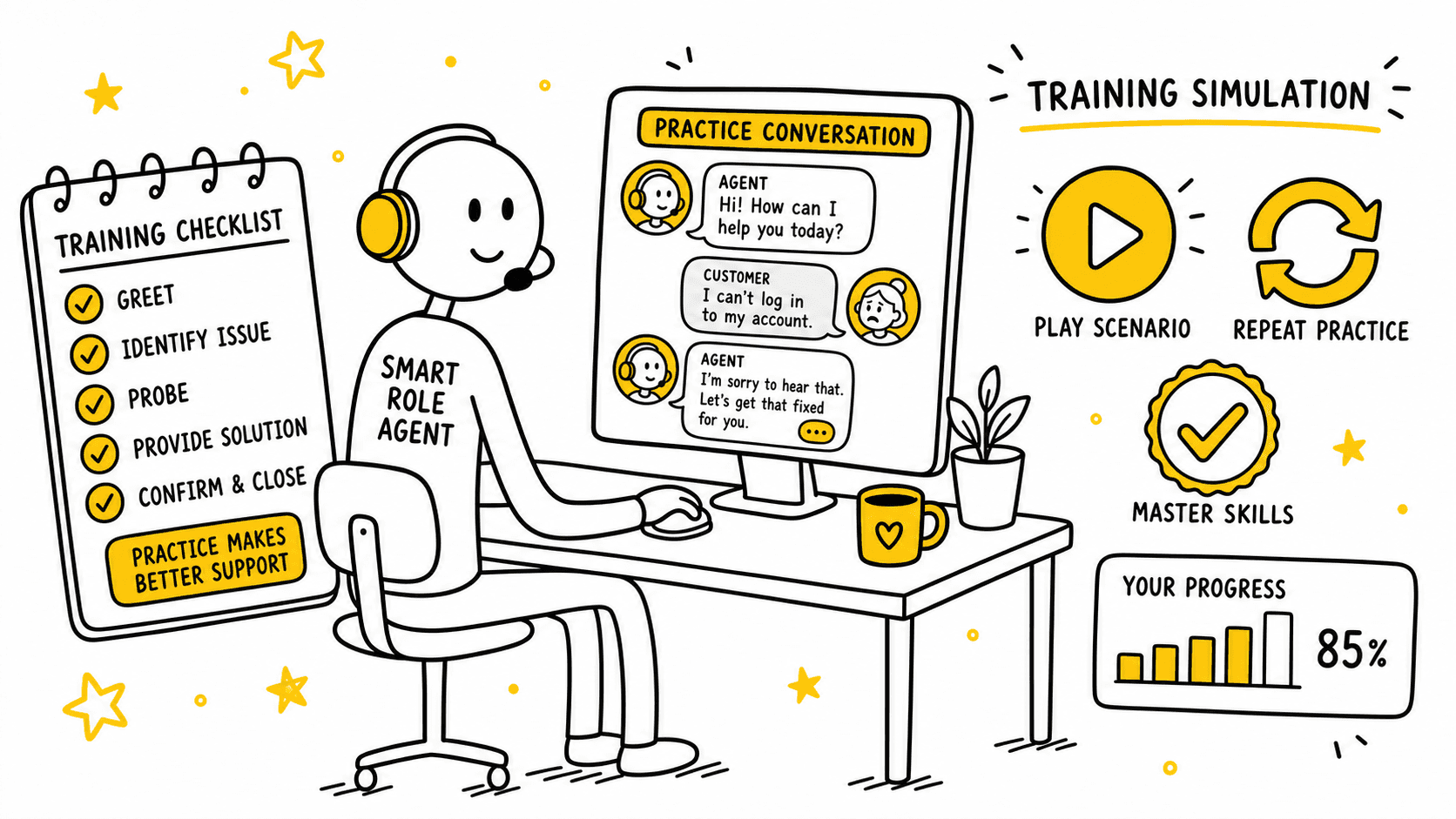
Simulation-based training for customer service is a learning approach that lets support agents practise realistic customer interactions in a risk-free environment using roleplays, scenarios, AI conversations, or virtual simulations that mirror real customer situations.
Customer service leaders face a difficult balance in 2026. Customers expect fast, accurate, empathetic support across channels, while organisations are under pressure to reduce onboarding time, improve quality assurance (QA), and control training costs. Traditional approaches such as classroom sessions, manuals, and shadowing remain useful, but they often leave a gap between knowledge and real-world performance.
Simulation-based training closes that gap. Instead of simply teaching policies and procedures, it allows agents to apply them in realistic conversations before they speak with live customers. Teams can practise difficult scenarios repeatedly, receive structured feedback, and build confidence without risking customer experience.
This guide explains what simulation-based training is, why learning science supports it, how to build a business case, and what to look for when evaluating platforms. It follows a learn → compare → buy journey and serves as the umbrella resource before diving deeper into implementation, software comparisons, and AI-powered roleplay tools.
TL;DR
Simulation-based training focuses on skill application, not just knowledge transfer.
Research on experiential learning, deliberate practice, and retrieval practice supports its effectiveness.
Customer service teams use simulations to reduce ramp time, improve QA consistency, and prepare agents for complex interactions.
AI-powered simulations make realistic practice scalable across large support teams and BPOs.
Platform selection should focus on realism, feedback quality, analytics, AI capabilities, and integrations.
What Is Simulation-Based Training for Customer Service?
Simulation-based training is a training method that recreates customer interactions so agents can practise handling real situations in a controlled environment.
Unlike traditional training, which often focuses on information delivery, simulation training focuses on performance. Agents must actively respond, solve problems, communicate effectively, and make decisions under realistic conditions.
Common formats include:
Live roleplay with trainers or peers
Branching scenario exercises
Voice call simulations
Chat simulations
Email response simulations
AI-powered customer roleplay
Omnichannel customer journey simulations
A new hire might complete a simulated refund request, a billing complaint, and a technical troubleshooting case before handling actual customers. An experienced agent might use simulations to prepare for a product launch or improve escalation management skills.
In mature support organisations, simulations are often mapped directly to competency frameworks. For example, a company may define core skills such as empathy, ownership, policy adherence, product knowledge, and problem-solving. Each simulation is then designed to assess and strengthen one or more of those competencies, creating a structured path from onboarding through advanced development.
Simulation training can support:
New hire onboarding
Continuous coaching
QA remediation
Leadership development
Compliance training
Product and policy updates
Traditional Training vs Simulation-Based Training
Traditional methods remain important, but they primarily transfer knowledge. Simulations allow learners to demonstrate and refine skills.
Training Method
Realism
Scalability
Feedback Speed
Skill Retention
Classroom
Low
Medium
Slow
Low
Shadowing
Medium
Low
Medium
Medium
Human Roleplay
High
Low
Medium
High
Simulation Training
High
High
Fast
High
The key difference is application.
Knowledge-based training asks:
- Do agents know the policy?
Simulation-based training asks:
- Can agents apply the policy correctly during a challenging customer interaction?
This distinction matters because customer service performance depends on behaviour, communication, judgement, and adaptability—not memorisation alone.
For organisations building a structured enablement programme, simulation training often sits alongside QA reviews, knowledge management, coaching, and workforce development initiatives.
Internal reference: /product/quality-review
Why Simulation-Based Training Works: The Learning Science
Simulation training is not simply a technology trend. Several well-established learning theories explain why it can improve performance.
Experiential Learning
Experiential Learning Theory, developed by David Kolb, proposes that learning occurs through a cycle of experience, reflection, conceptualisation, and experimentation.
Source: https://learningfromexperience.com/research-library/experiential-learning-theory
In customer service, agents learn more effectively when they:
Experience a realistic interaction
Reflect on what happened
Understand what worked or failed
Apply improvements in the next scenario
This learn-by-doing approach mirrors real workplace performance.
A practical example is a customer threatening to cancel a subscription. Reading retention policies helps, but handling a simulated cancellation conversation requires the agent to uncover root causes, demonstrate empathy, explain options, and negotiate a resolution. The learning becomes active rather than theoretical.
Deliberate Practice
Research by Anders Ericsson highlights the importance of deliberate practice for developing expertise.
Source: https://www.cambridge.org/core/books/cambridge-handbook-of-expertise-and-expert-performance
Deliberate practice involves:
Repetition
Targeted feedback
Increasing difficulty
Focus on specific skill improvement
For example, an agent struggling with empathy statements can repeatedly practise emotionally charged conversations until performance improves.
Traditional onboarding often provides limited repetitions. AI-driven simulations can provide hundreds.
Managers can also progressively increase complexity. An agent may start with straightforward billing questions, move to frustrated customers, and eventually handle scenarios involving multiple issues, escalations, and strict policy constraints.
Retrieval Practice and Active Recall
Retrieval practice research shows that recalling information strengthens learning more effectively than simply reviewing content.
Source: https://www.retrievalpractice.org
When agents actively retrieve:
Product knowledge
Policies
Escalation procedures
Troubleshooting steps
they build stronger memory pathways.
A simulation forces recall under realistic conditions. This is closer to the demands of a live customer interaction than reading a knowledge article.
Safe Failure Environments
One of the biggest advantages of simulations is the ability to fail safely.
Agents can:
Make mistakes
Experiment with responses
Learn consequences
Receive coaching
without affecting real customers.
This reduces anxiety and builds confidence before live deployment.
Safe practice environments are particularly valuable for:
Compliance-sensitive industries
Financial services
Healthcare support
Telecommunications
Complex technical support
Immediate Feedback Loops
Fast feedback accelerates learning.
Traditional coaching often relies on reviewing interactions days or weeks later. Simulation systems can provide immediate guidance after each exercise.
Feedback may cover:
Empathy
Policy adherence
Active listening
Resolution quality
Communication clarity
Immediate correction prevents bad habits from becoming established.
The best learning environments also create a feedback cycle. Agents receive feedback, repeat the exercise, compare scores, and track progress over time. This makes improvement visible and encourages ongoing skill development.
What the Research Says
Learning retention statistics from the frequently cited National Training Laboratories "Learning Pyramid" suggest active participation methods outperform passive methods. However, researchers have raised concerns about the methodology, so these figures should be treated cautiously rather than as definitive evidence.
Source: https://www.ncbi.nlm.nih.gov
More broadly, evidence supporting active learning is stronger. A large meta-analysis published in the Proceedings of the National Academy of Sciences found active learning improved student performance compared with traditional lecturing.
Source: https://www.ncbi.nlm.nih.gov/pmc/articles/PMC4060654/
For customer service specifically, published research on simulation outcomes is more limited, but practitioner evidence from organisations that have adopted simulation-based training suggests improvements in onboarding speed and coaching efficiency.
Key Use Cases for Simulation-Based Training in Customer Service
Reducing Onboarding Ramp Time
New agent ramp time—the period from hire date to full productivity—is a significant operational cost.
Common ramp time benchmarks:
Contact centres typically report 4 to 12 weeks depending on complexity
High-complexity support (technical, financial, healthcare) may take longer
Simulation training can compress this by allowing new hires to complete hundreds of practice interactions before live customer contact. Key mechanisms include:
Replacing or supplementing shadowing with structured scenario practice
Allowing agents to fail and learn in a controlled environment
Building confidence before live queues
The result is often faster time to competency and reduced dependency on experienced agents for shadowing.
Improving QA Consistency
Quality assurance frameworks define expected agent behaviour. Common QA criteria include:
Greeting and closing scripts
Empathy and tone
Accurate product or policy information
First contact resolution attempts
Escalation handling
When QA reviews identify gaps, simulation training provides a structured remediation path. Rather than asking agents to reread policies, managers can assign specific simulations targeting the identified weakness.
Simulations also standardise practice. Every agent experiences the same challenging scenario, making performance comparisons more reliable.
Preparing for High-Stakes Interactions
Some interactions carry high risk:
Regulatory complaints
Data breach notifications
Executive or VIP customer escalations
Legal or compliance-sensitive conversations
Simulating these before agents face them live reduces errors, improves tone, and ensures consistent handling.
For product launches or significant policy changes, all agents can practise the new scenario before it reaches customers. This is particularly valuable for BPOs managing multiple clients, where each client has distinct policies and expectations.
Coaching at Scale
In traditional coaching models, a team leader listens to a limited number of interactions and provides feedback. This process is slow and heavily dependent on the coach's time and skill.
AI-driven simulation platforms can:
Provide consistent feedback to every agent
Identify skill gaps across the team
Flag which agents need specific targeted support
Track individual improvement over time
This enables managers to shift focus from delivering basic feedback to addressing complex coaching needs and strategy.
Supporting Remote and Distributed Teams
Remote support teams present coaching challenges:
Limited observation opportunities
Reduced ad-hoc coaching moments
Inconsistent access to experienced colleagues
Simulation platforms that operate online provide a consistent coaching resource regardless of location. Remote agents in different time zones can practise scenarios whenever needed, without requiring a trainer to be present.
The Role of AI in Simulation-Based Training
Artificial intelligence has significantly expanded what simulation-based training can do.
Earlier Approaches
Before AI, simulation training relied on:
Scripted branching scenarios with predetermined conversation paths
Human role-players acting as customers
Video or audio recordings with assessment questions
These approaches have value but limitations. Scripted scenarios cannot adapt to unexpected responses, human role-players are expensive and inconsistent, and recorded content cannot respond interactively.
What AI Enables
AI-powered simulation platforms can create dynamic, responsive practice environments.
Core AI capabilities include:
Natural language processing to understand and respond to agent input
Customisable customer personas with distinct behaviours and emotional states
Scenario libraries covering hundreds of interaction types
Automated scoring against defined criteria
Instant transcripts and feedback reports
Agents interact with AI customers that react dynamically to their responses. An empathetic tone might de-escalate a frustrated customer. A poor response might cause the customer to demand a supervisor. This dynamic feedback loop is far more realistic than scripted trees.
Customisation and Context
Modern AI simulation platforms allow organisations to build scenarios using:
Their own products and services
Their specific policies and procedures
Industry-specific terminology
Customer profiles reflecting their actual user base
A telecommunications provider can build a scenario where an agent handles a frustrated customer who has experienced repeated outages. A financial services firm can simulate a customer disputing a transaction. A software company can build a scenario where an agent troubleshoots a complex technical issue while managing the customer's frustration.
This level of customisation makes practice directly relevant to the job, which improves knowledge transfer to real interactions.
AI Assessment and Analytics
AI assessment goes beyond simple pass/fail scoring. Advanced platforms can:
Score multiple competencies per interaction
Identify specific moments where performance dropped
Compare performance across teams and cohorts
Track trends over time
Flag agents who may need remediation
This data integrates with broader workforce management, QA, and LMS systems to create a connected view of agent capability.
Building a Business Case for Simulation-Based Training
Leadership teams evaluating training investments will typically expect evidence that costs are justified by measurable business outcomes.
Key Metrics to Quantify
Onboarding cost reduction
Average cost per new hire (salary, trainer time, infrastructure)
Reduction in ramp time (weeks to productivity)
Reduced reliance on senior agent shadowing
QA improvement
Average QA score before and after simulation
Reduction in QA-identified errors
Decrease in repeat contacts related to agent error
CSAT and NPS impact
Customer satisfaction score changes correlated with training participation
Net promoter score trends for teams using simulation
Agent retention
Correlation between structured development programmes and attrition
Cost of attrition (hire, onboard, ramp costs per lost agent)
Operational efficiency
Average handle time (AHT) reduction
First contact resolution (FCR) improvement
Escalation rate reduction
Typical ROI Framing
A simplified business case might frame the investment as follows:
Example calculation (illustrative only):
100 new agents onboarded per year
Average ramp time reduced from 8 weeks to 6 weeks per agent
2 weeks x 100 agents x cost per week = savings estimate
Plus QA improvement, reduced attrition, CSAT uplift
Each organisation will need to calibrate these figures against their own data, but this framework provides a starting point for finance team discussions.
Pilot Approach
If leadership wants evidence before committing to a full rollout, a pilot programme structure typically includes:
A defined cohort of new hires or agents in a specific team
A control group using traditional training methods
Measurement of agreed KPIs over 30 to 90 days
A comparison report at the end of the pilot
This reduces risk and builds internal evidence to support the broader business case.
What to Look for When Evaluating Simulation Platforms
Choosing the right platform depends on organisational size, support complexity, existing systems, and budget. The following framework covers the core evaluation areas.
Realism and Scenario Quality
The core value of a simulation is its realism. Evaluate:
How convincingly the AI customer responds
Whether personas can express frustration, confusion, and satisfaction naturally
How well the system handles unexpected or creative agent responses
The breadth of scenario types available out of the box
How easy it is to build custom scenarios
Poor realism undermines the training value. Agents who experience obviously scripted or robotic simulations disengage quickly.
Feedback Quality
Feedback is what turns practice into learning. Evaluate:
Whether feedback is immediate or delayed
The specificity of the feedback (general comments vs targeted moment-by-moment analysis)
Whether the platform scores against your own competency framework
How feedback is communicated to agents (written reports, scores, conversation replays)
Whether managers can add qualitative coaching notes
A platform that produces only a pass/fail score provides limited coaching value. Look for platforms that identify specific moments, quote agent responses, and explain what the ideal response would have been.
Analytics and Reporting
Training programmes must demonstrate impact. Evaluate:
Individual agent dashboards
Team and cohort-level reporting
Trend analysis over time
Integration with QA and workforce management data
Ability to export data for custom analysis
Robust analytics allow managers to identify skill gaps proactively, rather than waiting for QA or CSAT scores to decline.
AI Capabilities
Not all AI simulation platforms are equal. Evaluate:
The underlying AI model (proprietary, GPT-based, or other)
Naturalness and coherence of AI customer responses
The ability to customise AI behaviour and personas
How the system handles edge cases and unusual agent responses
Voice simulation capability (if relevant for phone-based teams)
Integrations
A simulation platform that sits in isolation from other systems creates administrative overhead. Evaluate:
LMS integration (for assigning and tracking simulations within existing learning flows)
HRIS integration (for linking training data to employee records)
QA platform integration (for connecting simulation performance with live QA scores)
SSO support
Scalability and Administration
Evaluate how the platform scales as your team grows:
How scenarios are created and updated
How agents are managed and organised
Pricing model (per seat, per simulation, per outcome)
Support for multiple languages or regions
Vendor Stability and Support
Particularly relevant for enterprise buyers:
Vendor history and funding status
Customer references and case studies
Implementation support and onboarding
Ongoing technical support SLAs
Platform Comparison Overview
The simulation training platform market includes a range of tools with different specialisations. A detailed comparison of leading platforms—including AI roleplay tools, scenario-based LMS products, and enterprise simulation suites—is covered in a separate guide.
Internal reference: /blog/simulation-training-software
Evaluation Area
Key Questions
Realism
Does the AI respond naturally? Can you customise personas?
Feedback
Is feedback specific, immediate, and competency-mapped?
Analytics
Can you track trends, cohorts, and individual progress?
AI capabilities
Is the underlying model strong and customisable?
Integrations
Does it connect to your LMS, HRIS, and QA tools?
Scalability
Can it grow with your team across regions and languages?
Vendor
Is the company stable, with references and strong support?
Implementation Considerations
Even the best platform fails if implementation is poor. The most common implementation challenges are:
Scenario Design
Creating high-quality scenarios requires:
Clear learning objectives per scenario
Realistic customer personas
Appropriate difficulty levels
Alignment to competency frameworks
Many platforms provide scenario design support as part of onboarding, but internal subject matter experts (SMEs) are often needed to review and validate scenarios for accuracy.
Manager Buy-In
Simulation training works best when managers actively use the analytics. If managers ignore platform data and continue coaching only from live QA reviews, the investment is underutilised.
Success requires:
Manager training on the platform
Integration of simulation data into regular coaching conversations
Leadership support for the programme
Agent Adoption
Agents may initially be resistant, particularly if simulation is perceived as surveillance or punitive assessment. Positioning simulation as a development tool rather than a performance management tool encourages adoption.
Best practices include:
Communicating the purpose clearly
Involving agents in scenario feedback
Celebrating improvement, not just absolute scores
Making simulations low-stakes in early stages
Connecting Simulation to the Broader Enablement Ecosystem
Simulation training is most effective when it connects to the wider learning and quality ecosystem.
Typical connections include:
Knowledge base: agents should be able to reference the knowledge base during simulations, mirroring real conditions
QA: QA-identified weaknesses should trigger targeted simulation assignments
LMS: simulation completions and scores should flow into the LMS for compliance and development tracking
Coaching: simulation data should inform coaching agendas
Workforce management: training scheduling should consider agent availability and queue demand
Internal reference: /blog/customer-service-coaching
Organisations that treat simulation as a standalone tool miss the opportunity to embed it in a continuous improvement loop.
Frequently Asked Questions
What is simulation-based training in customer service?
Simulation-based training is a method that allows customer service agents to practise realistic customer interactions in a controlled environment. It includes formats such as AI-powered roleplays, branching scenarios, voice simulations, chat simulations, and email response exercises. The goal is to build applied skills before agents handle live customers.
How does simulation training differ from traditional training?
Traditional training primarily transfers knowledge through classroom sessions, manuals, e-learning, and shadowing. Simulation training focuses on skill application, requiring agents to respond, communicate, and make decisions in realistic scenarios. The key advantage is that agents practise doing the job, not just learning about it.
Is simulation-based training supported by learning science?
Yes. Simulation-based training aligns with several established learning theories, including experiential learning (Kolb), deliberate practice (Ericsson), and retrieval practice research. These frameworks support the value of active, practice-based learning over passive information consumption.
How does AI improve simulation-based training?
AI enables dynamic, responsive simulations that adapt to agent responses in real time. AI-powered customer personas can express different emotional states, escalate or de-escalate based on agent behaviour, and provide immediate automated feedback. This makes practice more realistic and scalable than scripted scenarios or human role-players.
What metrics should I use to measure the ROI of simulation training?
Key metrics include onboarding ramp time, QA score improvement, CSAT and NPS changes, agent retention rates, first contact resolution rates, and average handle time. A pilot programme comparing a trained cohort against a control group is a useful way to build early evidence.
What should I look for when choosing a simulation platform?
Evaluate realism, feedback quality, analytics depth, AI capabilities, integration options, scalability, and vendor stability. Avoid platforms that provide only pass/fail scoring without specific, actionable feedback. Check whether the platform supports your channels (voice, chat, email) and can be customised to your products and policies.
How long does it take to implement a simulation training programme?
Implementation timelines vary. Basic rollouts with existing scenario libraries can take two to four weeks. Custom scenario design, integrations with LMS or QA systems, and multi-site deployments typically take two to four months. Involving internal SMEs early accelerates the scenario design phase.
Can simulation training work for remote or distributed teams?
Yes. Cloud-based simulation platforms are channel-agnostic. Remote agents can complete simulations on demand without requiring a trainer to be present. This makes simulation particularly valuable for distributed teams, offshore BPOs, and organisations with inconsistent access to experienced coaches.
About the Author
Thibaut Martin is COO of Smart Role, an AI-powered training platform for customer support teams and BPOs. Before joining Smart Role, he worked at Google and later led customer experience operations at Otrium, where he was responsible for support performance and quality assurance.
Sources
Kolb, D. A. (1984). Experiential Learning: Experience as the Source of Learning and Development. Prentice Hall. https://learningfromexperience.com/research-library/experiential-learning-theory
Ericsson, K. A., Krampe, R. T., & Tesch-Römer, C. (1993). The role of deliberate practice in the acquisition of expert performance. Psychological Review. https://www.cambridge.org/core/books/cambridge-handbook-of-expertise-and-expert-performance
Retrieval Practice Research Network. https://www.retrievalpractice.org
Freeman, S. et al. (2014). Active learning increases student performance in science, engineering, and mathematics. PNAS. https://www.ncbi.nlm.nih.gov/pmc/articles/PMC4060654/
National Training Laboratories. Learning Pyramid (with caveats noted). https://www.ncbi.nlm.nih.gov