Travel

Travel

Travel

Top Travel Customer Service Training Scenarios & Tips (2025)

23 janv. 2026

23 janv. 2026

7 min read

7 min read

/ / / / / / / /

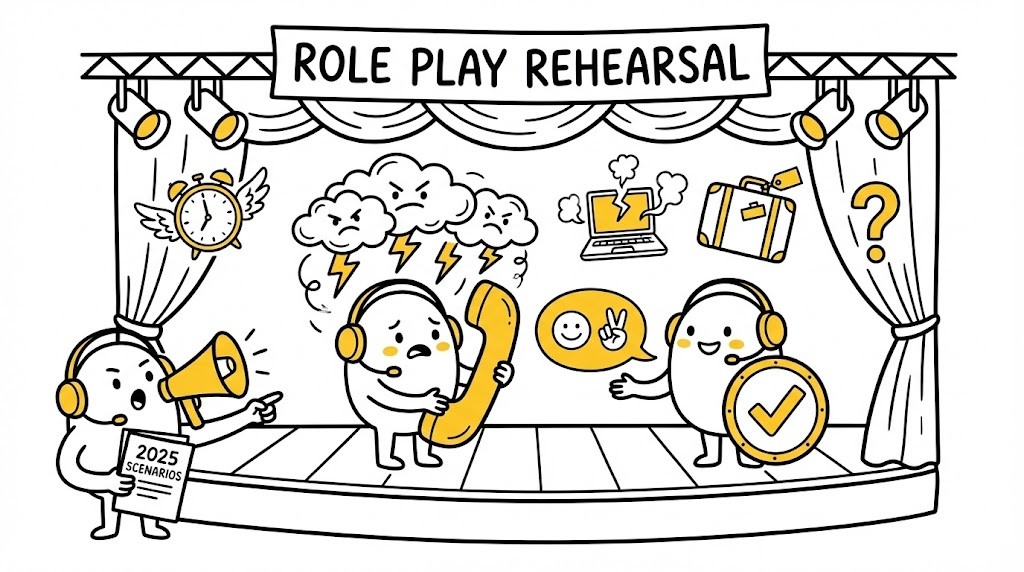
Exceptional customer service is the backbone of the travel industry. Whether it’s airlines, hotels, or travel agencies, every customer interaction can impact loyalty and reputation. Scenario-based training is a proven method to prepare teams for the unpredictable nature of travel, from routine requests to high-pressure emergencies. This article explores why scenario-based learning works, the key elements of effective scenarios, eight essential examples, and practical tips for implementing training that truly elevates guest satisfaction.


TL;DR

• Scenario-based training builds real-world skills for travel teams.

• Focus on realism, relevance, and variety in your scenarios.

• Cover both everyday and crisis situations (e.g., delays, emergencies).

• Use digital tools and feedback loops for continuous improvement.

• Regularly update scenarios to reflect current travel challenges.


Why Scenario-Based Training Matters in Travel Customer Service

Travel customer service faces unique challenges: language barriers, cultural differences, emergencies, and high-stress situations are common. Agents must be ready to handle everything from lost luggage to medical incidents, often under time pressure and public scrutiny.

Scenario-based training immerses staff in realistic situations, boosting engagement and knowledge retention. According to a 2021 AHA study, role-play and scenario learning improved staff confidence and empathy in high-stakes environments (Source: AHA, 2021: https://www.aha.org/education-events/aha-center-health-innovation-market-scan/2021-09-21-role-playing-helps-improve-patient-experience). In travel, this translates to faster, more consistent responses and higher customer satisfaction scores (Source: Zendesk, 2024: https://www.zendesk.com/blog/customer-service-training/).


Key Elements of Effective Travel Customer Service Training Scenarios

To maximise impact, travel customer service scenarios should be:

• Realistic: Mirror actual customer interactions, using authentic language and situations.

• Relevant: Tailored to specific roles—what a hotel concierge faces differs from an airline gate agent.

• Varied: Include both routine (check-ins, bookings) and crisis (emergencies, overbookings) scenarios.

• Feedback-driven: Incorporate structured debriefs and coaching, ideally with AI-powered or peer review.


Checklist: Building Effective Training Scenarios

• Reflects real customer issues from recent logs

• Customised to the team’s daily challenges

• Includes both positive and negative outcomes

• Provides clear learning objectives

• Ends with actionable feedback and coaching


8 Essential Travel Customer Service Training Scenarios

1) Handling Flight Delays and Cancellations

Situation: A flight is delayed due to weather, and passengers are anxious about missed connections.

Learning Objectives: Demonstrate empathy, communicate clearly, offer alternatives.

Example Dialogue:

Agent: “I understand how frustrating this delay is. Let me check alternative flights or accommodation for you.”

Trainer Tips: Encourage agents to acknowledge emotions first, then provide solutions. Use role-play to practise delivering bad news with empathy.

2) Managing Overbooked Hotels or Flights

Situation: A guest arrives, but the hotel or flight is overbooked.

Learning Objectives: Conflict resolution, compensation offers, escalation protocols.

Example Dialogue:

Agent: “I apologise for the inconvenience. We can arrange a room at a nearby hotel and cover your transport.”

Trainer Tips: Practise calm, assertive communication. Discuss when to escalate to a supervisor.

3) Dealing with Lost Luggage or Property

Situation: A traveller’s luggage is missing after arrival.

Learning Objectives: Apologise sincerely, explain the tracking process, reassure the customer.

Example Dialogue:

Agent: “I’m sorry your bag hasn’t arrived. I’ll file a report and keep you updated every step of the way.”

Trainer Tips: Emphasise regular updates and proactive communication.

4) Assisting Non-English Speaking Travelers

Situation: A guest struggles to communicate due to language barriers.

Learning Objectives: Use translation tools, patience, nonverbal cues.

Example Dialogue:

Agent (using translation app): “Welcome! How can I help you today?” (gestures to assist)

Trainer Tips: Practise using digital translation tools and basic phrases in common languages.

5) Responding to Medical Emergencies

Situation: A passenger faints at the airport check-in desk.

Learning Objectives: Stay calm, follow emergency protocols, contact authorities.

Example Dialogue:

Agent: “Please stay calm. I’m calling medical assistance now. Is anyone here a doctor?”

Trainer Tips: Review emergency procedures and role-play urgent response.

6) Addressing Cultural Sensitivities

Situation: A guest is offended by a gesture or comment due to cultural differences.

Learning Objectives: Cultural awareness, respectful communication, adapting service.

Example Dialogue:

Agent: “I apologise if I caused offence. Could you share how we can make your stay more comfortable?”

Trainer Tips: Use real-world examples to discuss cultural norms and respectful language.

7) Managing Difficult or Aggressive Customers

Situation: A traveller becomes verbally aggressive after a missed connection.

Learning Objectives: De-escalation, setting boundaries, personal safety.

Example Dialogue:

Agent: “I want to help, but I need us to speak calmly. Let’s find a solution together.”

Trainer Tips: Practise de-escalation scripts and when to seek security support.

8) Handling Special Requests (Accessibility, Dietary, etc.)

Situation: A guest requests a wheelchair or has a specific dietary need.

Learning Objectives: Proactive solutions, documentation, follow-up.

Example Dialogue:

Agent: “We’ve arranged a wheelchair for your arrival and noted your dietary preferences.”

Trainer Tips: Emphasise anticipating needs and confirming arrangements in writing.


Framework: Scenario Debrief Template

1) What went well?

2) What could be improved?

3) How did the customer feel?

4) What would you do differently next time?

5) What resources or tools could help?


Best Practices for Implementing Scenario-Based Training in Travel Teams

• Blended learning: Combine live role-play, e-learning modules, and AI-powered simulations for flexible, scalable training (Source: iSpring, 2024: https://www.ispringsolutions.com/blog/role-playing-scenarios-for-customer-service-training).

• Peer feedback: Use group debriefs and peer reviews to reinforce learning.

• Continuous improvement: Regularly update scenarios based on real incidents and customer feedback (Source: Forbes, 2022: https://www.forbes.com/sites/forbesbusinesscouncil/2022/11/16/how-to-create-effective-customer-service-training-programs/).

• Measure effectiveness: Track KPIs such as CSAT, first contact resolution, and post-training assessments.

https://smartrole.ai/product/quality-review


Tools and Resources for Travel Customer Service Training

• Digital platforms: iSpring, Smart Role, Zendesk for scenario creation and simulation (Source: Smart Role, 2025: https://www.smartrole.ai/).

• Scenario libraries: Ready-made scenarios from IATA and AHLEI (Source: IATA, 2025: https://www.iata.org/en/training/courses/customer-service/; AHLEI, 2025: https://www.ahlei.org/credentials/certifications/certified-guest-service-professional/).

• Certifications: Industry-recognised credentials for guest service.

• Customisation tips: Adapt scenarios to reflect your company’s policies, customer profiles, and recent incidents.

https://smartrole.ai/blog/call-center-scripts


Case Studies: Success Stories from Leading Travel Brands

Major airlines and hotel chains have reported double-digit improvements in CSAT after adopting scenario-based training (Source: TTEC, 2024: https://www.ttec.com/resources/articles/5-ways-travel-companies-can-improve-customer-experience). For example, one global airline reduced complaint resolution time by 30% after introducing AI-powered simulations and peer debriefs.


Conclusion & Next Steps

Scenario-based training is essential for travel teams facing complex, real-world challenges. Start by adopting or customising these scenarios—and try a sample simulation or contact us for a demo.

Related reading

• AI-Powered Simulations — https://smartrole.ai/services/ai-powered-simulations

• Call Center Scripts — https://smartrole.ai/blog/call-center-scripts

• E-Learning Tools — https://smartrole.ai/resources/e-learning-tools

• Cultural Competency Training — https://smartrole.ai/blog/cultural-competency-training

• Quality Review Tools — https://smartrole.ai/product/quality-review

• Travel Industry Consulting — https://smartrole.ai/services/travel-industry-consulting

• Customer Satisfaction Metrics — https://smartrole.ai/blog/customer-satisfaction-metrics

• Customer Service Strategies — https://smartrole.ai/blog/customer-service-strategies


FAQ

What are the most common travel customer service scenarios for training?

Common scenarios include handling flight delays, overbookings, lost luggage, medical emergencies, and assisting non-English speaking travellers.

How can scenario-based training improve customer satisfaction in travel?

Scenario-based training prepares agents for real-world situations, improving their confidence, empathy, and problem-solving skills, which leads to higher customer satisfaction.

What tools can I use to create realistic travel customer service scenarios?

Popular tools include iSpring, Smart Role, Zendesk, and industry scenario libraries from IATA and AHLEI.

How often should travel companies update their training scenarios?

Best practice is to review and update scenarios at least quarterly, or whenever new challenges or incidents arise.


About the author

Thibaut Martin is the COO of Smart Role, specialising in AI-powered training for support agents and BPOs. Formerly a CX lead at Google and Otrium, Thibaut brings over a decade of hands-on experience in customer experience strategy, training design, and digital transformation for global travel and tech brands. Smart Role is a SOC 2 Type 2 and ISO certified company, trusted by leading enterprises for secure, effective training solutions.

Sources

1) https://www.ispringsolutions.com/blog/role-playing-scenarios-for-customer-service-training

2) https://www.aha.org/education-events/aha-center-health-innovation-market-scan/2021-09-21-role-playing-helps-improve-patient-experience

3) https://www.iata.org/en/training/courses/customer-service/

4) https://www.ahlei.org/credentials/certifications/certified-guest-service-professional/

5) https://www.zendesk.com/blog/customer-service-training/

6) https://www.ttec.com/resources/articles/5-ways-travel-companies-can-improve-customer-experience

7) https://www.travelweekly.com/Travel-News/Travel-Agent-Issues/Customer-service-training-takes-on-new-urgency

8) https://www.forbes.com/sites/forbesbusinesscouncil/2022/11/16/how-to-create-effective-customer-service-training-programs/

9) https://www.shrm.org/resourcesandtools/hr-topics/organizational-and-employee-development/pages/role-play-training.aspx

10) https://www.smartrole.ai/

Exceptional customer service is the backbone of the travel industry. Whether it’s airlines, hotels, or travel agencies, every customer interaction can impact loyalty and reputation. Scenario-based training is a proven method to prepare teams for the unpredictable nature of travel, from routine requests to high-pressure emergencies. This article explores why scenario-based learning works, the key elements of effective scenarios, eight essential examples, and practical tips for implementing training that truly elevates guest satisfaction.


TL;DR

• Scenario-based training builds real-world skills for travel teams.

• Focus on realism, relevance, and variety in your scenarios.

• Cover both everyday and crisis situations (e.g., delays, emergencies).

• Use digital tools and feedback loops for continuous improvement.

• Regularly update scenarios to reflect current travel challenges.


Why Scenario-Based Training Matters in Travel Customer Service

Travel customer service faces unique challenges: language barriers, cultural differences, emergencies, and high-stress situations are common. Agents must be ready to handle everything from lost luggage to medical incidents, often under time pressure and public scrutiny.

Scenario-based training immerses staff in realistic situations, boosting engagement and knowledge retention. According to a 2021 AHA study, role-play and scenario learning improved staff confidence and empathy in high-stakes environments (Source: AHA, 2021: https://www.aha.org/education-events/aha-center-health-innovation-market-scan/2021-09-21-role-playing-helps-improve-patient-experience). In travel, this translates to faster, more consistent responses and higher customer satisfaction scores (Source: Zendesk, 2024: https://www.zendesk.com/blog/customer-service-training/).


Key Elements of Effective Travel Customer Service Training Scenarios

To maximise impact, travel customer service scenarios should be:

• Realistic: Mirror actual customer interactions, using authentic language and situations.

• Relevant: Tailored to specific roles—what a hotel concierge faces differs from an airline gate agent.

• Varied: Include both routine (check-ins, bookings) and crisis (emergencies, overbookings) scenarios.

• Feedback-driven: Incorporate structured debriefs and coaching, ideally with AI-powered or peer review.


Checklist: Building Effective Training Scenarios

• Reflects real customer issues from recent logs

• Customised to the team’s daily challenges

• Includes both positive and negative outcomes

• Provides clear learning objectives

• Ends with actionable feedback and coaching


8 Essential Travel Customer Service Training Scenarios

1) Handling Flight Delays and Cancellations

Situation: A flight is delayed due to weather, and passengers are anxious about missed connections.

Learning Objectives: Demonstrate empathy, communicate clearly, offer alternatives.

Example Dialogue:

Agent: “I understand how frustrating this delay is. Let me check alternative flights or accommodation for you.”

Trainer Tips: Encourage agents to acknowledge emotions first, then provide solutions. Use role-play to practise delivering bad news with empathy.

2) Managing Overbooked Hotels or Flights

Situation: A guest arrives, but the hotel or flight is overbooked.

Learning Objectives: Conflict resolution, compensation offers, escalation protocols.

Example Dialogue:

Agent: “I apologise for the inconvenience. We can arrange a room at a nearby hotel and cover your transport.”

Trainer Tips: Practise calm, assertive communication. Discuss when to escalate to a supervisor.

3) Dealing with Lost Luggage or Property

Situation: A traveller’s luggage is missing after arrival.

Learning Objectives: Apologise sincerely, explain the tracking process, reassure the customer.

Example Dialogue:

Agent: “I’m sorry your bag hasn’t arrived. I’ll file a report and keep you updated every step of the way.”

Trainer Tips: Emphasise regular updates and proactive communication.

4) Assisting Non-English Speaking Travelers

Situation: A guest struggles to communicate due to language barriers.

Learning Objectives: Use translation tools, patience, nonverbal cues.

Example Dialogue:

Agent (using translation app): “Welcome! How can I help you today?” (gestures to assist)

Trainer Tips: Practise using digital translation tools and basic phrases in common languages.

5) Responding to Medical Emergencies

Situation: A passenger faints at the airport check-in desk.

Learning Objectives: Stay calm, follow emergency protocols, contact authorities.

Example Dialogue:

Agent: “Please stay calm. I’m calling medical assistance now. Is anyone here a doctor?”

Trainer Tips: Review emergency procedures and role-play urgent response.

6) Addressing Cultural Sensitivities

Situation: A guest is offended by a gesture or comment due to cultural differences.

Learning Objectives: Cultural awareness, respectful communication, adapting service.

Example Dialogue:

Agent: “I apologise if I caused offence. Could you share how we can make your stay more comfortable?”

Trainer Tips: Use real-world examples to discuss cultural norms and respectful language.

7) Managing Difficult or Aggressive Customers

Situation: A traveller becomes verbally aggressive after a missed connection.

Learning Objectives: De-escalation, setting boundaries, personal safety.

Example Dialogue:

Agent: “I want to help, but I need us to speak calmly. Let’s find a solution together.”

Trainer Tips: Practise de-escalation scripts and when to seek security support.

8) Handling Special Requests (Accessibility, Dietary, etc.)

Situation: A guest requests a wheelchair or has a specific dietary need.

Learning Objectives: Proactive solutions, documentation, follow-up.

Example Dialogue:

Agent: “We’ve arranged a wheelchair for your arrival and noted your dietary preferences.”

Trainer Tips: Emphasise anticipating needs and confirming arrangements in writing.


Framework: Scenario Debrief Template

1) What went well?

2) What could be improved?

3) How did the customer feel?

4) What would you do differently next time?

5) What resources or tools could help?


Best Practices for Implementing Scenario-Based Training in Travel Teams

• Blended learning: Combine live role-play, e-learning modules, and AI-powered simulations for flexible, scalable training (Source: iSpring, 2024: https://www.ispringsolutions.com/blog/role-playing-scenarios-for-customer-service-training).

• Peer feedback: Use group debriefs and peer reviews to reinforce learning.

• Continuous improvement: Regularly update scenarios based on real incidents and customer feedback (Source: Forbes, 2022: https://www.forbes.com/sites/forbesbusinesscouncil/2022/11/16/how-to-create-effective-customer-service-training-programs/).

• Measure effectiveness: Track KPIs such as CSAT, first contact resolution, and post-training assessments.

https://smartrole.ai/product/quality-review


Tools and Resources for Travel Customer Service Training

• Digital platforms: iSpring, Smart Role, Zendesk for scenario creation and simulation (Source: Smart Role, 2025: https://www.smartrole.ai/).

• Scenario libraries: Ready-made scenarios from IATA and AHLEI (Source: IATA, 2025: https://www.iata.org/en/training/courses/customer-service/; AHLEI, 2025: https://www.ahlei.org/credentials/certifications/certified-guest-service-professional/).

• Certifications: Industry-recognised credentials for guest service.

• Customisation tips: Adapt scenarios to reflect your company’s policies, customer profiles, and recent incidents.

https://smartrole.ai/blog/call-center-scripts


Case Studies: Success Stories from Leading Travel Brands

Major airlines and hotel chains have reported double-digit improvements in CSAT after adopting scenario-based training (Source: TTEC, 2024: https://www.ttec.com/resources/articles/5-ways-travel-companies-can-improve-customer-experience). For example, one global airline reduced complaint resolution time by 30% after introducing AI-powered simulations and peer debriefs.


Conclusion & Next Steps

Scenario-based training is essential for travel teams facing complex, real-world challenges. Start by adopting or customising these scenarios—and try a sample simulation or contact us for a demo.

Related reading

• AI-Powered Simulations — https://smartrole.ai/services/ai-powered-simulations

• Call Center Scripts — https://smartrole.ai/blog/call-center-scripts

• E-Learning Tools — https://smartrole.ai/resources/e-learning-tools

• Cultural Competency Training — https://smartrole.ai/blog/cultural-competency-training

• Quality Review Tools — https://smartrole.ai/product/quality-review

• Travel Industry Consulting — https://smartrole.ai/services/travel-industry-consulting

• Customer Satisfaction Metrics — https://smartrole.ai/blog/customer-satisfaction-metrics

• Customer Service Strategies — https://smartrole.ai/blog/customer-service-strategies


FAQ

What are the most common travel customer service scenarios for training?

Common scenarios include handling flight delays, overbookings, lost luggage, medical emergencies, and assisting non-English speaking travellers.

How can scenario-based training improve customer satisfaction in travel?

Scenario-based training prepares agents for real-world situations, improving their confidence, empathy, and problem-solving skills, which leads to higher customer satisfaction.

What tools can I use to create realistic travel customer service scenarios?

Popular tools include iSpring, Smart Role, Zendesk, and industry scenario libraries from IATA and AHLEI.

How often should travel companies update their training scenarios?

Best practice is to review and update scenarios at least quarterly, or whenever new challenges or incidents arise.


About the author

Thibaut Martin is the COO of Smart Role, specialising in AI-powered training for support agents and BPOs. Formerly a CX lead at Google and Otrium, Thibaut brings over a decade of hands-on experience in customer experience strategy, training design, and digital transformation for global travel and tech brands. Smart Role is a SOC 2 Type 2 and ISO certified company, trusted by leading enterprises for secure, effective training solutions.

Sources

1) https://www.ispringsolutions.com/blog/role-playing-scenarios-for-customer-service-training

2) https://www.aha.org/education-events/aha-center-health-innovation-market-scan/2021-09-21-role-playing-helps-improve-patient-experience

3) https://www.iata.org/en/training/courses/customer-service/

4) https://www.ahlei.org/credentials/certifications/certified-guest-service-professional/

5) https://www.zendesk.com/blog/customer-service-training/

6) https://www.ttec.com/resources/articles/5-ways-travel-companies-can-improve-customer-experience

7) https://www.travelweekly.com/Travel-News/Travel-Agent-Issues/Customer-service-training-takes-on-new-urgency

8) https://www.forbes.com/sites/forbesbusinesscouncil/2022/11/16/how-to-create-effective-customer-service-training-programs/

9) https://www.shrm.org/resourcesandtools/hr-topics/organizational-and-employee-development/pages/role-play-training.aspx

10) https://www.smartrole.ai/

Exceptional customer service is the backbone of the travel industry. Whether it’s airlines, hotels, or travel agencies, every customer interaction can impact loyalty and reputation. Scenario-based training is a proven method to prepare teams for the unpredictable nature of travel, from routine requests to high-pressure emergencies. This article explores why scenario-based learning works, the key elements of effective scenarios, eight essential examples, and practical tips for implementing training that truly elevates guest satisfaction.


TL;DR

• Scenario-based training builds real-world skills for travel teams.

• Focus on realism, relevance, and variety in your scenarios.

• Cover both everyday and crisis situations (e.g., delays, emergencies).

• Use digital tools and feedback loops for continuous improvement.

• Regularly update scenarios to reflect current travel challenges.


Why Scenario-Based Training Matters in Travel Customer Service

Travel customer service faces unique challenges: language barriers, cultural differences, emergencies, and high-stress situations are common. Agents must be ready to handle everything from lost luggage to medical incidents, often under time pressure and public scrutiny.

Scenario-based training immerses staff in realistic situations, boosting engagement and knowledge retention. According to a 2021 AHA study, role-play and scenario learning improved staff confidence and empathy in high-stakes environments (Source: AHA, 2021: https://www.aha.org/education-events/aha-center-health-innovation-market-scan/2021-09-21-role-playing-helps-improve-patient-experience). In travel, this translates to faster, more consistent responses and higher customer satisfaction scores (Source: Zendesk, 2024: https://www.zendesk.com/blog/customer-service-training/).


Key Elements of Effective Travel Customer Service Training Scenarios

To maximise impact, travel customer service scenarios should be:

• Realistic: Mirror actual customer interactions, using authentic language and situations.

• Relevant: Tailored to specific roles—what a hotel concierge faces differs from an airline gate agent.

• Varied: Include both routine (check-ins, bookings) and crisis (emergencies, overbookings) scenarios.

• Feedback-driven: Incorporate structured debriefs and coaching, ideally with AI-powered or peer review.


Checklist: Building Effective Training Scenarios

• Reflects real customer issues from recent logs

• Customised to the team’s daily challenges

• Includes both positive and negative outcomes

• Provides clear learning objectives

• Ends with actionable feedback and coaching


8 Essential Travel Customer Service Training Scenarios

1) Handling Flight Delays and Cancellations

Situation: A flight is delayed due to weather, and passengers are anxious about missed connections.

Learning Objectives: Demonstrate empathy, communicate clearly, offer alternatives.

Example Dialogue:

Agent: “I understand how frustrating this delay is. Let me check alternative flights or accommodation for you.”

Trainer Tips: Encourage agents to acknowledge emotions first, then provide solutions. Use role-play to practise delivering bad news with empathy.

2) Managing Overbooked Hotels or Flights

Situation: A guest arrives, but the hotel or flight is overbooked.

Learning Objectives: Conflict resolution, compensation offers, escalation protocols.

Example Dialogue:

Agent: “I apologise for the inconvenience. We can arrange a room at a nearby hotel and cover your transport.”

Trainer Tips: Practise calm, assertive communication. Discuss when to escalate to a supervisor.

3) Dealing with Lost Luggage or Property

Situation: A traveller’s luggage is missing after arrival.

Learning Objectives: Apologise sincerely, explain the tracking process, reassure the customer.

Example Dialogue:

Agent: “I’m sorry your bag hasn’t arrived. I’ll file a report and keep you updated every step of the way.”

Trainer Tips: Emphasise regular updates and proactive communication.

4) Assisting Non-English Speaking Travelers

Situation: A guest struggles to communicate due to language barriers.

Learning Objectives: Use translation tools, patience, nonverbal cues.

Example Dialogue:

Agent (using translation app): “Welcome! How can I help you today?” (gestures to assist)

Trainer Tips: Practise using digital translation tools and basic phrases in common languages.

5) Responding to Medical Emergencies

Situation: A passenger faints at the airport check-in desk.

Learning Objectives: Stay calm, follow emergency protocols, contact authorities.

Example Dialogue:

Agent: “Please stay calm. I’m calling medical assistance now. Is anyone here a doctor?”

Trainer Tips: Review emergency procedures and role-play urgent response.

6) Addressing Cultural Sensitivities

Situation: A guest is offended by a gesture or comment due to cultural differences.

Learning Objectives: Cultural awareness, respectful communication, adapting service.

Example Dialogue:

Agent: “I apologise if I caused offence. Could you share how we can make your stay more comfortable?”

Trainer Tips: Use real-world examples to discuss cultural norms and respectful language.

7) Managing Difficult or Aggressive Customers

Situation: A traveller becomes verbally aggressive after a missed connection.

Learning Objectives: De-escalation, setting boundaries, personal safety.

Example Dialogue:

Agent: “I want to help, but I need us to speak calmly. Let’s find a solution together.”

Trainer Tips: Practise de-escalation scripts and when to seek security support.

8) Handling Special Requests (Accessibility, Dietary, etc.)

Situation: A guest requests a wheelchair or has a specific dietary need.

Learning Objectives: Proactive solutions, documentation, follow-up.

Example Dialogue:

Agent: “We’ve arranged a wheelchair for your arrival and noted your dietary preferences.”

Trainer Tips: Emphasise anticipating needs and confirming arrangements in writing.


Framework: Scenario Debrief Template

1) What went well?

2) What could be improved?

3) How did the customer feel?

4) What would you do differently next time?

5) What resources or tools could help?


Best Practices for Implementing Scenario-Based Training in Travel Teams

• Blended learning: Combine live role-play, e-learning modules, and AI-powered simulations for flexible, scalable training (Source: iSpring, 2024: https://www.ispringsolutions.com/blog/role-playing-scenarios-for-customer-service-training).

• Peer feedback: Use group debriefs and peer reviews to reinforce learning.

• Continuous improvement: Regularly update scenarios based on real incidents and customer feedback (Source: Forbes, 2022: https://www.forbes.com/sites/forbesbusinesscouncil/2022/11/16/how-to-create-effective-customer-service-training-programs/).

• Measure effectiveness: Track KPIs such as CSAT, first contact resolution, and post-training assessments.

https://smartrole.ai/product/quality-review


Tools and Resources for Travel Customer Service Training

• Digital platforms: iSpring, Smart Role, Zendesk for scenario creation and simulation (Source: Smart Role, 2025: https://www.smartrole.ai/).

• Scenario libraries: Ready-made scenarios from IATA and AHLEI (Source: IATA, 2025: https://www.iata.org/en/training/courses/customer-service/; AHLEI, 2025: https://www.ahlei.org/credentials/certifications/certified-guest-service-professional/).

• Certifications: Industry-recognised credentials for guest service.

• Customisation tips: Adapt scenarios to reflect your company’s policies, customer profiles, and recent incidents.

https://smartrole.ai/blog/call-center-scripts


Case Studies: Success Stories from Leading Travel Brands

Major airlines and hotel chains have reported double-digit improvements in CSAT after adopting scenario-based training (Source: TTEC, 2024: https://www.ttec.com/resources/articles/5-ways-travel-companies-can-improve-customer-experience). For example, one global airline reduced complaint resolution time by 30% after introducing AI-powered simulations and peer debriefs.


Conclusion & Next Steps

Scenario-based training is essential for travel teams facing complex, real-world challenges. Start by adopting or customising these scenarios—and try a sample simulation or contact us for a demo.

Related reading

• AI-Powered Simulations — https://smartrole.ai/services/ai-powered-simulations

• Call Center Scripts — https://smartrole.ai/blog/call-center-scripts

• E-Learning Tools — https://smartrole.ai/resources/e-learning-tools

• Cultural Competency Training — https://smartrole.ai/blog/cultural-competency-training

• Quality Review Tools — https://smartrole.ai/product/quality-review

• Travel Industry Consulting — https://smartrole.ai/services/travel-industry-consulting

• Customer Satisfaction Metrics — https://smartrole.ai/blog/customer-satisfaction-metrics

• Customer Service Strategies — https://smartrole.ai/blog/customer-service-strategies


FAQ

What are the most common travel customer service scenarios for training?

Common scenarios include handling flight delays, overbookings, lost luggage, medical emergencies, and assisting non-English speaking travellers.

How can scenario-based training improve customer satisfaction in travel?

Scenario-based training prepares agents for real-world situations, improving their confidence, empathy, and problem-solving skills, which leads to higher customer satisfaction.

What tools can I use to create realistic travel customer service scenarios?

Popular tools include iSpring, Smart Role, Zendesk, and industry scenario libraries from IATA and AHLEI.

How often should travel companies update their training scenarios?

Best practice is to review and update scenarios at least quarterly, or whenever new challenges or incidents arise.


About the author

Thibaut Martin is the COO of Smart Role, specialising in AI-powered training for support agents and BPOs. Formerly a CX lead at Google and Otrium, Thibaut brings over a decade of hands-on experience in customer experience strategy, training design, and digital transformation for global travel and tech brands. Smart Role is a SOC 2 Type 2 and ISO certified company, trusted by leading enterprises for secure, effective training solutions.

Sources

1) https://www.ispringsolutions.com/blog/role-playing-scenarios-for-customer-service-training

2) https://www.aha.org/education-events/aha-center-health-innovation-market-scan/2021-09-21-role-playing-helps-improve-patient-experience

3) https://www.iata.org/en/training/courses/customer-service/

4) https://www.ahlei.org/credentials/certifications/certified-guest-service-professional/

5) https://www.zendesk.com/blog/customer-service-training/

6) https://www.ttec.com/resources/articles/5-ways-travel-companies-can-improve-customer-experience

7) https://www.travelweekly.com/Travel-News/Travel-Agent-Issues/Customer-service-training-takes-on-new-urgency

8) https://www.forbes.com/sites/forbesbusinesscouncil/2022/11/16/how-to-create-effective-customer-service-training-programs/

9) https://www.shrm.org/resourcesandtools/hr-topics/organizational-and-employee-development/pages/role-play-training.aspx

10) https://www.smartrole.ai/

Exceptional customer service is the backbone of the travel industry. Whether it’s airlines, hotels, or travel agencies, every customer interaction can impact loyalty and reputation. Scenario-based training is a proven method to prepare teams for the unpredictable nature of travel, from routine requests to high-pressure emergencies. This article explores why scenario-based learning works, the key elements of effective scenarios, eight essential examples, and practical tips for implementing training that truly elevates guest satisfaction.


TL;DR

• Scenario-based training builds real-world skills for travel teams.

• Focus on realism, relevance, and variety in your scenarios.

• Cover both everyday and crisis situations (e.g., delays, emergencies).

• Use digital tools and feedback loops for continuous improvement.

• Regularly update scenarios to reflect current travel challenges.


Why Scenario-Based Training Matters in Travel Customer Service

Travel customer service faces unique challenges: language barriers, cultural differences, emergencies, and high-stress situations are common. Agents must be ready to handle everything from lost luggage to medical incidents, often under time pressure and public scrutiny.

Scenario-based training immerses staff in realistic situations, boosting engagement and knowledge retention. According to a 2021 AHA study, role-play and scenario learning improved staff confidence and empathy in high-stakes environments (Source: AHA, 2021: https://www.aha.org/education-events/aha-center-health-innovation-market-scan/2021-09-21-role-playing-helps-improve-patient-experience). In travel, this translates to faster, more consistent responses and higher customer satisfaction scores (Source: Zendesk, 2024: https://www.zendesk.com/blog/customer-service-training/).


Key Elements of Effective Travel Customer Service Training Scenarios

To maximise impact, travel customer service scenarios should be:

• Realistic: Mirror actual customer interactions, using authentic language and situations.

• Relevant: Tailored to specific roles—what a hotel concierge faces differs from an airline gate agent.

• Varied: Include both routine (check-ins, bookings) and crisis (emergencies, overbookings) scenarios.

• Feedback-driven: Incorporate structured debriefs and coaching, ideally with AI-powered or peer review.


Checklist: Building Effective Training Scenarios

• Reflects real customer issues from recent logs

• Customised to the team’s daily challenges

• Includes both positive and negative outcomes

• Provides clear learning objectives

• Ends with actionable feedback and coaching


8 Essential Travel Customer Service Training Scenarios

1) Handling Flight Delays and Cancellations

Situation: A flight is delayed due to weather, and passengers are anxious about missed connections.

Learning Objectives: Demonstrate empathy, communicate clearly, offer alternatives.

Example Dialogue:

Agent: “I understand how frustrating this delay is. Let me check alternative flights or accommodation for you.”

Trainer Tips: Encourage agents to acknowledge emotions first, then provide solutions. Use role-play to practise delivering bad news with empathy.

2) Managing Overbooked Hotels or Flights

Situation: A guest arrives, but the hotel or flight is overbooked.

Learning Objectives: Conflict resolution, compensation offers, escalation protocols.

Example Dialogue:

Agent: “I apologise for the inconvenience. We can arrange a room at a nearby hotel and cover your transport.”

Trainer Tips: Practise calm, assertive communication. Discuss when to escalate to a supervisor.

3) Dealing with Lost Luggage or Property

Situation: A traveller’s luggage is missing after arrival.

Learning Objectives: Apologise sincerely, explain the tracking process, reassure the customer.

Example Dialogue:

Agent: “I’m sorry your bag hasn’t arrived. I’ll file a report and keep you updated every step of the way.”

Trainer Tips: Emphasise regular updates and proactive communication.

4) Assisting Non-English Speaking Travelers

Situation: A guest struggles to communicate due to language barriers.

Learning Objectives: Use translation tools, patience, nonverbal cues.

Example Dialogue:

Agent (using translation app): “Welcome! How can I help you today?” (gestures to assist)

Trainer Tips: Practise using digital translation tools and basic phrases in common languages.

5) Responding to Medical Emergencies

Situation: A passenger faints at the airport check-in desk.

Learning Objectives: Stay calm, follow emergency protocols, contact authorities.

Example Dialogue:

Agent: “Please stay calm. I’m calling medical assistance now. Is anyone here a doctor?”

Trainer Tips: Review emergency procedures and role-play urgent response.

6) Addressing Cultural Sensitivities

Situation: A guest is offended by a gesture or comment due to cultural differences.

Learning Objectives: Cultural awareness, respectful communication, adapting service.

Example Dialogue:

Agent: “I apologise if I caused offence. Could you share how we can make your stay more comfortable?”

Trainer Tips: Use real-world examples to discuss cultural norms and respectful language.

7) Managing Difficult or Aggressive Customers

Situation: A traveller becomes verbally aggressive after a missed connection.

Learning Objectives: De-escalation, setting boundaries, personal safety.

Example Dialogue:

Agent: “I want to help, but I need us to speak calmly. Let’s find a solution together.”

Trainer Tips: Practise de-escalation scripts and when to seek security support.

8) Handling Special Requests (Accessibility, Dietary, etc.)

Situation: A guest requests a wheelchair or has a specific dietary need.

Learning Objectives: Proactive solutions, documentation, follow-up.

Example Dialogue:

Agent: “We’ve arranged a wheelchair for your arrival and noted your dietary preferences.”

Trainer Tips: Emphasise anticipating needs and confirming arrangements in writing.


Framework: Scenario Debrief Template

1) What went well?

2) What could be improved?

3) How did the customer feel?

4) What would you do differently next time?

5) What resources or tools could help?


Best Practices for Implementing Scenario-Based Training in Travel Teams

• Blended learning: Combine live role-play, e-learning modules, and AI-powered simulations for flexible, scalable training (Source: iSpring, 2024: https://www.ispringsolutions.com/blog/role-playing-scenarios-for-customer-service-training).

• Peer feedback: Use group debriefs and peer reviews to reinforce learning.

• Continuous improvement: Regularly update scenarios based on real incidents and customer feedback (Source: Forbes, 2022: https://www.forbes.com/sites/forbesbusinesscouncil/2022/11/16/how-to-create-effective-customer-service-training-programs/).

• Measure effectiveness: Track KPIs such as CSAT, first contact resolution, and post-training assessments.

https://smartrole.ai/product/quality-review


Tools and Resources for Travel Customer Service Training

• Digital platforms: iSpring, Smart Role, Zendesk for scenario creation and simulation (Source: Smart Role, 2025: https://www.smartrole.ai/).

• Scenario libraries: Ready-made scenarios from IATA and AHLEI (Source: IATA, 2025: https://www.iata.org/en/training/courses/customer-service/; AHLEI, 2025: https://www.ahlei.org/credentials/certifications/certified-guest-service-professional/).

• Certifications: Industry-recognised credentials for guest service.

• Customisation tips: Adapt scenarios to reflect your company’s policies, customer profiles, and recent incidents.

https://smartrole.ai/blog/call-center-scripts


Case Studies: Success Stories from Leading Travel Brands

Major airlines and hotel chains have reported double-digit improvements in CSAT after adopting scenario-based training (Source: TTEC, 2024: https://www.ttec.com/resources/articles/5-ways-travel-companies-can-improve-customer-experience). For example, one global airline reduced complaint resolution time by 30% after introducing AI-powered simulations and peer debriefs.


Conclusion & Next Steps

Scenario-based training is essential for travel teams facing complex, real-world challenges. Start by adopting or customising these scenarios—and try a sample simulation or contact us for a demo.

Related reading

• AI-Powered Simulations — https://smartrole.ai/services/ai-powered-simulations

• Call Center Scripts — https://smartrole.ai/blog/call-center-scripts

• E-Learning Tools — https://smartrole.ai/resources/e-learning-tools

• Cultural Competency Training — https://smartrole.ai/blog/cultural-competency-training

• Quality Review Tools — https://smartrole.ai/product/quality-review

• Travel Industry Consulting — https://smartrole.ai/services/travel-industry-consulting

• Customer Satisfaction Metrics — https://smartrole.ai/blog/customer-satisfaction-metrics

• Customer Service Strategies — https://smartrole.ai/blog/customer-service-strategies


FAQ

What are the most common travel customer service scenarios for training?

Common scenarios include handling flight delays, overbookings, lost luggage, medical emergencies, and assisting non-English speaking travellers.

How can scenario-based training improve customer satisfaction in travel?

Scenario-based training prepares agents for real-world situations, improving their confidence, empathy, and problem-solving skills, which leads to higher customer satisfaction.

What tools can I use to create realistic travel customer service scenarios?

Popular tools include iSpring, Smart Role, Zendesk, and industry scenario libraries from IATA and AHLEI.

How often should travel companies update their training scenarios?

Best practice is to review and update scenarios at least quarterly, or whenever new challenges or incidents arise.


About the author

Thibaut Martin is the COO of Smart Role, specialising in AI-powered training for support agents and BPOs. Formerly a CX lead at Google and Otrium, Thibaut brings over a decade of hands-on experience in customer experience strategy, training design, and digital transformation for global travel and tech brands. Smart Role is a SOC 2 Type 2 and ISO certified company, trusted by leading enterprises for secure, effective training solutions.

Sources

1) https://www.ispringsolutions.com/blog/role-playing-scenarios-for-customer-service-training

2) https://www.aha.org/education-events/aha-center-health-innovation-market-scan/2021-09-21-role-playing-helps-improve-patient-experience

3) https://www.iata.org/en/training/courses/customer-service/

4) https://www.ahlei.org/credentials/certifications/certified-guest-service-professional/

5) https://www.zendesk.com/blog/customer-service-training/

6) https://www.ttec.com/resources/articles/5-ways-travel-companies-can-improve-customer-experience

7) https://www.travelweekly.com/Travel-News/Travel-Agent-Issues/Customer-service-training-takes-on-new-urgency

8) https://www.forbes.com/sites/forbesbusinesscouncil/2022/11/16/how-to-create-effective-customer-service-training-programs/

9) https://www.shrm.org/resourcesandtools/hr-topics/organizational-and-employee-development/pages/role-play-training.aspx

10) https://www.smartrole.ai/

Rejoignez la newsletter Smart Role

Le succès en service client repose à 10 % sur les connaissances et à 90 % sur la manière dont vous les appliquez dans des situations réelles.

Rejoignez la newsletter Smart Role

Le succès en service client repose à 10 % sur les connaissances et à 90 % sur la manière dont vous les appliquez dans des situations réelles.

Rejoignez la newsletter Smart Role

Le succès en service client repose à 10 % sur les connaissances et à 90 % sur la manière dont vous les appliquez dans des situations réelles.

Smart Role est une plateforme qui transforme le recrutement, l'intégration et la formation en service client. Notre technologie aide les entreprises à rationaliser le processus et à réduire les coûts.

Demandez à l'IA un résumé de Smart Role
French

Smart Role est une plateforme qui transforme le recrutement, l'intégration et la formation en service client. Notre technologie aide les entreprises à rationaliser le processus et à réduire les coûts.

Demandez à l'IA un résumé de Smart Role
French

Smart Role est une plateforme qui transforme le recrutement, l'intégration et la formation en service client. Notre technologie aide les entreprises à rationaliser le processus et à réduire les coûts.

Demandez à l'IA un résumé de Smart Role
French