
Onboarding
Onboarding
Onboarding
New Hire Training Call Center: A Complete Guide to Faster Ramp-Up and Better Retention
/ / / / / / / /
New Hire Training Call Center: A Complete Guide to Faster Ramp-Up and Better Retention
New hire training in a call center is the structured process of preparing agents to handle customer interactions successfully through onboarding, practice, live-call support, and ongoing coaching.
Every contact centre leader faces the same challenge: getting new agents productive quickly without sacrificing quality, compliance, or customer experience. The pressure has increased as customer expectations rise, products become more complex, and staffing costs remain high.
A modern onboarding programme is no longer limited to classroom sessions and a few roleplays. High-performing contact centres now combine foundational learning, simulation-based practice, nesting support, quality assurance, and personalised coaching to accelerate readiness and reduce early attrition.
This guide covers the full onboarding journey, including pre-boarding, classroom training, nesting, continuous coaching, and the growing role of AI-powered simulations in agent development.
TL;DR
Effective call centre onboarding includes pre-boarding, foundational training, nesting, and ongoing coaching.
Slow ramp times increase operating costs and expose customers to inconsistent service.
Classroom learning alone is insufficient because knowledge retention declines without practice.
Simulation-based roleplay gives agents more realistic repetitions before they reach live customers.
In a controlled CCD study, nesting pass rates improved from 46.1% to 80% when simulation-based practice was integrated into onboarding.
What Is New Hire Training in a Call Center?
New hire training in a call centre is a structured onboarding and readiness programme that equips agents with product knowledge, system proficiency, communication skills, compliance understanding, and customer service capabilities before they operate independently.
A strong onboarding programme helps organisations reduce time to proficiency, improve quality scores, increase customer satisfaction, lower compliance risk, improve retention, and create a consistent customer experience.
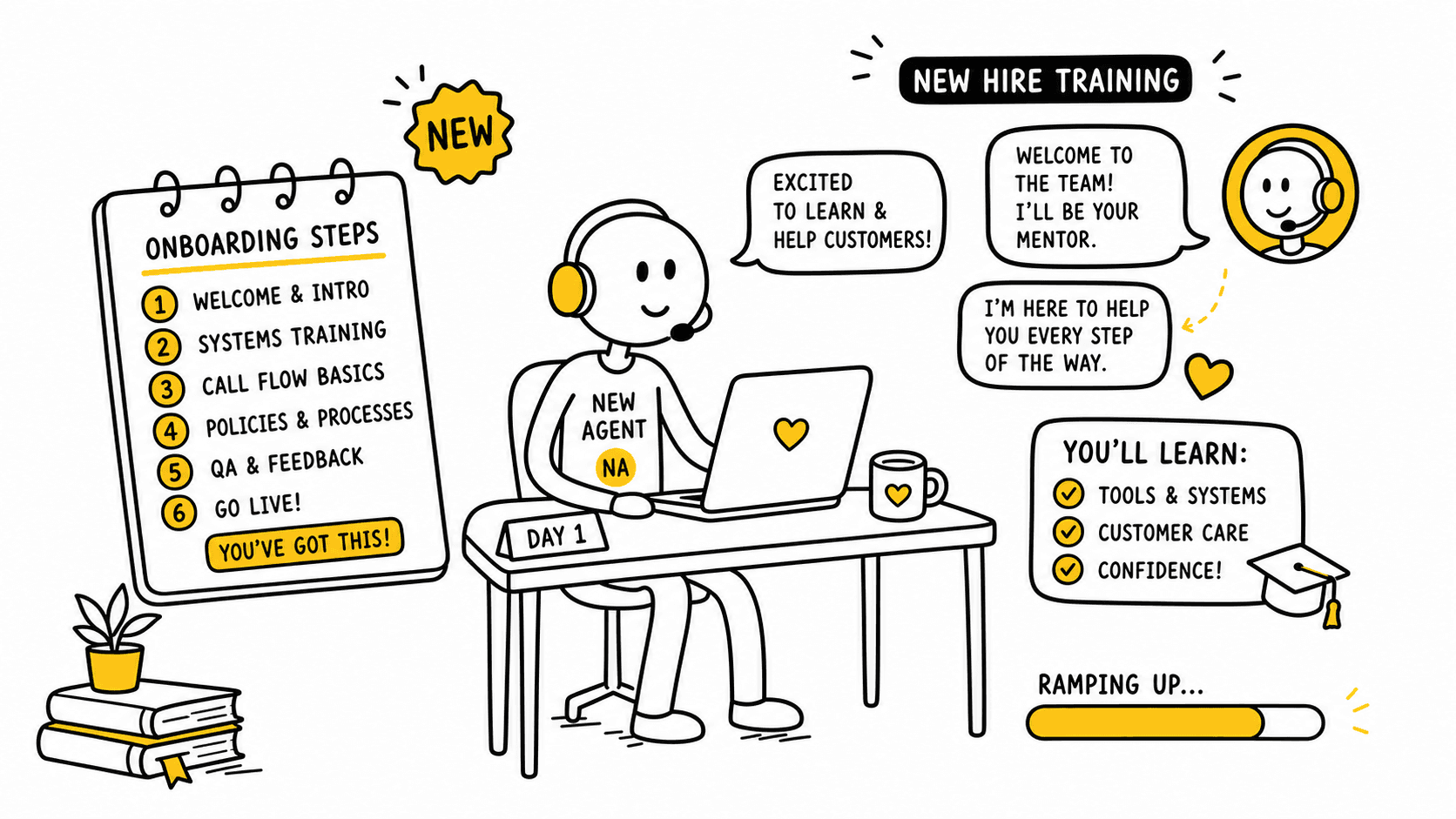
The most effective programmes treat onboarding as a journey: (1) Pre-boarding, (2) Foundational training, (3) Nesting, (4) Ongoing coaching. Across all four stages, structured practice becomes the bridge between knowledge and performance.
Why Call Center New Hire Training Matters More Than Ever
Research consistently shows that onboarding quality influences employee engagement and retention. Gallup has reported that effective onboarding is linked to improved employee experience and long-term engagement (Source: Gallup Workplace Research). SHRM also highlights onboarding as a critical factor in retention and productivity (Source: SHRM).
For contact centres, the stakes are especially high because customer interactions happen in real time. Knowledge gaps become customer experience problems almost immediately.
The Hidden Cost of Slow Ramp Time
Ramp time measures how long it takes a new agent to reach expected performance levels. Slow ramp time creates hidden costs including increased escalation volume, longer average handle time (AHT), lower first contact resolution (FCR), and reduced workforce planning accuracy.
Many organisations focus heavily on knowledge transfer but spend too little time on skill development. Agents may pass knowledge assessments while still struggling in real customer conversations. That gap becomes visible during nesting.
How Early Attrition Damages Contact Center Economics
Early attrition is one of the most expensive problems in customer service operations. According to the U.S. Bureau of Labor Statistics, customer service roles remain a significant employment category with ongoing hiring needs, making retention a continuous operational concern (Source: BLS).
Many departures happen because new hires feel unprepared due to unrealistic job expectations, insufficient practice, poor coaching support, technology overwhelm, or lack of confidence during customer interactions.
The Modern Call Center Onboarding Journey
The most effective onboarding programmes follow a progressive readiness model.
Stage | Primary Goal | Key Activities |
|---|---|---|
Pre-boarding | Readiness | Access, expectations, systems setup |
Foundational training | Knowledge and skills | Products, systems, communication, compliance |
Nesting | Guided performance | Live calls with support and coaching |
Ongoing coaching | Continuous improvement | QA reviews, simulations, development plans |
Stage 1: Pre-Boarding Before Day One
Pre-boarding begins after an offer is accepted and before formal training starts. A well-designed pre-boarding programme reduces administrative friction and helps new hires arrive prepared. Administrative, technology, and learning readiness should all be confirmed before training day one.
Common pre-boarding mistakes include waiting until day one for access, information overload, ignoring culture, failing to explain the role realistically, and providing no early practice exposure.
Stage 2: Classroom and Foundational Training
Foundational training builds the knowledge and skills agents need before customer interactions. A useful framework is the 40-40-20 model: 40% knowledge acquisition, 40% guided practice, 20% feedback and reinforcement.
Learning science consistently shows that forgetting occurs rapidly without reinforcement. The forgetting curve demonstrates that information retention declines when learners do not revisit or apply new knowledge (Source: ATD). Simulation-based learning is particularly effective because it allows agents to practise realistic situations repeatedly before speaking with customers.
Useful resources: simulation-based contact centre training and customer conversation frameworks.
Traditional Roleplay vs AI-Powered Simulation Training
Criteria | Trainer-Led Roleplay | Peer Roleplay | AI Roleplay Simulation |
|---|---|---|---|
Scalability | Low | Medium | High |
Consistency | Medium | Low | High |
Feedback quality | High when trainers available | Variable | Consistent and immediate |
Availability | Limited | Limited | 24/7 |
Cost efficiency | Lower at scale | Medium | High at scale |
Scenario variety | Limited by trainer capacity | Limited | Extensive |
Measurement | Often manual | Minimal | Automated |
A blended approach often delivers the strongest results. Trainers can introduce concepts and coach nuanced behaviours, while simulation tools provide repetition and reinforcement between sessions. This combination helps organisations maintain quality without dramatically increasing trainer workload.
The Rise of Simulation-Based Training
Simulation-based learning creates realistic customer scenarios in a controlled environment, covering billing disputes, escalation requests, compliance conversations, product troubleshooting, and retention discussions. Because simulations are repeatable, agents can master difficult interactions before they affect customers.
This approach aligns closely with broader workplace learning trends emphasising active learning and experiential development (Source: Training Industry). For deeper exploration, see: AI customer service roleplay tools.
Stage 3: Nesting and Transition to Live Calls
Nesting is the supervised transition period between training and independent production. In a controlled CCD study referenced by Smart Role, learners who incorporated structured simulation practice achieved a nesting pass rate of 80%, compared with 46.1% in the comparison group.
Quality assurance should not operate separately from training. The most effective organisations create closed-loop learning: monitor interactions, identify patterns, deliver coaching, reinforce through practice, and reassess performance. Many organisations also use automated quality review tools: Smart Role Quality Review.
Stage 4: Ongoing Coaching After Graduation
Graduation from onboarding is not the end of learning. It marks the beginning of performance development. High-performing contact centres build continuous coaching into daily operations using weekly reviews, QA feedback sessions, skill workshops, and simulation refreshers.
Coaching should occur regularly rather than only after performance issues emerge. Simulation-based reinforcement helps agents maintain critical skills, practise new processes, prepare for seasonal demand, and strengthen weak areas.
Recommended 30-60-90 Day Call Center Training Plan
Period | Focus | Activities | Success Metrics |
|---|---|---|---|
Days 1 to 30 | Learning and readiness | Training, simulations, certification | Assessment scores, simulation performance |
Days 31 to 60 | Guided production | Nesting, coaching, QA reviews | QA scores, compliance, confidence |
Days 61 to 90 | Performance growth | Independent production, targeted coaching | CSAT, FCR, productivity metrics |
Metrics Every Contact Center Training Leader Should Track
Time to Proficiency: Measures how quickly agents reach expected performance. This is often the most important onboarding KPI.
Nesting Pass Rate: Measures readiness for independent production.
QA Scores: Quality scores reveal behavioural performance and process adherence.
CSAT: Customer satisfaction connects training outcomes to customer experience.
FCR: First contact resolution reflects knowledge and problem-solving capability. Research from SQM Group consistently highlights the connection between FCR and customer satisfaction outcomes (Source: SQM Group).
AHT: Average handle time helps identify operational efficiency trends.
Attrition: Monitor 30-day, 60-day, and 90-day attrition. Early attrition often reveals onboarding weaknesses.
Simulation Performance: Simulation data provides a valuable leading indicator of production readiness.
Best Practices for Building a High-Performing New Hire Training Program
Standardise Core Training: Every agent should receive consistent foundational learning. Standardisation improves quality and reduces variability.
Use Blended Learning: Combine instructor-led training, self-paced learning, simulations, and coaching.
Adopt a Simulation-First Mindset: Practice should occur throughout onboarding, not only at the end.
Build Closed Coaching Loops: Connect QA insights, coaching plans, practice activities, and reassessment.
Implement Certification Gates: Advancement should depend on demonstrated competence, not just attendance.
Measure Everything That Matters: Track ramp time, nesting outcomes, quality, attrition, and customer metrics.
Treat Onboarding as a Business Process: The best organisations view onboarding as an operational capability rather than a training event.
Conclusion
Effective new hire training in a call centre is a structured journey that starts before day one and continues well beyond graduation. Pre-boarding, foundational learning, nesting, and ongoing coaching all contribute to agent success. The biggest shift in modern onboarding is the move from information-heavy programmes to practice-driven learning.
Simulation-based training and AI roleplay help agents build confidence, apply knowledge, and receive feedback before customer interactions carry real consequences. As contact centres face increasing pressure to improve quality, retention, and efficiency, scalable practice and coaching are becoming essential components of workforce readiness.
Want to see how Smart Role helps contact centres cut ramp time and boost nesting pass rates? Explore Smart Role and discover how AI-powered simulation training can transform your new hire onboarding.
Want more contact centre training insights? Explore the Smart Role blog for practical guides on simulation-based learning, AI roleplay, onboarding optimisation, and agent performance improvement.
Related Reading
FAQ
How long should call center new hire training last?
Most call centre new hire training programmes last between two and eight weeks, depending on product complexity, regulatory requirements, customer channels, and system demands. Effective programmes combine classroom learning, simulation-based practice, assessments, and supervised live-customer experience before agents move into independent production.
What is the nesting phase in a call center?
Nesting is the supervised transition period between training and independent production in which agents handle real customer interactions while receiving close support from supervisors, mentors, and quality teams. The purpose is to reinforce learning, build confidence, validate readiness, and identify coaching opportunities before full production responsibilities begin.
How can call centers reduce new hire attrition?
Call centres reduce new hire attrition by creating structured onboarding programmes, setting realistic expectations, providing extensive practice opportunities, delivering frequent coaching, and validating readiness before agents handle full workloads. Strong onboarding improves confidence, engagement, and job preparedness during the critical first months of employment.
What is the best way to practice customer conversations during onboarding?
Simulation-based roleplay is one of the most effective methods for practising customer conversations because it allows agents to experience realistic scenarios repeatedly, receive immediate feedback, and improve performance before interacting with live customers. AI-powered roleplay extends these benefits by making practice available at scale and on demand.
How can AI simulation improve call center new hire training?
AI simulation improves call center new hire training by giving agents unlimited practice in realistic customer scenarios before handling live interactions. Agents receive immediate, objective feedback on communication quality, compliance adherence, and knowledge application, accelerating confidence and reducing ramp time compared with traditional classroom-only approaches.
New Hire Training Call Center: A Complete Guide to Faster Ramp-Up and Better Retention
New hire training in a call center is the structured process of preparing agents to handle customer interactions successfully through onboarding, practice, live-call support, and ongoing coaching.
Every contact centre leader faces the same challenge: getting new agents productive quickly without sacrificing quality, compliance, or customer experience. The pressure has increased as customer expectations rise, products become more complex, and staffing costs remain high.
A modern onboarding programme is no longer limited to classroom sessions and a few roleplays. High-performing contact centres now combine foundational learning, simulation-based practice, nesting support, quality assurance, and personalised coaching to accelerate readiness and reduce early attrition.
This guide covers the full onboarding journey, including pre-boarding, classroom training, nesting, continuous coaching, and the growing role of AI-powered simulations in agent development.
TL;DR
Effective call centre onboarding includes pre-boarding, foundational training, nesting, and ongoing coaching.
Slow ramp times increase operating costs and expose customers to inconsistent service.
Classroom learning alone is insufficient because knowledge retention declines without practice.
Simulation-based roleplay gives agents more realistic repetitions before they reach live customers.
In a controlled CCD study, nesting pass rates improved from 46.1% to 80% when simulation-based practice was integrated into onboarding.
What Is New Hire Training in a Call Center?
New hire training in a call centre is a structured onboarding and readiness programme that equips agents with product knowledge, system proficiency, communication skills, compliance understanding, and customer service capabilities before they operate independently.
A strong onboarding programme helps organisations reduce time to proficiency, improve quality scores, increase customer satisfaction, lower compliance risk, improve retention, and create a consistent customer experience.
The most effective programmes treat onboarding as a journey: (1) Pre-boarding, (2) Foundational training, (3) Nesting, (4) Ongoing coaching. Across all four stages, structured practice becomes the bridge between knowledge and performance.
Why Call Center New Hire Training Matters More Than Ever
Research consistently shows that onboarding quality influences employee engagement and retention. Gallup has reported that effective onboarding is linked to improved employee experience and long-term engagement (Source: Gallup Workplace Research). SHRM also highlights onboarding as a critical factor in retention and productivity (Source: SHRM).
For contact centres, the stakes are especially high because customer interactions happen in real time. Knowledge gaps become customer experience problems almost immediately.
The Hidden Cost of Slow Ramp Time
Ramp time measures how long it takes a new agent to reach expected performance levels. Slow ramp time creates hidden costs including increased escalation volume, longer average handle time (AHT), lower first contact resolution (FCR), and reduced workforce planning accuracy.
Many organisations focus heavily on knowledge transfer but spend too little time on skill development. Agents may pass knowledge assessments while still struggling in real customer conversations. That gap becomes visible during nesting.
How Early Attrition Damages Contact Center Economics
Early attrition is one of the most expensive problems in customer service operations. According to the U.S. Bureau of Labor Statistics, customer service roles remain a significant employment category with ongoing hiring needs, making retention a continuous operational concern (Source: BLS).
Many departures happen because new hires feel unprepared due to unrealistic job expectations, insufficient practice, poor coaching support, technology overwhelm, or lack of confidence during customer interactions.
The Modern Call Center Onboarding Journey
The most effective onboarding programmes follow a progressive readiness model.
Stage | Primary Goal | Key Activities |
|---|---|---|
Pre-boarding | Readiness | Access, expectations, systems setup |
Foundational training | Knowledge and skills | Products, systems, communication, compliance |
Nesting | Guided performance | Live calls with support and coaching |
Ongoing coaching | Continuous improvement | QA reviews, simulations, development plans |
Stage 1: Pre-Boarding Before Day One
Pre-boarding begins after an offer is accepted and before formal training starts. A well-designed pre-boarding programme reduces administrative friction and helps new hires arrive prepared. Administrative, technology, and learning readiness should all be confirmed before training day one.
Common pre-boarding mistakes include waiting until day one for access, information overload, ignoring culture, failing to explain the role realistically, and providing no early practice exposure.
Stage 2: Classroom and Foundational Training
Foundational training builds the knowledge and skills agents need before customer interactions. A useful framework is the 40-40-20 model: 40% knowledge acquisition, 40% guided practice, 20% feedback and reinforcement.
Learning science consistently shows that forgetting occurs rapidly without reinforcement. The forgetting curve demonstrates that information retention declines when learners do not revisit or apply new knowledge (Source: ATD). Simulation-based learning is particularly effective because it allows agents to practise realistic situations repeatedly before speaking with customers.
Useful resources: simulation-based contact centre training and customer conversation frameworks.
Traditional Roleplay vs AI-Powered Simulation Training
Criteria | Trainer-Led Roleplay | Peer Roleplay | AI Roleplay Simulation |
|---|---|---|---|
Scalability | Low | Medium | High |
Consistency | Medium | Low | High |
Feedback quality | High when trainers available | Variable | Consistent and immediate |
Availability | Limited | Limited | 24/7 |
Cost efficiency | Lower at scale | Medium | High at scale |
Scenario variety | Limited by trainer capacity | Limited | Extensive |
Measurement | Often manual | Minimal | Automated |
A blended approach often delivers the strongest results. Trainers can introduce concepts and coach nuanced behaviours, while simulation tools provide repetition and reinforcement between sessions. This combination helps organisations maintain quality without dramatically increasing trainer workload.
The Rise of Simulation-Based Training
Simulation-based learning creates realistic customer scenarios in a controlled environment, covering billing disputes, escalation requests, compliance conversations, product troubleshooting, and retention discussions. Because simulations are repeatable, agents can master difficult interactions before they affect customers.
This approach aligns closely with broader workplace learning trends emphasising active learning and experiential development (Source: Training Industry). For deeper exploration, see: AI customer service roleplay tools.
Stage 3: Nesting and Transition to Live Calls
Nesting is the supervised transition period between training and independent production. In a controlled CCD study referenced by Smart Role, learners who incorporated structured simulation practice achieved a nesting pass rate of 80%, compared with 46.1% in the comparison group.
Quality assurance should not operate separately from training. The most effective organisations create closed-loop learning: monitor interactions, identify patterns, deliver coaching, reinforce through practice, and reassess performance. Many organisations also use automated quality review tools: Smart Role Quality Review.
Stage 4: Ongoing Coaching After Graduation
Graduation from onboarding is not the end of learning. It marks the beginning of performance development. High-performing contact centres build continuous coaching into daily operations using weekly reviews, QA feedback sessions, skill workshops, and simulation refreshers.
Coaching should occur regularly rather than only after performance issues emerge. Simulation-based reinforcement helps agents maintain critical skills, practise new processes, prepare for seasonal demand, and strengthen weak areas.
Recommended 30-60-90 Day Call Center Training Plan
Period | Focus | Activities | Success Metrics |
|---|---|---|---|
Days 1 to 30 | Learning and readiness | Training, simulations, certification | Assessment scores, simulation performance |
Days 31 to 60 | Guided production | Nesting, coaching, QA reviews | QA scores, compliance, confidence |
Days 61 to 90 | Performance growth | Independent production, targeted coaching | CSAT, FCR, productivity metrics |
Metrics Every Contact Center Training Leader Should Track
Time to Proficiency: Measures how quickly agents reach expected performance. This is often the most important onboarding KPI.
Nesting Pass Rate: Measures readiness for independent production.
QA Scores: Quality scores reveal behavioural performance and process adherence.
CSAT: Customer satisfaction connects training outcomes to customer experience.
FCR: First contact resolution reflects knowledge and problem-solving capability. Research from SQM Group consistently highlights the connection between FCR and customer satisfaction outcomes (Source: SQM Group).
AHT: Average handle time helps identify operational efficiency trends.
Attrition: Monitor 30-day, 60-day, and 90-day attrition. Early attrition often reveals onboarding weaknesses.
Simulation Performance: Simulation data provides a valuable leading indicator of production readiness.
Best Practices for Building a High-Performing New Hire Training Program
Standardise Core Training: Every agent should receive consistent foundational learning. Standardisation improves quality and reduces variability.
Use Blended Learning: Combine instructor-led training, self-paced learning, simulations, and coaching.
Adopt a Simulation-First Mindset: Practice should occur throughout onboarding, not only at the end.
Build Closed Coaching Loops: Connect QA insights, coaching plans, practice activities, and reassessment.
Implement Certification Gates: Advancement should depend on demonstrated competence, not just attendance.
Measure Everything That Matters: Track ramp time, nesting outcomes, quality, attrition, and customer metrics.
Treat Onboarding as a Business Process: The best organisations view onboarding as an operational capability rather than a training event.
Conclusion
Effective new hire training in a call centre is a structured journey that starts before day one and continues well beyond graduation. Pre-boarding, foundational learning, nesting, and ongoing coaching all contribute to agent success. The biggest shift in modern onboarding is the move from information-heavy programmes to practice-driven learning.
Simulation-based training and AI roleplay help agents build confidence, apply knowledge, and receive feedback before customer interactions carry real consequences. As contact centres face increasing pressure to improve quality, retention, and efficiency, scalable practice and coaching are becoming essential components of workforce readiness.
Want to see how Smart Role helps contact centres cut ramp time and boost nesting pass rates? Explore Smart Role and discover how AI-powered simulation training can transform your new hire onboarding.
Want more contact centre training insights? Explore the Smart Role blog for practical guides on simulation-based learning, AI roleplay, onboarding optimisation, and agent performance improvement.
Related Reading
FAQ
How long should call center new hire training last?
Most call centre new hire training programmes last between two and eight weeks, depending on product complexity, regulatory requirements, customer channels, and system demands. Effective programmes combine classroom learning, simulation-based practice, assessments, and supervised live-customer experience before agents move into independent production.
What is the nesting phase in a call center?
Nesting is the supervised transition period between training and independent production in which agents handle real customer interactions while receiving close support from supervisors, mentors, and quality teams. The purpose is to reinforce learning, build confidence, validate readiness, and identify coaching opportunities before full production responsibilities begin.
How can call centers reduce new hire attrition?
Call centres reduce new hire attrition by creating structured onboarding programmes, setting realistic expectations, providing extensive practice opportunities, delivering frequent coaching, and validating readiness before agents handle full workloads. Strong onboarding improves confidence, engagement, and job preparedness during the critical first months of employment.
What is the best way to practice customer conversations during onboarding?
Simulation-based roleplay is one of the most effective methods for practising customer conversations because it allows agents to experience realistic scenarios repeatedly, receive immediate feedback, and improve performance before interacting with live customers. AI-powered roleplay extends these benefits by making practice available at scale and on demand.
How can AI simulation improve call center new hire training?
AI simulation improves call center new hire training by giving agents unlimited practice in realistic customer scenarios before handling live interactions. Agents receive immediate, objective feedback on communication quality, compliance adherence, and knowledge application, accelerating confidence and reducing ramp time compared with traditional classroom-only approaches.
New Hire Training Call Center: A Complete Guide to Faster Ramp-Up and Better Retention
New hire training in a call center is the structured process of preparing agents to handle customer interactions successfully through onboarding, practice, live-call support, and ongoing coaching.
Every contact centre leader faces the same challenge: getting new agents productive quickly without sacrificing quality, compliance, or customer experience. The pressure has increased as customer expectations rise, products become more complex, and staffing costs remain high.
A modern onboarding programme is no longer limited to classroom sessions and a few roleplays. High-performing contact centres now combine foundational learning, simulation-based practice, nesting support, quality assurance, and personalised coaching to accelerate readiness and reduce early attrition.
This guide covers the full onboarding journey, including pre-boarding, classroom training, nesting, continuous coaching, and the growing role of AI-powered simulations in agent development.
TL;DR
Effective call centre onboarding includes pre-boarding, foundational training, nesting, and ongoing coaching.
Slow ramp times increase operating costs and expose customers to inconsistent service.
Classroom learning alone is insufficient because knowledge retention declines without practice.
Simulation-based roleplay gives agents more realistic repetitions before they reach live customers.
In a controlled CCD study, nesting pass rates improved from 46.1% to 80% when simulation-based practice was integrated into onboarding.
What Is New Hire Training in a Call Center?
New hire training in a call centre is a structured onboarding and readiness programme that equips agents with product knowledge, system proficiency, communication skills, compliance understanding, and customer service capabilities before they operate independently.
A strong onboarding programme helps organisations reduce time to proficiency, improve quality scores, increase customer satisfaction, lower compliance risk, improve retention, and create a consistent customer experience.
The most effective programmes treat onboarding as a journey: (1) Pre-boarding, (2) Foundational training, (3) Nesting, (4) Ongoing coaching. Across all four stages, structured practice becomes the bridge between knowledge and performance.
Why Call Center New Hire Training Matters More Than Ever
Research consistently shows that onboarding quality influences employee engagement and retention. Gallup has reported that effective onboarding is linked to improved employee experience and long-term engagement (Source: Gallup Workplace Research). SHRM also highlights onboarding as a critical factor in retention and productivity (Source: SHRM).
For contact centres, the stakes are especially high because customer interactions happen in real time. Knowledge gaps become customer experience problems almost immediately.
The Hidden Cost of Slow Ramp Time
Ramp time measures how long it takes a new agent to reach expected performance levels. Slow ramp time creates hidden costs including increased escalation volume, longer average handle time (AHT), lower first contact resolution (FCR), and reduced workforce planning accuracy.
Many organisations focus heavily on knowledge transfer but spend too little time on skill development. Agents may pass knowledge assessments while still struggling in real customer conversations. That gap becomes visible during nesting.
How Early Attrition Damages Contact Center Economics
Early attrition is one of the most expensive problems in customer service operations. According to the U.S. Bureau of Labor Statistics, customer service roles remain a significant employment category with ongoing hiring needs, making retention a continuous operational concern (Source: BLS).
Many departures happen because new hires feel unprepared due to unrealistic job expectations, insufficient practice, poor coaching support, technology overwhelm, or lack of confidence during customer interactions.
The Modern Call Center Onboarding Journey
The most effective onboarding programmes follow a progressive readiness model.
Stage | Primary Goal | Key Activities |
|---|---|---|
Pre-boarding | Readiness | Access, expectations, systems setup |
Foundational training | Knowledge and skills | Products, systems, communication, compliance |
Nesting | Guided performance | Live calls with support and coaching |
Ongoing coaching | Continuous improvement | QA reviews, simulations, development plans |
Stage 1: Pre-Boarding Before Day One
Pre-boarding begins after an offer is accepted and before formal training starts. A well-designed pre-boarding programme reduces administrative friction and helps new hires arrive prepared. Administrative, technology, and learning readiness should all be confirmed before training day one.
Common pre-boarding mistakes include waiting until day one for access, information overload, ignoring culture, failing to explain the role realistically, and providing no early practice exposure.
Stage 2: Classroom and Foundational Training
Foundational training builds the knowledge and skills agents need before customer interactions. A useful framework is the 40-40-20 model: 40% knowledge acquisition, 40% guided practice, 20% feedback and reinforcement.
Learning science consistently shows that forgetting occurs rapidly without reinforcement. The forgetting curve demonstrates that information retention declines when learners do not revisit or apply new knowledge (Source: ATD). Simulation-based learning is particularly effective because it allows agents to practise realistic situations repeatedly before speaking with customers.
Useful resources: simulation-based contact centre training and customer conversation frameworks.
Traditional Roleplay vs AI-Powered Simulation Training
Criteria | Trainer-Led Roleplay | Peer Roleplay | AI Roleplay Simulation |
|---|---|---|---|
Scalability | Low | Medium | High |
Consistency | Medium | Low | High |
Feedback quality | High when trainers available | Variable | Consistent and immediate |
Availability | Limited | Limited | 24/7 |
Cost efficiency | Lower at scale | Medium | High at scale |
Scenario variety | Limited by trainer capacity | Limited | Extensive |
Measurement | Often manual | Minimal | Automated |
A blended approach often delivers the strongest results. Trainers can introduce concepts and coach nuanced behaviours, while simulation tools provide repetition and reinforcement between sessions. This combination helps organisations maintain quality without dramatically increasing trainer workload.
The Rise of Simulation-Based Training
Simulation-based learning creates realistic customer scenarios in a controlled environment, covering billing disputes, escalation requests, compliance conversations, product troubleshooting, and retention discussions. Because simulations are repeatable, agents can master difficult interactions before they affect customers.
This approach aligns closely with broader workplace learning trends emphasising active learning and experiential development (Source: Training Industry). For deeper exploration, see: AI customer service roleplay tools.
Stage 3: Nesting and Transition to Live Calls
Nesting is the supervised transition period between training and independent production. In a controlled CCD study referenced by Smart Role, learners who incorporated structured simulation practice achieved a nesting pass rate of 80%, compared with 46.1% in the comparison group.
Quality assurance should not operate separately from training. The most effective organisations create closed-loop learning: monitor interactions, identify patterns, deliver coaching, reinforce through practice, and reassess performance. Many organisations also use automated quality review tools: Smart Role Quality Review.
Stage 4: Ongoing Coaching After Graduation
Graduation from onboarding is not the end of learning. It marks the beginning of performance development. High-performing contact centres build continuous coaching into daily operations using weekly reviews, QA feedback sessions, skill workshops, and simulation refreshers.
Coaching should occur regularly rather than only after performance issues emerge. Simulation-based reinforcement helps agents maintain critical skills, practise new processes, prepare for seasonal demand, and strengthen weak areas.
Recommended 30-60-90 Day Call Center Training Plan
Period | Focus | Activities | Success Metrics |
|---|---|---|---|
Days 1 to 30 | Learning and readiness | Training, simulations, certification | Assessment scores, simulation performance |
Days 31 to 60 | Guided production | Nesting, coaching, QA reviews | QA scores, compliance, confidence |
Days 61 to 90 | Performance growth | Independent production, targeted coaching | CSAT, FCR, productivity metrics |
Metrics Every Contact Center Training Leader Should Track
Time to Proficiency: Measures how quickly agents reach expected performance. This is often the most important onboarding KPI.
Nesting Pass Rate: Measures readiness for independent production.
QA Scores: Quality scores reveal behavioural performance and process adherence.
CSAT: Customer satisfaction connects training outcomes to customer experience.
FCR: First contact resolution reflects knowledge and problem-solving capability. Research from SQM Group consistently highlights the connection between FCR and customer satisfaction outcomes (Source: SQM Group).
AHT: Average handle time helps identify operational efficiency trends.
Attrition: Monitor 30-day, 60-day, and 90-day attrition. Early attrition often reveals onboarding weaknesses.
Simulation Performance: Simulation data provides a valuable leading indicator of production readiness.
Best Practices for Building a High-Performing New Hire Training Program
Standardise Core Training: Every agent should receive consistent foundational learning. Standardisation improves quality and reduces variability.
Use Blended Learning: Combine instructor-led training, self-paced learning, simulations, and coaching.
Adopt a Simulation-First Mindset: Practice should occur throughout onboarding, not only at the end.
Build Closed Coaching Loops: Connect QA insights, coaching plans, practice activities, and reassessment.
Implement Certification Gates: Advancement should depend on demonstrated competence, not just attendance.
Measure Everything That Matters: Track ramp time, nesting outcomes, quality, attrition, and customer metrics.
Treat Onboarding as a Business Process: The best organisations view onboarding as an operational capability rather than a training event.
Conclusion
Effective new hire training in a call centre is a structured journey that starts before day one and continues well beyond graduation. Pre-boarding, foundational learning, nesting, and ongoing coaching all contribute to agent success. The biggest shift in modern onboarding is the move from information-heavy programmes to practice-driven learning.
Simulation-based training and AI roleplay help agents build confidence, apply knowledge, and receive feedback before customer interactions carry real consequences. As contact centres face increasing pressure to improve quality, retention, and efficiency, scalable practice and coaching are becoming essential components of workforce readiness.
Want to see how Smart Role helps contact centres cut ramp time and boost nesting pass rates? Explore Smart Role and discover how AI-powered simulation training can transform your new hire onboarding.
Want more contact centre training insights? Explore the Smart Role blog for practical guides on simulation-based learning, AI roleplay, onboarding optimisation, and agent performance improvement.
Related Reading
FAQ
How long should call center new hire training last?
Most call centre new hire training programmes last between two and eight weeks, depending on product complexity, regulatory requirements, customer channels, and system demands. Effective programmes combine classroom learning, simulation-based practice, assessments, and supervised live-customer experience before agents move into independent production.
What is the nesting phase in a call center?
Nesting is the supervised transition period between training and independent production in which agents handle real customer interactions while receiving close support from supervisors, mentors, and quality teams. The purpose is to reinforce learning, build confidence, validate readiness, and identify coaching opportunities before full production responsibilities begin.
How can call centers reduce new hire attrition?
Call centres reduce new hire attrition by creating structured onboarding programmes, setting realistic expectations, providing extensive practice opportunities, delivering frequent coaching, and validating readiness before agents handle full workloads. Strong onboarding improves confidence, engagement, and job preparedness during the critical first months of employment.
What is the best way to practice customer conversations during onboarding?
Simulation-based roleplay is one of the most effective methods for practising customer conversations because it allows agents to experience realistic scenarios repeatedly, receive immediate feedback, and improve performance before interacting with live customers. AI-powered roleplay extends these benefits by making practice available at scale and on demand.
How can AI simulation improve call center new hire training?
AI simulation improves call center new hire training by giving agents unlimited practice in realistic customer scenarios before handling live interactions. Agents receive immediate, objective feedback on communication quality, compliance adherence, and knowledge application, accelerating confidence and reducing ramp time compared with traditional classroom-only approaches.
Rejoignez la newsletter Smart Role

Le succès en service client repose à 10 % sur les connaissances et à 90 % sur la manière dont vous les appliquez dans des situations réelles.
Rejoignez la newsletter Smart Role

Le succès en service client repose à 10 % sur les connaissances et à 90 % sur la manière dont vous les appliquez dans des situations réelles.
Rejoignez la newsletter Smart Role

Le succès en service client repose à 10 % sur les connaissances et à 90 % sur la manière dont vous les appliquez dans des situations réelles.

Smart Role est une plateforme qui transforme le recrutement, l'intégration et la formation en service client. Notre technologie aide les entreprises à rationaliser le processus et à réduire les coûts.


Smart Role est une plateforme qui transforme le recrutement, l'intégration et la formation en service client. Notre technologie aide les entreprises à rationaliser le processus et à réduire les coûts.


Smart Role est une plateforme qui transforme le recrutement, l'intégration et la formation en service client. Notre technologie aide les entreprises à rationaliser le processus et à réduire les coûts.


