
Onboarding
Onboarding
Onboarding
Call Center Nesting Period Best Practices: The 2026 Manager's Playbook
/ / / / / / / /
Call Center Nesting Period Best Practices: The 2026 Manager's Playbook
A call center nesting period is the structured bridge phase between classroom training and full independent production, during which newly trained agents handle live customer interactions under close supervision and real-time coaching support before graduating to an unsupported queue.
TL;DR
A nesting period typically runs 1 to 4 weeks and sits between formal training and solo production.
Agents in a well-structured nesting programme show measurably faster quality score improvement than those placed directly on the floor.
The five pillars of effective nesting are: graduated call volume, dedicated coach-to-agent ratios, competency-based exit criteria, real-time feedback loops, and honest readiness assessments.
Without a formal nesting phase, early attrition and quality failures spike in the first 90 days.
Smart Role's real-time agent guidance tools can compress nesting duration without cutting corners on confidence or compliance.
What Is a Call Center Nesting Period?
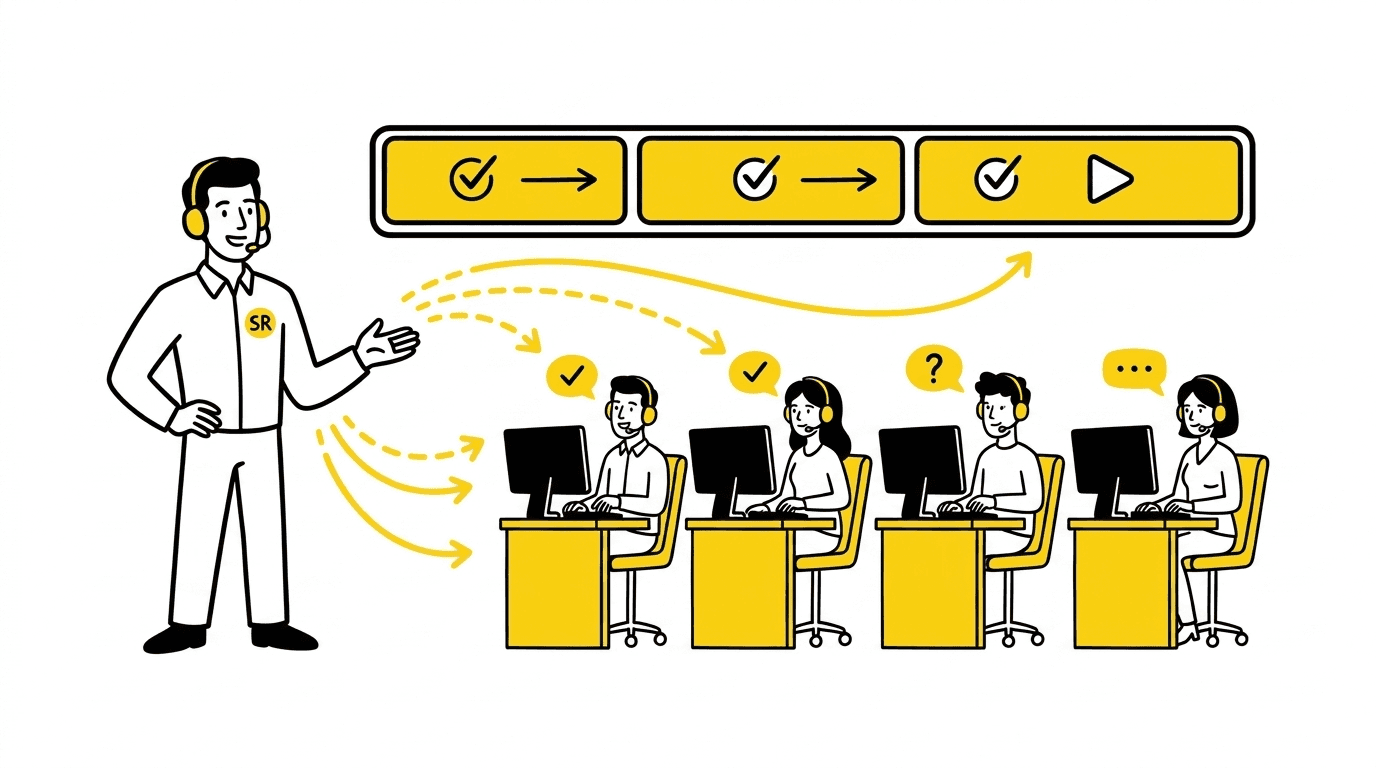
A call center nesting period is the supervised production phase immediately following initial training. Agents take real calls or handle real tickets, but a dedicated nesting coach or senior agent monitors each interaction in real time, ready to intervene via whisper coaching, barging, or instant messaging.
Unlike shadowing (observing others) or training simulations (synthetic scenarios), nesting is live. The stakes are real, the customers are real, and the mistakes have real consequences. That reality is precisely what makes nesting so valuable: it closes the gap between knowing a policy and executing it under pressure.
According to research published by the ICMI (International Customer Management Institute), agents who go through a formal structured nesting phase reach proficiency on average 30 to 40 per cent faster than peers placed directly into production without supervision (ICMI, 2024). A Gallup Workplace study found that employees who feel supported during their first 90 days are 2.6 times more likely to remain with the organisation after one year (Gallup, 2023).
Why the Nesting Period Is Often Mismanaged
Most contact centres acknowledge nesting in principle. Few execute it well. Common failure modes include:
Time-based graduation: agents exit nesting after a fixed number of days regardless of actual readiness.
Coach overload: one nesting coach covering 15 or 20 agents simultaneously, making real-time guidance impossible.
Unclear success criteria: agents and managers both unsure what "ready" looks like.
Abrupt transitions: one day in nesting, the next day on their own with no bridging support.
Metric mismatch: measuring handle time from day one of nesting, creating incentives to rush calls rather than build quality habits.
McKinsey's 2024 Future of Work in Contact Centres report noted that organisations with poorly defined onboarding transitions experience first-year attrition rates 22 per cent higher than those with structured programmes (McKinsey, 2024).
10 Call Center Nesting Period Best Practices
1. Define Competency-Based Exit Criteria Before Nesting Begins
Never let time alone determine when an agent graduates from nesting. Before the first nesting shift, publish a clear, measurable readiness scorecard. A robust scorecard typically includes:
Quality assurance score of 85 per cent or above across five or more monitored calls
First-call resolution rate above the team baseline
Average handle time within 20 per cent of the team median
Compliance adherence score of 100 per cent on regulated call types
Customer satisfaction score at or above 4 out of 5 on post-call surveys
These criteria create a shared language between the agent, the nesting coach, and the team leader. Agents know exactly what they are working toward, and coaches can direct coaching energy precisely at gaps rather than guessing.
2. Keep Coach-to-Agent Ratios Tight
Real-time coaching only works if the coach can actually hear and intervene. A ratio of one nesting coach to five or six agents is the industry-standard recommendation for effective supervision in live environments (Deloitte Human Capital Trends, 2023). Above eight agents per coach, real-time whisper interventions become rare, feedback becomes reactive rather than preventive, and the nesting period ceases to function as genuine supervision.
If budget constrains dedicated nesting coaches, consider pulling senior agents into a rotating nesting support role for two-week cycles. Peer nesting coaches often connect with new hires more naturally and can describe processes in practical rather than theoretical terms.
3. Graduate Call Volume Progressively
Agents should not handle a full production load from minute one of nesting. A graduated volume ramp gives agents the cognitive headroom to process feedback between calls.
Week | Approximate Call Volume | Focus |
|---|---|---|
Week 1 | 30 to 40% of production target | Process adherence, script familiarisation |
Week 2 | 50 to 60% of production target | Handle time improvement, de-escalation basics |
Week 3 | 70 to 80% of production target | QA score consistency, FCR focus |
Week 4 | 90 to 100% of production target | Full readiness assessment |
Zendesk's 2024 CX Trends Report found that contact centres using progressive volume ramps during onboarding reported 18 per cent lower early-tenure error rates compared with those using immediate full-load assignment (Zendesk, 2024).
4. Schedule Structured Debrief Sessions Daily
Between calls, nesting coaches should hold brief debrief conversations rather than simply pointing out errors. An effective debrief takes three to five minutes and follows a consistent structure:
Ask the agent to self-assess: "How do you feel that call went?"
Acknowledge one thing the agent did well and name it specifically.
Identify one improvement area and describe it in observable, behavioural terms.
Confirm the agent's plan for the next call.
This structure, rooted in evidence-based coaching frameworks recommended by Salesforce's State of Service Report (Salesforce, 2024), builds metacognitive awareness rather than dependency.
5. Use Real-Time Agent Guidance Technology
Relying solely on a human coach to catch every misstep creates a coverage gap. Real-time agent guidance software monitors live interactions and surfaces relevant knowledge articles, compliance prompts, and next-best-action suggestions directly in the agent's desktop at the moment the information is needed.
Smart Role's real-time guidance platform detects conversation signals such as silence, sentiment shifts, and policy keywords and pushes contextual support cards without the agent needing to leave the call or search a knowledge base. A study by Intercom on customer support team efficiency found that agents using in-conversation assistance tools resolved 26 per cent more queries successfully in their first 60 days than unaided peers (Intercom, 2024).
6. Monitor Consistency, Not Just Average Performance
A single high-scoring call in week three of nesting is not evidence of readiness. Coaches should track performance trend lines across a minimum of ten to fifteen monitored interactions before recommending graduation. Consistent performance across diverse call types (complaints, billing queries, technical support, inbound sales) matters more than peaks on easy calls.
7. Separate Nesting Queues from Production Queues
Wherever possible, route nesting agents through a dedicated nesting queue that limits call complexity. Calls involving escalated complaints, legal disclosures, or high-value account changes should be suppressed from the nesting queue until agents have demonstrated foundational readiness. This approach protects customers from avoidable errors while ensuring nesting metrics reflect agent development rather than queue variance.
8. Standardise the Nesting Coaching Playbook
Every nesting coach should work from the same playbook. Inconsistent coaching during nesting is one of the most common causes of uneven cohort performance. A standardised coaching playbook includes:
Observation templates aligned to the exit criteria scorecard
Whisper script examples for common intervention scenarios
Feedback language guidelines (specific, observable, non-judgmental)
Weekly coaching conversation outlines
Escalation triggers (when to flag an agent as at risk of not completing nesting)
9. Run a Formal Nesting Readiness Review
Before any agent graduates to independent production, hold a structured readiness review between the agent, the nesting coach, and the team leader. This covers: review of performance data against exit criteria; agent self-assessment of confidence by call type; coach recommendation (graduate, extend by one week, or flag for retraining); and an agreed post-nesting check-in schedule. Agents who feel prepared and acknowledged at graduation show markedly higher engagement in the following 30 days (Gallup, 2023).
10. Build a Post-Nesting Support Bridge
The transition out of nesting is a vulnerability window. Agents who thrived with a coach nearby often experience a confidence dip in their first solo week. Mitigate this with a structured post-nesting bridge:
Assign a peer mentor or buddy for the first two weeks after graduation
Schedule three brief check-in calls with the team leader in the first 14 days
Keep access to a real-time guidance tool active post-nesting
Flag any agent who drops below exit criteria thresholds within 30 days for a brief refresher coaching cycle
Nesting Period vs. Traditional Onboarding: Key Differences
Dimension | Traditional Onboarding | Structured Nesting Period |
|---|---|---|
Supervision | Minimal after classroom | Real-time coaching throughout |
Call volume | Full load immediately | Graduated ramp |
Exit criteria | Time-based (days) | Competency-based (performance) |
Feedback frequency | Weekly or monthly | Daily or per-call |
Technology support | Knowledge base only | Real-time guidance tools |
Post-transition support | None typically | Peer mentor, check-in schedule |
Average time to proficiency | 60 to 90 days | 30 to 45 days |
How Long Should a Call Center Nesting Period Last?
The right nesting duration depends on product complexity, call type variety, and the depth of the classroom training programme that preceded it.
Simple transactional environments (order tracking, appointment booking): 1 to 2 weeks
Mid-complexity environments (billing support, first-line technical support): 2 to 3 weeks
High-complexity environments (financial services compliance, multi-channel healthcare support): 3 to 5 weeks
The most important rule: use exit criteria, not calendar dates, to make graduation decisions. Time-based cutoffs are the single most common reason nesting programmes produce inconsistent results.
How Smart Role Accelerates the Nesting Period
Smart Role's real-time agent guidance platform is built specifically for the nesting and early production phases of contact centre onboarding. By surfacing relevant knowledge, compliance cues, and coaching suggestions in the flow of live interactions, Smart Role reduces the cognitive load on nesting agents and allows coaches to focus on higher-order skills rather than policy recall.
Teams using Smart Role during structured nesting programmes report significant reductions in nesting duration without sacrificing agent readiness, alongside improvements in first-call resolution rates and post-nesting quality scores. If you are reviewing or rebuilding your nesting programme, request a Smart Role demo to see how real-time guidance integrates into your existing nesting workflow.
Frequently Asked Questions
What is a nesting period in a call center?
A nesting period in a call center is the supervised transition phase between formal training and full independent production, during which new agents handle live customer interactions with a dedicated coach available for real-time support, feedback, and intervention before they are placed on an unsupported production queue.
How long should a call center nesting period last?
A call center nesting period should last between one and four weeks depending on role complexity, with simple transactional environments requiring one to two weeks and high-complexity regulated environments requiring three to five weeks; the most reliable approach is to use competency-based exit criteria rather than fixed calendar dates to determine when each individual agent is ready to graduate.
What metrics should be used to assess nesting readiness?
Nesting readiness should be assessed using a combination of quality assurance scores (typically 85 per cent or above), first-call resolution rate, average handle time relative to the team median, compliance adherence on regulated call types, and post-call customer satisfaction scores, all measured consistently across a minimum of ten to fifteen monitored interactions.
What is the ideal coach-to-agent ratio during nesting?
The ideal coach-to-agent ratio during a call center nesting period is one nesting coach to five or six agents, which allows for real-time whisper coaching and timely debrief conversations; ratios above one to eight typically result in reactive rather than preventive coaching and reduce the effectiveness of the nesting programme significantly.
How does real-time agent guidance technology support the nesting period?
Real-time agent guidance technology supports the nesting period by monitoring live interactions and surfacing relevant knowledge articles, compliance prompts, and next-best-action suggestions directly in the agent's desktop at the moment they are needed, giving agents a safety net independent of coach availability and allowing coaches to focus on higher-order skills rather than policy recall during live calls.
Sources: ICMI 2024 | Gallup 2023 | McKinsey 2024 | Deloitte 2023 | Zendesk 2024 | Salesforce 2024 | Intercom 2024
Call Center Nesting Period Best Practices: The 2026 Manager's Playbook
A call center nesting period is the structured bridge phase between classroom training and full independent production, during which newly trained agents handle live customer interactions under close supervision and real-time coaching support before graduating to an unsupported queue.
TL;DR
A nesting period typically runs 1 to 4 weeks and sits between formal training and solo production.
Agents in a well-structured nesting programme show measurably faster quality score improvement than those placed directly on the floor.
The five pillars of effective nesting are: graduated call volume, dedicated coach-to-agent ratios, competency-based exit criteria, real-time feedback loops, and honest readiness assessments.
Without a formal nesting phase, early attrition and quality failures spike in the first 90 days.
Smart Role's real-time agent guidance tools can compress nesting duration without cutting corners on confidence or compliance.
What Is a Call Center Nesting Period?
A call center nesting period is the supervised production phase immediately following initial training. Agents take real calls or handle real tickets, but a dedicated nesting coach or senior agent monitors each interaction in real time, ready to intervene via whisper coaching, barging, or instant messaging.
Unlike shadowing (observing others) or training simulations (synthetic scenarios), nesting is live. The stakes are real, the customers are real, and the mistakes have real consequences. That reality is precisely what makes nesting so valuable: it closes the gap between knowing a policy and executing it under pressure.
According to research published by the ICMI (International Customer Management Institute), agents who go through a formal structured nesting phase reach proficiency on average 30 to 40 per cent faster than peers placed directly into production without supervision (ICMI, 2024). A Gallup Workplace study found that employees who feel supported during their first 90 days are 2.6 times more likely to remain with the organisation after one year (Gallup, 2023).
Why the Nesting Period Is Often Mismanaged
Most contact centres acknowledge nesting in principle. Few execute it well. Common failure modes include:
Time-based graduation: agents exit nesting after a fixed number of days regardless of actual readiness.
Coach overload: one nesting coach covering 15 or 20 agents simultaneously, making real-time guidance impossible.
Unclear success criteria: agents and managers both unsure what "ready" looks like.
Abrupt transitions: one day in nesting, the next day on their own with no bridging support.
Metric mismatch: measuring handle time from day one of nesting, creating incentives to rush calls rather than build quality habits.
McKinsey's 2024 Future of Work in Contact Centres report noted that organisations with poorly defined onboarding transitions experience first-year attrition rates 22 per cent higher than those with structured programmes (McKinsey, 2024).
10 Call Center Nesting Period Best Practices
1. Define Competency-Based Exit Criteria Before Nesting Begins
Never let time alone determine when an agent graduates from nesting. Before the first nesting shift, publish a clear, measurable readiness scorecard. A robust scorecard typically includes:
Quality assurance score of 85 per cent or above across five or more monitored calls
First-call resolution rate above the team baseline
Average handle time within 20 per cent of the team median
Compliance adherence score of 100 per cent on regulated call types
Customer satisfaction score at or above 4 out of 5 on post-call surveys
These criteria create a shared language between the agent, the nesting coach, and the team leader. Agents know exactly what they are working toward, and coaches can direct coaching energy precisely at gaps rather than guessing.
2. Keep Coach-to-Agent Ratios Tight
Real-time coaching only works if the coach can actually hear and intervene. A ratio of one nesting coach to five or six agents is the industry-standard recommendation for effective supervision in live environments (Deloitte Human Capital Trends, 2023). Above eight agents per coach, real-time whisper interventions become rare, feedback becomes reactive rather than preventive, and the nesting period ceases to function as genuine supervision.
If budget constrains dedicated nesting coaches, consider pulling senior agents into a rotating nesting support role for two-week cycles. Peer nesting coaches often connect with new hires more naturally and can describe processes in practical rather than theoretical terms.
3. Graduate Call Volume Progressively
Agents should not handle a full production load from minute one of nesting. A graduated volume ramp gives agents the cognitive headroom to process feedback between calls.
Week | Approximate Call Volume | Focus |
|---|---|---|
Week 1 | 30 to 40% of production target | Process adherence, script familiarisation |
Week 2 | 50 to 60% of production target | Handle time improvement, de-escalation basics |
Week 3 | 70 to 80% of production target | QA score consistency, FCR focus |
Week 4 | 90 to 100% of production target | Full readiness assessment |
Zendesk's 2024 CX Trends Report found that contact centres using progressive volume ramps during onboarding reported 18 per cent lower early-tenure error rates compared with those using immediate full-load assignment (Zendesk, 2024).
4. Schedule Structured Debrief Sessions Daily
Between calls, nesting coaches should hold brief debrief conversations rather than simply pointing out errors. An effective debrief takes three to five minutes and follows a consistent structure:
Ask the agent to self-assess: "How do you feel that call went?"
Acknowledge one thing the agent did well and name it specifically.
Identify one improvement area and describe it in observable, behavioural terms.
Confirm the agent's plan for the next call.
This structure, rooted in evidence-based coaching frameworks recommended by Salesforce's State of Service Report (Salesforce, 2024), builds metacognitive awareness rather than dependency.
5. Use Real-Time Agent Guidance Technology
Relying solely on a human coach to catch every misstep creates a coverage gap. Real-time agent guidance software monitors live interactions and surfaces relevant knowledge articles, compliance prompts, and next-best-action suggestions directly in the agent's desktop at the moment the information is needed.
Smart Role's real-time guidance platform detects conversation signals such as silence, sentiment shifts, and policy keywords and pushes contextual support cards without the agent needing to leave the call or search a knowledge base. A study by Intercom on customer support team efficiency found that agents using in-conversation assistance tools resolved 26 per cent more queries successfully in their first 60 days than unaided peers (Intercom, 2024).
6. Monitor Consistency, Not Just Average Performance
A single high-scoring call in week three of nesting is not evidence of readiness. Coaches should track performance trend lines across a minimum of ten to fifteen monitored interactions before recommending graduation. Consistent performance across diverse call types (complaints, billing queries, technical support, inbound sales) matters more than peaks on easy calls.
7. Separate Nesting Queues from Production Queues
Wherever possible, route nesting agents through a dedicated nesting queue that limits call complexity. Calls involving escalated complaints, legal disclosures, or high-value account changes should be suppressed from the nesting queue until agents have demonstrated foundational readiness. This approach protects customers from avoidable errors while ensuring nesting metrics reflect agent development rather than queue variance.
8. Standardise the Nesting Coaching Playbook
Every nesting coach should work from the same playbook. Inconsistent coaching during nesting is one of the most common causes of uneven cohort performance. A standardised coaching playbook includes:
Observation templates aligned to the exit criteria scorecard
Whisper script examples for common intervention scenarios
Feedback language guidelines (specific, observable, non-judgmental)
Weekly coaching conversation outlines
Escalation triggers (when to flag an agent as at risk of not completing nesting)
9. Run a Formal Nesting Readiness Review
Before any agent graduates to independent production, hold a structured readiness review between the agent, the nesting coach, and the team leader. This covers: review of performance data against exit criteria; agent self-assessment of confidence by call type; coach recommendation (graduate, extend by one week, or flag for retraining); and an agreed post-nesting check-in schedule. Agents who feel prepared and acknowledged at graduation show markedly higher engagement in the following 30 days (Gallup, 2023).
10. Build a Post-Nesting Support Bridge
The transition out of nesting is a vulnerability window. Agents who thrived with a coach nearby often experience a confidence dip in their first solo week. Mitigate this with a structured post-nesting bridge:
Assign a peer mentor or buddy for the first two weeks after graduation
Schedule three brief check-in calls with the team leader in the first 14 days
Keep access to a real-time guidance tool active post-nesting
Flag any agent who drops below exit criteria thresholds within 30 days for a brief refresher coaching cycle
Nesting Period vs. Traditional Onboarding: Key Differences
Dimension | Traditional Onboarding | Structured Nesting Period |
|---|---|---|
Supervision | Minimal after classroom | Real-time coaching throughout |
Call volume | Full load immediately | Graduated ramp |
Exit criteria | Time-based (days) | Competency-based (performance) |
Feedback frequency | Weekly or monthly | Daily or per-call |
Technology support | Knowledge base only | Real-time guidance tools |
Post-transition support | None typically | Peer mentor, check-in schedule |
Average time to proficiency | 60 to 90 days | 30 to 45 days |
How Long Should a Call Center Nesting Period Last?
The right nesting duration depends on product complexity, call type variety, and the depth of the classroom training programme that preceded it.
Simple transactional environments (order tracking, appointment booking): 1 to 2 weeks
Mid-complexity environments (billing support, first-line technical support): 2 to 3 weeks
High-complexity environments (financial services compliance, multi-channel healthcare support): 3 to 5 weeks
The most important rule: use exit criteria, not calendar dates, to make graduation decisions. Time-based cutoffs are the single most common reason nesting programmes produce inconsistent results.
How Smart Role Accelerates the Nesting Period
Smart Role's real-time agent guidance platform is built specifically for the nesting and early production phases of contact centre onboarding. By surfacing relevant knowledge, compliance cues, and coaching suggestions in the flow of live interactions, Smart Role reduces the cognitive load on nesting agents and allows coaches to focus on higher-order skills rather than policy recall.
Teams using Smart Role during structured nesting programmes report significant reductions in nesting duration without sacrificing agent readiness, alongside improvements in first-call resolution rates and post-nesting quality scores. If you are reviewing or rebuilding your nesting programme, request a Smart Role demo to see how real-time guidance integrates into your existing nesting workflow.
Frequently Asked Questions
What is a nesting period in a call center?
A nesting period in a call center is the supervised transition phase between formal training and full independent production, during which new agents handle live customer interactions with a dedicated coach available for real-time support, feedback, and intervention before they are placed on an unsupported production queue.
How long should a call center nesting period last?
A call center nesting period should last between one and four weeks depending on role complexity, with simple transactional environments requiring one to two weeks and high-complexity regulated environments requiring three to five weeks; the most reliable approach is to use competency-based exit criteria rather than fixed calendar dates to determine when each individual agent is ready to graduate.
What metrics should be used to assess nesting readiness?
Nesting readiness should be assessed using a combination of quality assurance scores (typically 85 per cent or above), first-call resolution rate, average handle time relative to the team median, compliance adherence on regulated call types, and post-call customer satisfaction scores, all measured consistently across a minimum of ten to fifteen monitored interactions.
What is the ideal coach-to-agent ratio during nesting?
The ideal coach-to-agent ratio during a call center nesting period is one nesting coach to five or six agents, which allows for real-time whisper coaching and timely debrief conversations; ratios above one to eight typically result in reactive rather than preventive coaching and reduce the effectiveness of the nesting programme significantly.
How does real-time agent guidance technology support the nesting period?
Real-time agent guidance technology supports the nesting period by monitoring live interactions and surfacing relevant knowledge articles, compliance prompts, and next-best-action suggestions directly in the agent's desktop at the moment they are needed, giving agents a safety net independent of coach availability and allowing coaches to focus on higher-order skills rather than policy recall during live calls.
Sources: ICMI 2024 | Gallup 2023 | McKinsey 2024 | Deloitte 2023 | Zendesk 2024 | Salesforce 2024 | Intercom 2024
Call Center Nesting Period Best Practices: The 2026 Manager's Playbook
A call center nesting period is the structured bridge phase between classroom training and full independent production, during which newly trained agents handle live customer interactions under close supervision and real-time coaching support before graduating to an unsupported queue.
TL;DR
A nesting period typically runs 1 to 4 weeks and sits between formal training and solo production.
Agents in a well-structured nesting programme show measurably faster quality score improvement than those placed directly on the floor.
The five pillars of effective nesting are: graduated call volume, dedicated coach-to-agent ratios, competency-based exit criteria, real-time feedback loops, and honest readiness assessments.
Without a formal nesting phase, early attrition and quality failures spike in the first 90 days.
Smart Role's real-time agent guidance tools can compress nesting duration without cutting corners on confidence or compliance.
What Is a Call Center Nesting Period?
A call center nesting period is the supervised production phase immediately following initial training. Agents take real calls or handle real tickets, but a dedicated nesting coach or senior agent monitors each interaction in real time, ready to intervene via whisper coaching, barging, or instant messaging.
Unlike shadowing (observing others) or training simulations (synthetic scenarios), nesting is live. The stakes are real, the customers are real, and the mistakes have real consequences. That reality is precisely what makes nesting so valuable: it closes the gap between knowing a policy and executing it under pressure.
According to research published by the ICMI (International Customer Management Institute), agents who go through a formal structured nesting phase reach proficiency on average 30 to 40 per cent faster than peers placed directly into production without supervision (ICMI, 2024). A Gallup Workplace study found that employees who feel supported during their first 90 days are 2.6 times more likely to remain with the organisation after one year (Gallup, 2023).
Why the Nesting Period Is Often Mismanaged
Most contact centres acknowledge nesting in principle. Few execute it well. Common failure modes include:
Time-based graduation: agents exit nesting after a fixed number of days regardless of actual readiness.
Coach overload: one nesting coach covering 15 or 20 agents simultaneously, making real-time guidance impossible.
Unclear success criteria: agents and managers both unsure what "ready" looks like.
Abrupt transitions: one day in nesting, the next day on their own with no bridging support.
Metric mismatch: measuring handle time from day one of nesting, creating incentives to rush calls rather than build quality habits.
McKinsey's 2024 Future of Work in Contact Centres report noted that organisations with poorly defined onboarding transitions experience first-year attrition rates 22 per cent higher than those with structured programmes (McKinsey, 2024).
10 Call Center Nesting Period Best Practices
1. Define Competency-Based Exit Criteria Before Nesting Begins
Never let time alone determine when an agent graduates from nesting. Before the first nesting shift, publish a clear, measurable readiness scorecard. A robust scorecard typically includes:
Quality assurance score of 85 per cent or above across five or more monitored calls
First-call resolution rate above the team baseline
Average handle time within 20 per cent of the team median
Compliance adherence score of 100 per cent on regulated call types
Customer satisfaction score at or above 4 out of 5 on post-call surveys
These criteria create a shared language between the agent, the nesting coach, and the team leader. Agents know exactly what they are working toward, and coaches can direct coaching energy precisely at gaps rather than guessing.
2. Keep Coach-to-Agent Ratios Tight
Real-time coaching only works if the coach can actually hear and intervene. A ratio of one nesting coach to five or six agents is the industry-standard recommendation for effective supervision in live environments (Deloitte Human Capital Trends, 2023). Above eight agents per coach, real-time whisper interventions become rare, feedback becomes reactive rather than preventive, and the nesting period ceases to function as genuine supervision.
If budget constrains dedicated nesting coaches, consider pulling senior agents into a rotating nesting support role for two-week cycles. Peer nesting coaches often connect with new hires more naturally and can describe processes in practical rather than theoretical terms.
3. Graduate Call Volume Progressively
Agents should not handle a full production load from minute one of nesting. A graduated volume ramp gives agents the cognitive headroom to process feedback between calls.
Week | Approximate Call Volume | Focus |
|---|---|---|
Week 1 | 30 to 40% of production target | Process adherence, script familiarisation |
Week 2 | 50 to 60% of production target | Handle time improvement, de-escalation basics |
Week 3 | 70 to 80% of production target | QA score consistency, FCR focus |
Week 4 | 90 to 100% of production target | Full readiness assessment |
Zendesk's 2024 CX Trends Report found that contact centres using progressive volume ramps during onboarding reported 18 per cent lower early-tenure error rates compared with those using immediate full-load assignment (Zendesk, 2024).
4. Schedule Structured Debrief Sessions Daily
Between calls, nesting coaches should hold brief debrief conversations rather than simply pointing out errors. An effective debrief takes three to five minutes and follows a consistent structure:
Ask the agent to self-assess: "How do you feel that call went?"
Acknowledge one thing the agent did well and name it specifically.
Identify one improvement area and describe it in observable, behavioural terms.
Confirm the agent's plan for the next call.
This structure, rooted in evidence-based coaching frameworks recommended by Salesforce's State of Service Report (Salesforce, 2024), builds metacognitive awareness rather than dependency.
5. Use Real-Time Agent Guidance Technology
Relying solely on a human coach to catch every misstep creates a coverage gap. Real-time agent guidance software monitors live interactions and surfaces relevant knowledge articles, compliance prompts, and next-best-action suggestions directly in the agent's desktop at the moment the information is needed.
Smart Role's real-time guidance platform detects conversation signals such as silence, sentiment shifts, and policy keywords and pushes contextual support cards without the agent needing to leave the call or search a knowledge base. A study by Intercom on customer support team efficiency found that agents using in-conversation assistance tools resolved 26 per cent more queries successfully in their first 60 days than unaided peers (Intercom, 2024).
6. Monitor Consistency, Not Just Average Performance
A single high-scoring call in week three of nesting is not evidence of readiness. Coaches should track performance trend lines across a minimum of ten to fifteen monitored interactions before recommending graduation. Consistent performance across diverse call types (complaints, billing queries, technical support, inbound sales) matters more than peaks on easy calls.
7. Separate Nesting Queues from Production Queues
Wherever possible, route nesting agents through a dedicated nesting queue that limits call complexity. Calls involving escalated complaints, legal disclosures, or high-value account changes should be suppressed from the nesting queue until agents have demonstrated foundational readiness. This approach protects customers from avoidable errors while ensuring nesting metrics reflect agent development rather than queue variance.
8. Standardise the Nesting Coaching Playbook
Every nesting coach should work from the same playbook. Inconsistent coaching during nesting is one of the most common causes of uneven cohort performance. A standardised coaching playbook includes:
Observation templates aligned to the exit criteria scorecard
Whisper script examples for common intervention scenarios
Feedback language guidelines (specific, observable, non-judgmental)
Weekly coaching conversation outlines
Escalation triggers (when to flag an agent as at risk of not completing nesting)
9. Run a Formal Nesting Readiness Review
Before any agent graduates to independent production, hold a structured readiness review between the agent, the nesting coach, and the team leader. This covers: review of performance data against exit criteria; agent self-assessment of confidence by call type; coach recommendation (graduate, extend by one week, or flag for retraining); and an agreed post-nesting check-in schedule. Agents who feel prepared and acknowledged at graduation show markedly higher engagement in the following 30 days (Gallup, 2023).
10. Build a Post-Nesting Support Bridge
The transition out of nesting is a vulnerability window. Agents who thrived with a coach nearby often experience a confidence dip in their first solo week. Mitigate this with a structured post-nesting bridge:
Assign a peer mentor or buddy for the first two weeks after graduation
Schedule three brief check-in calls with the team leader in the first 14 days
Keep access to a real-time guidance tool active post-nesting
Flag any agent who drops below exit criteria thresholds within 30 days for a brief refresher coaching cycle
Nesting Period vs. Traditional Onboarding: Key Differences
Dimension | Traditional Onboarding | Structured Nesting Period |
|---|---|---|
Supervision | Minimal after classroom | Real-time coaching throughout |
Call volume | Full load immediately | Graduated ramp |
Exit criteria | Time-based (days) | Competency-based (performance) |
Feedback frequency | Weekly or monthly | Daily or per-call |
Technology support | Knowledge base only | Real-time guidance tools |
Post-transition support | None typically | Peer mentor, check-in schedule |
Average time to proficiency | 60 to 90 days | 30 to 45 days |
How Long Should a Call Center Nesting Period Last?
The right nesting duration depends on product complexity, call type variety, and the depth of the classroom training programme that preceded it.
Simple transactional environments (order tracking, appointment booking): 1 to 2 weeks
Mid-complexity environments (billing support, first-line technical support): 2 to 3 weeks
High-complexity environments (financial services compliance, multi-channel healthcare support): 3 to 5 weeks
The most important rule: use exit criteria, not calendar dates, to make graduation decisions. Time-based cutoffs are the single most common reason nesting programmes produce inconsistent results.
How Smart Role Accelerates the Nesting Period
Smart Role's real-time agent guidance platform is built specifically for the nesting and early production phases of contact centre onboarding. By surfacing relevant knowledge, compliance cues, and coaching suggestions in the flow of live interactions, Smart Role reduces the cognitive load on nesting agents and allows coaches to focus on higher-order skills rather than policy recall.
Teams using Smart Role during structured nesting programmes report significant reductions in nesting duration without sacrificing agent readiness, alongside improvements in first-call resolution rates and post-nesting quality scores. If you are reviewing or rebuilding your nesting programme, request a Smart Role demo to see how real-time guidance integrates into your existing nesting workflow.
Frequently Asked Questions
What is a nesting period in a call center?
A nesting period in a call center is the supervised transition phase between formal training and full independent production, during which new agents handle live customer interactions with a dedicated coach available for real-time support, feedback, and intervention before they are placed on an unsupported production queue.
How long should a call center nesting period last?
A call center nesting period should last between one and four weeks depending on role complexity, with simple transactional environments requiring one to two weeks and high-complexity regulated environments requiring three to five weeks; the most reliable approach is to use competency-based exit criteria rather than fixed calendar dates to determine when each individual agent is ready to graduate.
What metrics should be used to assess nesting readiness?
Nesting readiness should be assessed using a combination of quality assurance scores (typically 85 per cent or above), first-call resolution rate, average handle time relative to the team median, compliance adherence on regulated call types, and post-call customer satisfaction scores, all measured consistently across a minimum of ten to fifteen monitored interactions.
What is the ideal coach-to-agent ratio during nesting?
The ideal coach-to-agent ratio during a call center nesting period is one nesting coach to five or six agents, which allows for real-time whisper coaching and timely debrief conversations; ratios above one to eight typically result in reactive rather than preventive coaching and reduce the effectiveness of the nesting programme significantly.
How does real-time agent guidance technology support the nesting period?
Real-time agent guidance technology supports the nesting period by monitoring live interactions and surfacing relevant knowledge articles, compliance prompts, and next-best-action suggestions directly in the agent's desktop at the moment they are needed, giving agents a safety net independent of coach availability and allowing coaches to focus on higher-order skills rather than policy recall during live calls.
Sources: ICMI 2024 | Gallup 2023 | McKinsey 2024 | Deloitte 2023 | Zendesk 2024 | Salesforce 2024 | Intercom 2024
Rejoignez la newsletter Smart Role

Le succès en service client repose à 10 % sur les connaissances et à 90 % sur la manière dont vous les appliquez dans des situations réelles.
Rejoignez la newsletter Smart Role

Le succès en service client repose à 10 % sur les connaissances et à 90 % sur la manière dont vous les appliquez dans des situations réelles.
Rejoignez la newsletter Smart Role

Le succès en service client repose à 10 % sur les connaissances et à 90 % sur la manière dont vous les appliquez dans des situations réelles.

Smart Role est une plateforme qui transforme le recrutement, l'intégration et la formation en service client. Notre technologie aide les entreprises à rationaliser le processus et à réduire les coûts.


Smart Role est une plateforme qui transforme le recrutement, l'intégration et la formation en service client. Notre technologie aide les entreprises à rationaliser le processus et à réduire les coûts.


Smart Role est une plateforme qui transforme le recrutement, l'intégration et la formation en service client. Notre technologie aide les entreprises à rationaliser le processus et à réduire les coûts.


